-
Glass Fused To Steel Tanks (596)
-
Stainless Steel Tanks (434)
-
Fusion Bonded Epoxy Tanks (592)
-
Galvanized Steel Tanks (321)
-
Aluminum Dome Roofs (1336)
-
Wastewater Storage Tanks (232)
-
Welded Steel Tanks (457)
-
Pressure Vessels (295)
-
Anaerobic Digester (201)
-
Industrial Water Tanks (349)
-
Glass Lined Steel Tanks (180)
-
Bolted Steel Tanks (389)
-
Sludge Storage Tank (115)
-
Biogas Storage Tank (173)
-
Leachate Storage Tanks (133)
-
Agricultural Water Storage Tanks (179)
-
Fire Water Tank (166)
-
Grain Storage Silos (146)
-
Biogas Projects (425)
-
Wastewater Treatment Projects (938)
-
Double Membrane Roof (223)


|
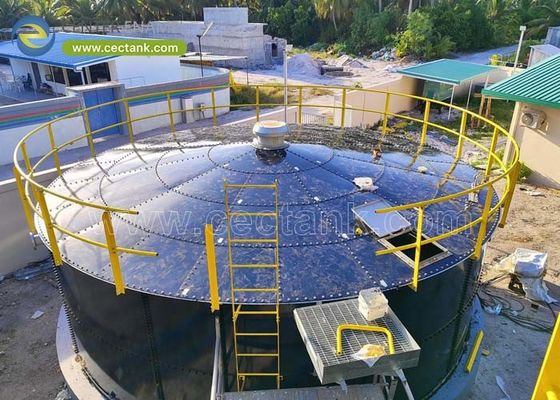
Corrosion-Resistant Bolted Steel Biogas Tanks: The Ideal Solution for Anaerobic Digestion
| Place of Origin: | China |
| Brand Name: | CEC TANKS |
| Certification: | ISO 9001:2008, AWWA D103 , OSHA , BSCI |
| Model Number: | W |
| Minimum Order Quantity: | 1set |
| Price: | $5000~$20000 one set |
| Packaging Details: | PE poly-foam between each two steel plates ; wooden pallet and wooden |
| Delivery Time: | 10-30 days after deposit received |
| Payment Terms: | L/C,T/T |
| Supply Ability: | 60 sets per month |
|
Detail Information |
|||
| Place of Origin | China | Brand Name | CEC TANKS |
|---|---|---|---|
| Certification | ISO 9001:2008, AWWA D103 , OSHA , BSCI | Model Number | W |
| Installation: | By Jacking Machine Or Steel Pole, Fast In Installation | Impact Resistance: | Excellent |
| Coating Thickness: | 0.25mm~0.40mm & Double Coating | Adhesion: | 3,450N/cm |
| Service Life: | ≥30 Years | Holiday Test: | >1500v |
| Highlight: | bio digester tank,biogas septic tank |
||
Product Description
Corrosion-Resistant Bolted Steel Biogas Tanks: The Ideal Solution for Anaerobic Digestion
In the anaerobic digestion (AD) industry, infrastructure failure is often synonymous with chemical corrosion. Biogas plants operate in one of the most hostile industrial environments—rich in hydrogen sulfide ($H_2S$), moisture, and volatile fatty acids. These elements quickly degrade concrete and standard carbon steel, leading to structural leaks and costly downtime.
For facility managers and EPC contractors, Bolted Steel Biogas Tanks equipped with Glass-Fused-to-Steel (GFS) roofs have emerged as the industry-leading solution. This technology combines the structural strength of high-tensile steel with the chemically inert properties of glass, providing a "fit-and-forget" infrastructure that maximizes methane yield and operational lifespan.
The Hostile Environment of Anaerobic Digestion
Anaerobic digesters do not just store waste; they are active chemical reactors. The microbial decomposition process creates:
-
Biogenic Sulfuric Acid: Produced when $H_2S$ and moisture meet, this acid aggressively attacks traditional materials.
-
Dynamic Gas Pressures: Digesters require a perfectly gas-tight system to maximize methane capture and prevent environmental hazards.
-
Mechanical Stress: Continuous mixing (CSTR) and thermal cycling put constant pressure on tank walls and roof structures.
Why Glass-Fused-to-Steel (GFS) Technology?
GFS technology involves fusing silicate glass frit to steel plates at temperatures exceeding $820^circtext{C}$. This is not a coating; it is a molecular fusion that creates a composite material.
-
Chemical Immunity: The glass surface is impervious to the acids and alkalis that destroy concrete and uncoated steel.
-
Zero Porosity: Unlike concrete, GFS is non-porous. It prevents the establishment of biofilms and microbial-induced corrosion (MIC), which are the primary causes of roof and wall failure in AD plants.
The Strategic Advantage of GFS Roofs
In biogas storage, the roof is as critical as the wall. A GFS roof provides superior protection compared to flexible membranes or steel covers:
-
Gas-Tight Integrity: By utilizing GFS panels on the roof, the entire vessel—walls and lid—becomes a unified, glass-lined, gas-tight system. This prevents the escape of valuable biogas and blocks oxygen ingress.
-
Minimal Maintenance: Traditional roofs require periodic painting or recoating to prevent rust. A GFS roof is virtually maintenance-free, drastically reducing the total cost of ownership (TCO).
-
Environmental Resistance: The glass surface reflects UV radiation and resists environmental weathering, ensuring the roof does not degrade over 30+ years of operation.
Comparative Analysis: Biogas Tank Materials
| Feature | GFS Bolted Steel | Poured Concrete | Welded Carbon Steel |
| Corrosion Resistance | Superior (Inert Glass) | Low (Acid Susceptible) | Low (Needs Coating) |
| MIC Resistance | Excellent (Non-porous) | Low | Low |
| Gas Tightness | Excellent | Moderate (Micro-cracking) | Moderate (Weld Defects) |
| Installation Speed | Fast (Modular) | Slow (Curing required) | Moderate (Field Welding) |
| Lifecycle | 30+ Years | 20–30 Years | 15–20 Years |
Frequently Asked Questions (FAQ)
Q: Why is GFS preferred over epoxy coatings for digesters?
A: Epoxy coatings rely on mechanical adhesion. In the acidic environment of a digester, epoxies can blister, peel, or delaminate, exposing the underlying steel to rapid corrosion. GFS is thermally fused to the steel, creating a single, cohesive material that cannot be undermined by the tank's contents.
Q: Are GFS tanks suitable for thermophilic digestion (high temperature)?
A: Yes. GFS tanks are thermally stable. The glass-fused bond is unaffected by the temperature fluctuations (typically $35^circtext{C}$ to $55^circtext{C}$) involved in active biological digestion.
Q: How do GFS tanks handle site-specific seismic and wind loads?
A: Every GFS tank is engineered to meet site-specific requirements. Using Finite Element Analysis (FEA), we calculate the necessary plate thickness and bolt configurations to comply with international structural standards like AWWA D103-19 and ISO 28765, ensuring safety in any climate.
Q: Can GFS digesters be expanded?
A: Yes. The bolted, modular nature of GFS tanks allows for future capacity upgrades. You can often add additional rings to existing tanks to increase storage volume without replacing the entire structure.
Partnering with Center Enamel
Center Enamel is the global leader in GFS infrastructure. With over 30 years of experience, we have successfully deployed biogas storage solutions in over 100 countries. We provide end-to-end support—from structural analysis and gas-capture manifold design to professional, modular assembly.
Ready to optimize your biogas production? Contact our engineering team today for a technical feasibility study.