-
Glass Fused To Steel Tanks (596)
-
Stainless Steel Tanks (434)
-
Fusion Bonded Epoxy Tanks (592)
-
Galvanized Steel Tanks (321)
-
Aluminum Dome Roofs (1336)
-
Wastewater Storage Tanks (232)
-
Welded Steel Tanks (457)
-
Pressure Vessels (295)
-
Anaerobic Digester (201)
-
Industrial Water Tanks (349)
-
Glass Lined Steel Tanks (180)
-
Bolted Steel Tanks (389)
-
Sludge Storage Tank (115)
-
Biogas Storage Tank (173)
-
Leachate Storage Tanks (133)
-
Agricultural Water Storage Tanks (179)
-
Fire Water Tank (166)
-
Grain Storage Silos (146)
-
Biogas Projects (425)
-
Wastewater Treatment Projects (928)
-
Double Membrane Roof (223)

|
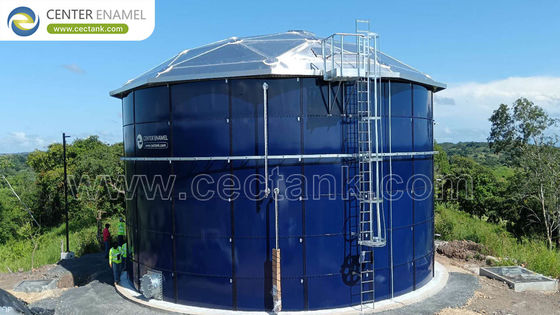
Customized Glass-Fused-to-Steel Tanks for Water Purification, RO Water, and Seawater Treatment with Rapid Installation
| Place of Origin: | China |
| Brand Name: | CEC TANKS |
| Certification: | ISO 9001:2008, AWWA D103 , OSHA , BSCI |
| Model Number: | W20170706009 |
| Minimum Order Quantity: | 1set |
| Price: | $5000~$20000 one set |
| Packaging Details: | PE poly-foam between each two steel plates ; wooden pallet and wooden box |
| Delivery Time: | 10-30 days after deposit received |
| Supply Ability: | 60 sets per month |
|
Detail Information |
|||
Product Description
Industrial and municipal water treatment infrastructure demands highly specialized containment materials. Processes involving advanced water purification, Reverse Osmosis (RO) processing, and seawater desalination introduce unique chemical environments—ranging from the aggressive, demineralized nature of "hungry" RO water to the severe chloride-induced pitting of marine environments.
Customized Glass-Fused-to-Steel (GFS) bolted tanks offer an engineered solution that balances extreme chemical resistance with the speed of modular construction. This guide analyzes the structural mechanics, material science, and operational efficiencies of deploying high-capacity GFS tanks across specialized water treatment networks.
The fundamental advantage of a GFS tank is its physical composition: a high-strength titanium-alloy carbon steel plate molecularly fused with a premium borosilicate glass coating at temperatures reaching 820°C to 930°C. The resulting boundary layer eliminates internal liquid-to-steel contact, presenting unique advantages for three distinct water treatment applications:
Standard water purification systems require completely inert materials to maintain water safety and prevent microbial growth. The smooth, vitrified surface of glass-lined steel prevents biofilm accumulation (Pseudomonas and algae species) and complies fully with NSF/ANSI 61 and WRAS certifications, ensuring zero chemical leaching into public water grids.
RO permeate water is highly pure, meaning it has been stripped of its natural mineral ions. This makes it chemically unstable and highly aggressive—frequently termed "hungry water." RO water actively leaches minerals out of traditional concrete walls and rapidly accelerates corrosion in basic carbon steel tanks. The silica matrix of a GFS tank is completely impervious to ion-depleted water, preserving both water purity and structural longevity.
Seawater contains extreme concentrations of chloride ions (Cl-), typically exceeding 19,000 mg/L. These ions penetrate the passive chromium-oxide layer of standard stainless steels (such as 304), leading to severe pitting and stress corrosion cracking. Center Enamel utilizes specialized, double-sided glass formulations engineered to withstand extreme chloride environments, outperforming standard metallic alloys at a fraction of the capital cost.
Engineering a customized GFS tank requires balancing the liquid's specific gravity (rho_fluid) against the structural boundaries of the bolted steel shell.
To determine the maximum hydrostatic pressure (P_max) exerted at the base ring of a tank, engineers apply the standard fluid pressure equation:
Once the localized pressure profile is established, the required structural steel plate thickness (t) for each individual ring level is calculated using a modification of the thin-walled cylinder hoop stress equation:
-
t is the calculated structural plate thickness.
-
D is the inner tank diameter.
-
is the allowable design stress of the specific titanium-carbon steel grade according to AWWA D103 standards.
-
E is the mechanical joint efficiency of the high-tensile bolted array (typically ranging from 0.70 to 0.85).
-
is the designated corrosion allowance. For Center Enamel GFS tanks,, because the impermeable glass layer entirely isolates the steel from material loss over time.
Because water chemistry varies dramatically across purification stages, GFS tanks must be customized with precise material configurations:
|
Design Parameter |
Pure Water Purification |
RO Permeate Water |
Seawater Desalination |
|---|---|---|---|
|
Target Fluid Density |
1000 kg/m3 |
1000 kg/m3 |
1025 kg/m3 to 1030 kg/m3 |
|
Applicable pH Spectrum |
Standard: 6.5 – 8.5 |
Aggressive: 5.5 – 7.0 |
Extended: 4.0 – 9.0 |
|
Chloride (Cl-) Resistance |
Low (< 250 mg/L) |
Near-Zero |
Extreme (Up to 25,000+ mg/L) |
|
Enamel Coating Type |
Standard Potable Grade |
High-Purity Grade |
Premium High-Chloride Enamel |
|
Appurtenance Material |
Galvanized / 304 SS |
316L Stainless Steel |
Duplex SS / Super Duplex Alloys |
|
Primary Standard |
NSF/ANSI 61, WRAS |
AWWA D103-19 |
AWWA D103, ISO 28765:2016 |
The primary bottleneck for modern industrial water treatment projects is field execution time. Traditional concrete basins require extensive excavation, framework erection, rebar tying, and lengthy chemical curing periods. Field-welded tanks require extensive structural scaffolding, multi-pass welding by certified crews, and non-destructive testing (NDT) under favorable weather conditions.
Center Enamel addresses this bottleneck through a Modular Rapid Installation System:
-
Factory Prefabrication: 100% of the cutting, punching, grit-blasting, and enameling is performed inside an automated facility. Every panel is pre-tested via a high-voltage 1500V electrical holiday test to verify zero micro-porosity before shipment.
-
Compact Containerized Logistics: The panels are packed efficiently on pallets and shipped in standard ocean containers, minimizing logistics costs and site footprints.
-
Ground-Level Synchronization: Assembly occurs from the top down using specialized mechanical jack-up systems. The top panel ring and roof are assembled at ground level, then jacked upward to allow the next ring to be bolted underneath.
-
Zero Hot Work: Crews assemble the entire structure using high-tensile self-locking bolts and specialized elastomeric sealants. This avoids all field welding, cuts installation times by up to 60%, and allows construction to proceed regardless of rain, heat, or sub-zero ambient conditions.
Q: Why can't standard stainless steel be used for seawater desalination storage?
A: While stainless steel resists general atmospheric oxidation, standard grades like 304 or 316 are highly susceptible to localized pitting and crevice corrosion when exposed to high chloride levels (Cl-) found in seawater. GFS provides a complete chemical barrier that avoids metallic pitting entirely.
Q: What is the expected service life of a customized GFS tank in an RO water system?
A: Thanks to the inert nature of the glass coating, which does not react with demineralized water, a properly engineered and maintained GFS tank features a design lifespan exceeding 30 to 50 years.
Q: Can these tanks be adjusted if water treatment plant capacities expand?
A: Yes. The modular bolted design allows the tank configuration to be scaled vertically by adding lower panel rings, provided the foundational concrete ring beam was engineered to support the additional hydrostatic load.
Building resilient, high-performance water treatment networks requires an experienced manufacturing partner. Shijiazhuang Zhengzhong Technology Co., Ltd. (Center Enamel) is Asia's leading manufacturer of modular bolted storage systems, combining over 30 years of material science expertise with successful installations across more than 100 nations.
Operating under audited ISO 9001, ISO 14001, and ISO 45001 standards, Center Enamel holds nearly 200 proprietary patents, partnering with global EPC firms and municipal utilities to lower project risks and accelerate installation timelines.
Secure your water processing assets with precision factory-applied protection.
To help engineering and procurement teams visualize their project parameters, the following interactive simulation tool can be used to calculate fluid dynamics, baseline hydrostatic pressure profiles, and required material specifications for customized Glass-Fused-to-Steel tank arrays based on your target capacity and specialized water application.