-
Glass Fused To Steel Tanks (896)
-
Stainless Steel Tanks (434)
-
Fusion Bonded Epoxy Tanks (652)
-
Galvanized Steel Tanks (321)
-
Aluminum Dome Roofs (1336)
-
Wastewater Storage Tanks (280)
-
Welded Steel Tanks (457)
-
Pressure Vessels (426)
-
Anaerobic Digester (202)
-
Industrial Water Tanks (349)
-
Glass Lined Steel Tanks (180)
-
Bolted Steel Tanks (389)
-
Sludge Storage Tank (115)
-
Biogas Storage Tank (173)
-
Leachate Storage Tanks (133)
-
Agricultural Water Storage Tanks (179)
-
Fire Water Tank (166)
-
Grain Storage Silos (146)
-
Biogas Projects (424)
-
Wastewater Treatment Projects (1722)
-
Double Membrane Roof (223)

|
Industrial Wastewater Storage Tanks: Types Design and Selection Guide
| Place of Origin: | China |
| Brand Name: | CEC TANKS |
| Certification: | ISO 9001:2008, AWWA D103 , OSHA , BSCI |
| Model Number: | W20161021023 |
| Minimum Order Quantity: | 1set |
| Price: | $5000~$20000 one set |
| Packaging Details: | PE poly-foam between each two steel plates ; wooden pallet and wooden box |
| Delivery Time: | 0-60 days after deposit received |
| Payment Terms: | L/C,T/T |
| Supply Ability: | 60 sets per month |
|
Detail Information |
|||
Product Description
Select an industrial wastewater storage tank from the corrosion profile and the erection/ expansion needs, not the sticker price: bolted Glass-Fused-to-Steel suits corrosive and expandable duty, epoxy-coated steel suits moderate chemical exposure, welded steel suits high pressure or very large single volumes, and concrete suits permanent in-ground basins. Center Enamel delivered an 8-tank GFS industrial wastewater system in Canada (2025, 6,595 m3) and a 7-tank GFS system in South Africa (2026, 6,075 m3); individual tank diameter and height are not disclosed in the public record, so single-tank geometry is reported as Not Provided per our verification standard. Match the material to the effluent, then confirm the standard.
Industrial plants generate wastewater with chemistry that varies by process, pH and suspended load, so the storage tank is rarely a generic vessel. The selection decision weighs corrosion profile, erection speed, future capacity expansion and total cost of ownership. This guide compares the main tank types for industrial effluent duty and gives a practical selection framework, then anchors it to two verified Center Enamel deliveries: an 8-tank GFS installation in Canada (2025, 6,595 m3 total) and a 7-tank GFS installation in South Africa (2026, 6,075 m3 total).
Industrial effluent can be acidic, alkaline, saline, oily or loaded with abrasive solids depending on the process. A tank that performs for potable water can fail within months in a plating or fertilizer stream. The first selection step is therefore a chemistry and temperature profile, because that single input decides which liner and shell system survives the design life.
- pH swing: dictates enamel grade or coating system.
- Chlorides and sulfates: drive stainless or coated-steel choice.
- Temperature: above 40 deg C needs a high-temperature enamel.
- Abrasion: slurry duty needs harder internals and floor protection.
Bolted Glass-Fused-to-Steel fuses a vitreous enamel to steel at 820-930 deg C, giving a hard inert surface rated to 6.0 Mohs with no field-applied coating to maintain. Epoxy-coated bolted steel is a lower-cost alternative for milder duty. Welded steel serves high-pressure or very large single tanks. Concrete is durable in-ground but slow to build and hard to relocate.
- GFS: inert, 3450 N/cm2 adhesion, 1500 V spark-tested.
- Epoxy bolted: good for moderate chemical exposure.
- Welded steel: high pressure, single large volume.
- Concrete: permanent, in-ground, slow to construct.
Rank the duty by four questions: what is the chemistry, how fast must it be built, will capacity grow, and what is the 20-year cost? Bolted GFS usually wins where corrosion is real and expansion is likely because panels are added without rewelding the whole shell. Welded or concrete win where the volume is fixed and very large.
- Step 1: profile the effluent chemistry and temperature.
- Step 2: fix the erection window and site constraints.
- Step 3: model 20-year O&M, not just capital cost.
- Step 4: confirm the applicable AWWA / EN standard.
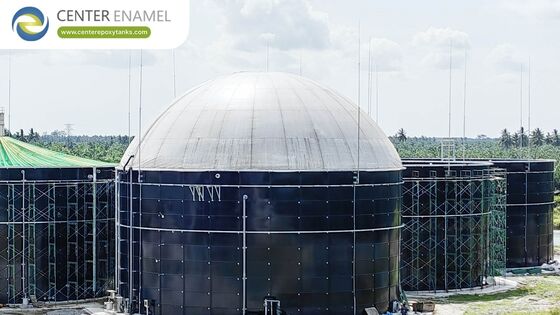
A Canadian dairy-industry wastewater project used 8 bolted GFS tanks totaling 6,595 m3 in 2025. The multiple-tank layout spreads equalization and process-stage storage across the site and lets one tank be serviced without stopping the line. Diameter and height are not disclosed in the public reference.
| Parameter | Value | Note |
|---|---|---|
| Application | Industrial wastewater | Dairy sector |
| Country / Year | Canada / 2025 | Verified delivery |
| Tank count | 8 | Bolted GFS |
| Total volume | 6,595 m3 | Public record |
| Single-tank volume | ~824 m3 (derived) | 6,595 / 8 |
| Diameter / Height | Not Provided | Not in source record |
| Roof | Not specified | Standard GFS roof |
A South African brewery-wastewater project used 7 bolted GFS tanks totaling 6,075 m3 in 2026 with an aluminum flat roof. The brewery stream is warm and organic-rich, a duty where the inert GFS surface resists both biological film and mild acidity better than bare steel.
- Warm organic effluent: GFS resists bio-film and mild acid.
- 7-tank array supports staged treatment and equalization.
- Aluminum flat roof reduces vapor space and cost.
- 2026 delivery shows active global GFS supply.
Bolted Glass-Fused-to-Steel is usually best where the effluent is acidic, alkaline or biological, because the fired enamel surface is inert and needs no field coating maintenance; epoxy-coated steel suits milder duty.
Size from peak flow, required equalization or retention hours, and freeboard, then add surge capacity for process upsets; the chemistry profile decides the material, not the reverse.
Yes - panels are factory-enameled and bolted on site with 8.8-grade fasteners, typically erecting far faster than welded fabrication and allowing later capacity expansion by adding rings.
AWWA D103-19 covers bolted steel tanks and ISO 28765 covers design of GFS tanks; EN 1090 applies to EU execution and NSF/ANSI 61 applies where potable-adjacent contact is possible.
Yes - an 8-tank GFS system in Canada (2025, 6,595 m3) and a 7-tank GFS system in South Africa (2026, 6,075 m3); individual diameters and heights are not disclosed in the public record.
Standard GFS suits up to about 35-38 deg C; a high-temperature enamel grade is specified for 50-55 deg C duty, so confirm the process temperature against the enamel rating.
GFS is enameled in the factory at 820-930 deg C, so there is no field coating to weather; epoxy and welded tanks rely on shop or field coating programs that need inspection.
The fired enamel is rated to 6.0 Mohs hardness with 3450 N/cm2 adhesion and 1500 V spark testing, giving a long service life in corrosive service when the chemistry is within the specified envelope.
Bolted GFS is the most expandable: panels and roof are added without rewelding the shell, which is why multi-tank staged layouts are common in industrial wastewater projects.
Choose an industrial wastewater storage tank from the effluent chemistry and the expansion need, not the headline price: bolted Glass-Fused-to-Steel carries corrosive and expandable duty, epoxy-coated steel covers milder exposure, and welded or concrete serve fixed very-large volumes. Center Enamel's verified record includes an 8-tank GFS system in Canada (2025, 6,595 m3) and a 7-tank GFS system in South Africa (2026, 6,075 m3); diameters and heights are not disclosed in the public references. Profile the chemistry first, then confirm the standard and the supplier's delivered track record.
Suggested CTA: Send us your effluent profile, flow and retention requirement and we will return a material, standard and capacity proposal for an industrial wastewater storage tank.