-
Glass Fused To Steel Tanks (896)
-
Stainless Steel Tanks (434)
-
Fusion Bonded Epoxy Tanks (652)
-
Galvanized Steel Tanks (321)
-
Aluminum Dome Roofs (1336)
-
Wastewater Storage Tanks (280)
-
Welded Steel Tanks (457)
-
Pressure Vessels (426)
-
Anaerobic Digester (202)
-
Industrial Water Tanks (349)
-
Glass Lined Steel Tanks (180)
-
Bolted Steel Tanks (389)
-
Sludge Storage Tank (115)
-
Biogas Storage Tank (173)
-
Leachate Storage Tanks (133)
-
Agricultural Water Storage Tanks (179)
-
Fire Water Tank (166)
-
Grain Storage Silos (146)
-
Biogas Projects (424)
-
Wastewater Treatment Projects (1722)
-
Double Membrane Roof (223)

|
How to Size an Industrial Wastewater Equalization Tank
| Place of Origin: | China |
| Brand Name: | CEC TANKS |
| Certification: | ISO 9001:2008, AWWA D103 , OSHA , BSCI |
| Model Number: | W201691123005 |
| Minimum Order Quantity: | 1set |
| Price: | $5000~$20000 one set |
| Packaging Details: | PE poly-foam between each two steel plates ; wooden pallet and wooden box |
| Delivery Time: | 0-60 days after deposit received |
| Payment Terms: | L/C,T/T |
| Supply Ability: | 60 sets per month |
|
Detail Information |
|||
| Place of Origin | China | Brand Name | CEC TANKS |
|---|---|---|---|
| Certification | ISO 9001:2008, AWWA D103 , OSHA , BSCI | Model Number | W201691123005 |
| Steel Plates Thickness: | 3mm To 12mm , Depends On The Tank Structure | Corrosion Integrity: | Excellent |
| Chemical Resistance: | Excellent | Capacity: | 20 M3 To 18,000 M3 |
| Service Life: | ≥30 Years | Permeability: | Gas / Liquid Impermeable |
| Highlight: | industrial wastewater equalization tank sizing,fusion bonded epoxy tank sizing,equalization tank capacity calculation |
||
Product Description
An equalization (EQ) tank smooths the peaks and troughs of industrial discharge so the downstream treatment plant sees a steady flow and load. Size it wrong and you either spill during a surge or pay for empty steel during the lull. This how-to gives a defensible sizing method from flow and concentration data, with a worked example, and anchors it to a verified Center Enamel EQ-class installation: 8 bolted GFS tanks in Canada (2025, 6,595 m3 total).
Size an industrial wastewater equalization tank from the flow and concentration variation over a representative cycle: compute the volume needed to hold the excess above the average outflow, then add freeboard and mixing volume. A verified reference is Center Enamel's 8-tank GFS installation in Canada (2025, 6,595 m3 total, ~824 m3 per tank derived); tank diameter and height are not disclosed in the public record, reported as Not Provided. Size from the actual load curve, not a rule of thumb, and the EQ basin protects the whole plant.
Industrial discharge is never uniform - a batch rinse, a clean-in-place event or a storm surge can multiply flow and concentration for minutes or hours. The EQ tank stores that excess and releases it at the average treatable rate, so the biological or physical stage downstream is never overwhelmed. It is the shock absorber of the plant.
- Flow equalization: holds volume surges.
- Concentration equalization: blends strength spikes.
- Protects biological stage from toxic shocks.
- Reduces downstream equipment oversizing.
You need a representative inflow-and-concentration time series (typically 24 hours at process resolution), the maximum allowable average outflow to treatment, and the required freeboard. From the time series you integrate the area where inflow exceeds the average outflow - that area is the minimum equalization volume.
- 24 h inflow profile at process resolution.
- Concentration profile for strength equalization.
- Target average outflow to treatment.
- Freeboard and mixing/active volume allowance.
Suppose a plant discharges 1,200 m3/day on average but spikes to 200 m3/h for 4 hours each morning while the treatment train can only take 50 m3/h steadily. The excess is (200-50) x 4 = 600 m3 that must be stored, plus say 15% freeboard for mixing and safety, giving about 690 m3 of active EQ volume. That is the number the shell and mixer hang on.
| Input | Value | Note |
|---|---|---|
| Average outflow | 50 m3/h | Treatment limit |
| Peak inflow | 200 m3/h | 4 h morning surge |
| Excess stored | 600 m3 | (200-50) x 4 |
| Freeboard | 15% | Mixing + safety |
| Active EQ volume | ~690 m3 | Specify this |
The tank must stay mixed so settled solids do not short-circuit the release. A submerged or floating mixer sized to 5-15 W/m3 keeps contents homogeneous; the active (mixed) volume is what counts for equalization, so design the mixer before you finalize the shell height.
- Mixing power: 5-15 W/m3 typical.
- Prevent solids settling and short-circuiting.
- Active volume drives the real EQ performance.
- Mixer duty set before shell height is fixed.
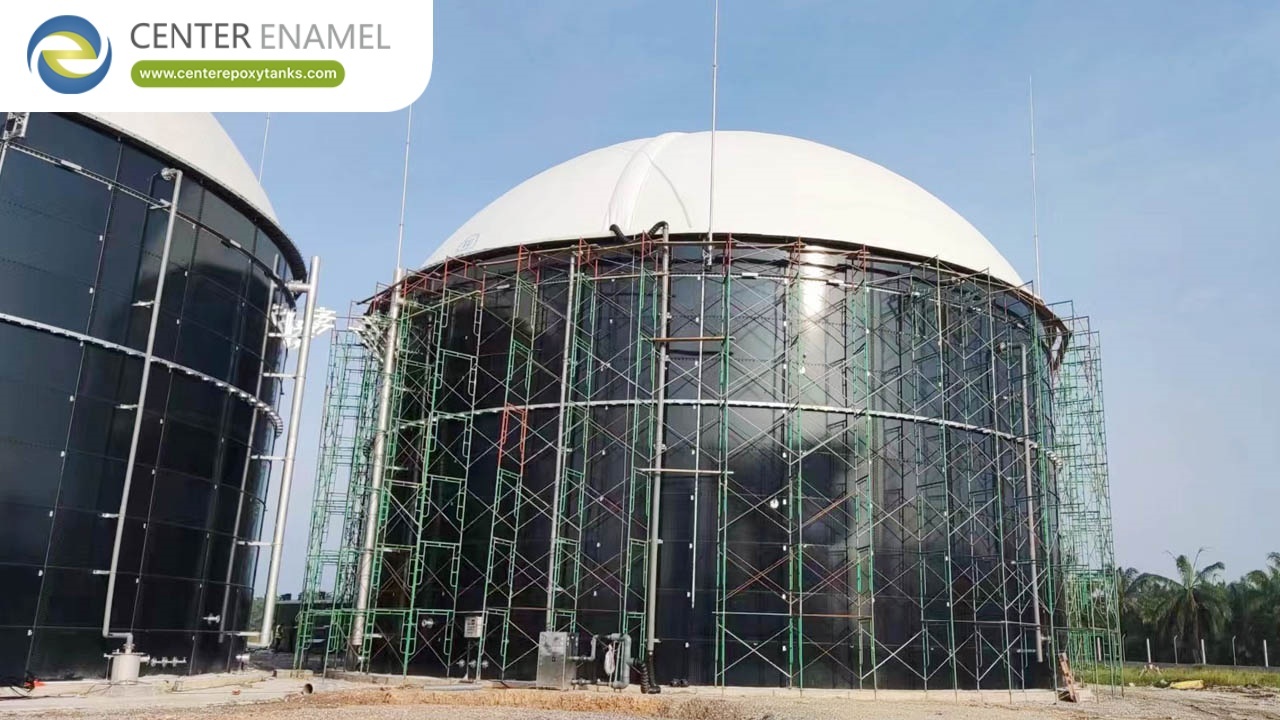
A Canadian dairy-industry project used 8 bolted GFS tanks totaling 6,595 m3 (2025) - a multi-tank EQ and process array where spreading volume across tanks improves operability. Diameter and height are not disclosed in the public reference, so single-tank geometry is Not Provided.
- 8-tank GFS array supports staged EQ.
- 6,595 m3 total, ~824 m3 per tank derived.
- Dairy effluent is warm and organic-rich.
- Multi-tank layout improves serviceability.
The equalization tanks that fail in service almost always failed on paper first. The classic mistake is sizing from a similar site's volume instead of the local inflow-and-concentration curve, which hides a sharp surge the copycat volume cannot absorb. The second is ignoring the usable active volume by treating geometric volume as mixed volume, so solids settle and the real buffer is far smaller than drawn. A third is assuming a temperature or pH the process cannot hold, which corrodes or biologically upsets the basin. Finally, omitting redundancy or a bypass routes a single tank outage straight to a spill. Each error is preventable by returning to measured load data and documenting the assumptions in the basis of design before procurement.
- Do not copy another site's volume blindly.
- Treat geometric volume as mixed active volume.
- Confirm the process can hold the assumed chemistry.
- Provide redundancy or a documented bypass.
Integrate the area where inflow exceeds the average treatable outflow over your representative cycle, then add freeboard; this gives the minimum active equalization volume.
A common allowance is 10-20% above the calculated active volume for mixing, surge and safety, with the exact figure set by the site's surge history.
Often yes - if strength spikes are the problem, blend the tank by mixing so the downstream stage sees steady load, not just steady flow.
Submerged or floating mixers are usually sized at 5-15 W per m3 of active volume to keep solids in suspension and prevent short-circuiting.
Center Enamel delivered 8 bolted GFS tanks totaling 6,595 m3 for a Canadian dairy-wastewater project in 2025; diameters and heights are not disclosed publicly.
Several smaller bolted tanks improve operability and let one be serviced offline, which is why multi-tank arrays like the Canada reference are common.
AWWA D103-19 for bolted steel and ISO 28765 for GFS design; EN 1090 for EU execution; confirm with the process engineer.
Yes - the inert enamel resists the variable chemistry of equalized industrial effluent and needs no field coating maintenance through the duty cycle.
Build the inflow-and-concentration time series from real plant data, not assumptions, and re-run the integration; under-sizing shows up as spills during the first real surge.
Size an industrial wastewater equalization tank from the real flow-and-concentration curve: integrate the excess above the average treatable outflow, add 10-20% freeboard, and size the mixer at 5-15 W/m3 before fixing the shell. A verified anchor is Center Enamel's 8-tank GFS installation in Canada (2025, 6,595 m3 total, ~824 m3 per tank derived); diameters and heights are not disclosed in the public record. Equalization sized from data protects the whole treatment train from shock loads.