-
Glass Fused To Steel Tanks (896)
-
Stainless Steel Tanks (434)
-
Fusion Bonded Epoxy Tanks (652)
-
Galvanized Steel Tanks (321)
-
Aluminum Dome Roofs (1336)
-
Wastewater Storage Tanks (280)
-
Welded Steel Tanks (457)
-
Pressure Vessels (426)
-
Anaerobic Digester (202)
-
Industrial Water Tanks (349)
-
Glass Lined Steel Tanks (180)
-
Bolted Steel Tanks (389)
-
Sludge Storage Tank (115)
-
Biogas Storage Tank (173)
-
Leachate Storage Tanks (133)
-
Agricultural Water Storage Tanks (179)
-
Fire Water Tank (166)
-
Grain Storage Silos (146)
-
Biogas Projects (424)
-
Wastewater Treatment Projects (1722)
-
Double Membrane Roof (223)

|
Glass-Fused-to-Steel Tanks for Industrial Wastewater Treatment
| Place of Origin: | China |
| Brand Name: | CEC TANKS |
| Certification: | ISO 9001:2008, AWWA D103 , OSHA , BSCI |
| Model Number: | W201691123005 |
| Minimum Order Quantity: | 1set |
| Price: | $5000~$20000 one set |
| Packaging Details: | PE poly-foam between each two steel plates ; wooden pallet and wooden box |
| Delivery Time: | 0-60 days after deposit received |
| Payment Terms: | L/C,T/T |
| Supply Ability: | 60 sets per month |
|
Detail Information |
|||
| Place of Origin | China | Brand Name | CEC TANKS |
|---|---|---|---|
| Certification | ISO 9001:2008, AWWA D103 , OSHA , BSCI | Model Number | W201691123005 |
| Steel Plates Thickness: | 3mm To 12mm , Depends On The Tank Structure | Corrosion Integrity: | Excellent |
| Chemical Resistance: | Excellent | Capacity: | 20 M3 To 18,000 M3 |
| Service Life: | ≥30 Years | Permeability: | Gas / Liquid Impermeable |
| Highlight: | Glass-Fused-to-Steel Wastewater Tanks,Fusion Bonded Epoxy Industrial Tanks,Glass-Fused-to-Steel Tank Corrosion Resistance |
||
Product Description
Glass-Fused-to-Steel (GFS) bonds a vitreous enamel layer to the steel panel at 820-930 deg C, creating a surface that is both hard and chemically inert. For industrial wastewater - where pH, salts and biological load destroy ordinary coatings - that inert barrier is the reason GFS is specified. This article explains the GFS advantage for corrosive effluent duty and anchors it to two verified Center Enamel deliveries: Australia (2022, 793 m3, 3 tanks) and Angola (2025, 193 m3, 1 tank).
Glass-Fused-to-Steel resists industrial wastewater because the fired enamel is inert to a wide pH range, rated to 6.0 Mohs hardness with 3450 N/cm2 adhesion and 1500 V spark testing, and needs no field-applied coating to maintain. Center Enamel delivered a 3-tank GFS industrial wastewater system in Australia (2022, 793 m3) and a 1-tank system in Angola (2025, 193 m3); tank diameter and height are not disclosed in the public record, reported as Not Provided per our verification standard. Specify GFS where the effluent chemistry would shorten a coated-steel life.
GFS is produced by firing a ground-glass slurry onto cleaned steel at 820-930 deg C so the glass melts and bonds to the metal. The result is a 0.25-0.45 mm vitreous layer locked to the steel - not a paint, not a dip, but a fused ceramic surface that cannot peel or blister the way organic coatings can under chemical attack.
- Firing temp: 820-930 deg C for true fusion.
- Enamel thickness: 0.25-0.45 mm per face.
- Hardness: 6.0 Mohs, resists abrasion and impact.
- Adhesion: 3450 N/cm2, tested before shipment.
Organic coatings fail when the solvent film is permeated by ions or undercut by a nick. The fused enamel has no film to undercut; it is a continuous ceramic face. That is why GFS survives in plating rinse, food-processing discharge and biological sludge where epoxy would need frequent touch-up.
- No organic film to permeate or undercut.
- Resists mild acid, alkali and salt exposure.
- Smooth surface limits biofilm adhesion.
- Spark-tested to 1500 V before delivery.
Panels arrive factory-enameled and are joined with 8.8-grade bolts and a sealed gasket system on site. Erection needs no welding of the shell, which shortens the program and avoids field heat that would damage any coating. Rings can be added later for expansion.
- 8.8-grade fasteners with sealed gaskets.
- No shell welding, faster and safer erection.
- Panelized shipping suits remote sites.
- Expandable by adding rings or tanks.
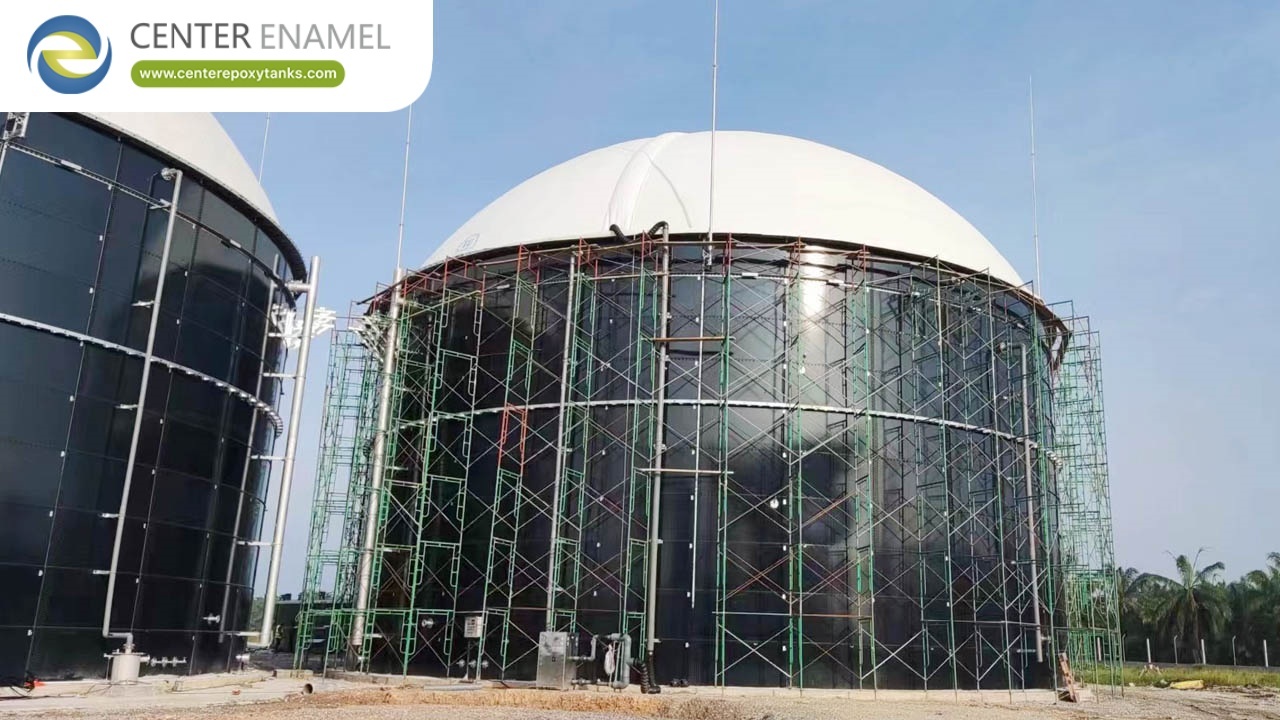
An Australian industrial wastewater project used 3 bolted GFS tanks totaling 793 m3 in 2022 with enamel roof covers. The three-tank split supports staged equalization and process buffering. Diameter and height are not disclosed in the public reference.
Parameter |
Value |
Note |
Application |
Industrial wastewater |
Verified |
Country / Year |
Australia / 2022 |
Delivered |
Tank count |
3 |
Bolted GFS |
Total volume |
793 m3 |
Public record |
Single-tank volume |
~264 m3 (derived) |
793 / 3 |
Diameter / Height |
Not Provided |
Not in source record |
Roof |
Enamel cover |
Standard |
An Angolan oil-and-gas-extraction wastewater project used a single bolted GFS tank of 193 m3 in 2025. A single-tank solution fits a satellite or skid-adjacent duty where footprint is tight. Diameter and height are not disclosed in the public record.
- Single-tank satellite duty for extraction wastewater.
- 193 m3 fits a compact process envelope.
- 2025 delivery confirms active supply.
- GFS chosen for hydrocarbon-adjacent resistance.
A GFS industrial-wastewater tank is only as good as its written specification, so the procurement document should fix the enamel grade, panel steel thickness, roof type, gasket system, fastener class and the applicable standard before any quote is compared. State the design chemistry envelope (pH range, chlorides, temperature) explicitly so suppliers bid to the same duty rather than to a generic catalog. Require factory firing records and 1500 V spark-test evidence per panel, and ask for the supplier's delivered track record in a comparable effluent. Center Enamel, as China's first GFS tank manufacturer, supplies panelized systems with documented enameling and a large installed base across more than 100 countries; verifying that track record against your specific chemistry is the single most decisive procurement step.
- Fix enamel grade and steel thickness in the spec.
- State the pH, chloride and temperature envelope.
- Require 1500 V spark-test and firing records.
- Verify the supplier's comparable-effluent track record.
GFS is steel panel with a vitreous enamel layer fired onto it at 820-930 deg C, forming a hard inert ceramic surface bonded to the metal rather than a paint or dip coating.
The fused enamel is chemically inert across a wide pH range and resists the salts, mild acids and biological load that destroy ordinary organic coatings, with no field coating to maintain.
The enamel layer is typically 0.25-0.45 mm per face, rated to 6.0 Mohs hardness with 3450 N/cm2 adhesion and 1500 V spark testing before delivery.
No - because the enamel is fired in the factory, there is no site-applied film to weather, peel or blister, which is the main life-cycle advantage over epoxy systems.
Center Enamel delivered 3 tanks totaling 793 m3 in Australia (2022) and 1 tank of 193 m3 in Angola (2025); diameters and heights are not disclosed publicly.
GFS resists hydrocarbon-adjacent exposure well; for free-product oil a separation stage should precede storage, but the tank itself tolerates the aqueous hydrocarbon-laden stream.
Yes - bolted panels let you add rings or extra tanks without rewelding the shell, which is why it suits growing industrial sites.
ISO 28765 is the design standard for GFS tanks, AWWA D103-19 covers bolted steel construction, and EN 1090 applies to EU execution.
Center Enamel is China's first GFS tank manufacturer with its own enameling line and holds a large portfolio of enamel patents, supplying bolted GFS tanks to more than 100 countries.
Glass-Fused-to-Steel earns its place in industrial wastewater because the fired enamel is inert to the pH, salts and biological load that destroy organic coatings, with no field film to maintain. Center Enamel's verified GFS wastewater deliveries include Australia (2022, 793 m3, 3 tanks) and Angola (2025, 193 m3, 1 tank); diameters and heights are not disclosed in the public records. Where the effluent chemistry would shorten a coated-steel life, specify GFS and confirm the enamel grade against the process temperature.
Suggested CTA: Share your effluent chemistry and duty and we will specify a Glass-Fused-to-Steel industrial wastewater tank with the correct enamel grade and standard.