-
Glass Fused To Steel Tanks (896)
-
Stainless Steel Tanks (434)
-
Fusion Bonded Epoxy Tanks (652)
-
Galvanized Steel Tanks (321)
-
Aluminum Dome Roofs (1336)
-
Wastewater Storage Tanks (280)
-
Welded Steel Tanks (457)
-
Pressure Vessels (426)
-
Anaerobic Digester (202)
-
Industrial Water Tanks (349)
-
Glass Lined Steel Tanks (180)
-
Bolted Steel Tanks (389)
-
Sludge Storage Tank (115)
-
Biogas Storage Tank (173)
-
Leachate Storage Tanks (133)
-
Agricultural Water Storage Tanks (179)
-
Fire Water Tank (166)
-
Grain Storage Silos (146)
-
Biogas Projects (424)
-
Wastewater Treatment Projects (1722)
-
Double Membrane Roof (223)

|
Food Waste Anaerobic Digestion Tanks
| Place of Origin: | China |
| Brand Name: | CEC TANKS |
| Certification: | ISO 9001:2008, AWWA D103 , OSHA , BSCI |
| Model Number: | W201691123005 |
| Minimum Order Quantity: | 1set |
| Price: | $5000~$20000 one set |
| Packaging Details: | PE poly-foam between each two steel plates ; wooden pallet and wooden box |
| Delivery Time: | 0-60 days after deposit received |
| Payment Terms: | L/C,T/T |
| Supply Ability: | 60 sets per month |
|
Detail Information |
|||
| Place of Origin | China | Brand Name | CEC TANKS |
|---|---|---|---|
| Certification | ISO 9001:2008, AWWA D103 , OSHA , BSCI | Model Number | W201691123005 |
| Steel Plates Thickness: | 3mm To 12mm , Depends On The Tank Structure | Corrosion Integrity: | Excellent |
| Chemical Resistance: | Excellent | Capacity: | 20 M3 To 18,000 M3 |
| Service Life: | ≥30 Years | Permeability: | Gas / Liquid Impermeable |
| Highlight: | Anaerobic Digestion Tanks,Fusion Bonded Epoxy Tanks,Food Waste Digestion Tanks |
||
Product Description
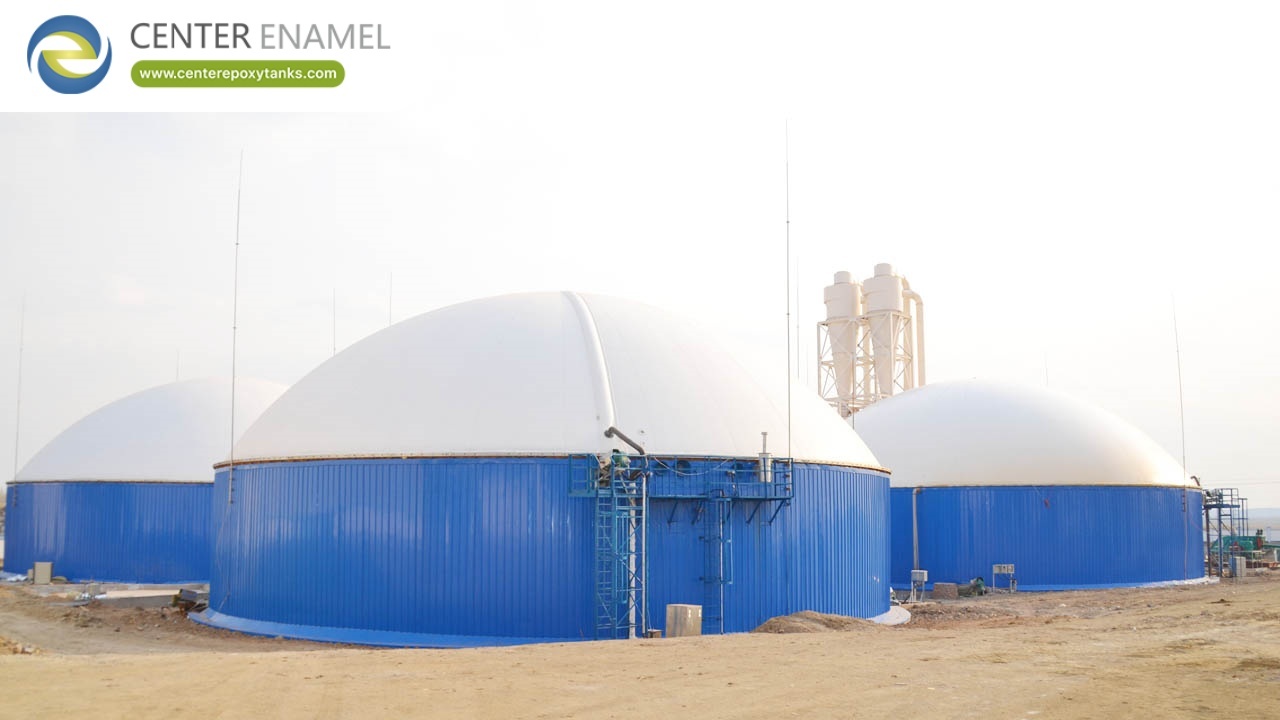
Food waste - from households, restaurants and food processing - is one of the highest-yield biogas feedstocks because of its high organic content. Turning it into energy needs a digester that resists the acidic, variable slurry and captures the gas. This article focuses on food-waste anaerobic digestion tanks, distinct by feedstock from the farm and general biogas articles, anchored to four verified Center Enamel GFS AD tanks in China ranging from 219 to 2,913 m3.
Food waste is a high-biogas-yield feedstock that demands a digester resistant to acidic, variable slurry and capable of gas capture. Center Enamel delivered four verified GFS food-waste AD tanks in China: 804 m3 (2021), 418 m3 (6 tanks, 2024), 219 m3 (2 tanks, 2023) and 2,913 m3 (2023); diameters and heights are not disclosed and reported as Not Provided. Hold the 35-38 deg C window, mix the feedstock, and size from the organic load, not the volume alone.
Food waste is dense in readily degradable organics, so per tonne it yields more biogas than many agricultural streams. But it is also variable in composition and acidic as it ferments, which is why the digester must tolerate swings and keep the biological community stable at the mesophilic window.
- High organic content, high biogas yield.
- Variable composition batch to batch.
- Acidic as it ferments.
- Needs stable mesophilic biology.
The reactor holds the feedstock at 35-38 deg C, excludes oxygen, and captures methane. An inert GFS shell resists the acidic fermenting slurry with no field coating, and the bolted form supports a gas-tight roof. Mixing keeps the high-solid feedstock from stratifying.
- Hold 35-38 deg C, exclude oxygen.
- Inert GFS face resists acidic slurry.
- Gas-tight bolted roof for capture.
- Mix high-solid feedstock.
Food waste often needs de-packaging and grinding before it enters the digester, and co-digestion with manure or sludge can balance nutrients and improve stability. The tank design therefore allows for a steady, screened feed rather than bulk tipping straight in.
- De-package and grind before feed.
- Co-digest with manure or sludge.
- Steady screened feed to the tank.
- Balance nutrients for stability.
Four verified Center Enamel GFS food-waste AD tanks in China show the scale range: 804 m3 (2021, 1 tank), 418 m3 (2024, 6 tanks), 219 m3 (2023, 2 tanks) and 2,913 m3 (2023, 1 tank). Diameter and height are not disclosed in the public records.
Year |
Volume |
Tanks |
Note |
2021 |
804 m3 |
1 |
Verified |
2024 |
418 m3 |
6 |
Verified |
2023 |
219 m3 |
2 |
Verified |
2023 |
2,913 m3 |
1 |
Verified |
Size the digester from the organic loading rate and hydraulic retention time (commonly 20-40 days for AD), not just the volume. Operation keeps temperature, mixing and feedstock quality steady, and desludges the stabilized digestate for land application. The inert GFS face cuts internal inspection load.
- Size from organic load and HRT (20-40 d).
- Keep temperature and mixing steady.
- Desludge digestate for land use.
- GFS reduces coating inspection.
Food waste's high biogas yield is also its biggest risk, because the stream arrives mixed with plastics, packaging and inerts that damage equipment and contaminate digestate. Contamination control therefore starts at source separation and continues through de-packaging, screening and grit removal before the feed enters the digester. A tank specified without accounting for this upstream cleaning will see abrasive solids accelerate wear and non-organics accumulate as refuse. The verified China food-waste AD fleet (219-2,913 m3) reflects systems where the reactor and the contamination-control line are specified as one; the digester's long life depends on keeping the feed as clean as the biology needs, not on the tank alone.
- Separate at source and de-package.
- Screen and remove grit before feed.
- Keep abrasive solids out of the tank.
- Specify reactor and cleaning line together.
Food-waste anaerobic digestion lives or dies on feed quality, so a feed checklist belongs in the specification. Start with source separation and de-packaging to keep plastics and inerts out. Screen and remove grit before the feed enters the digester, because abrasive solids wear mixers and accumulate as refuse. Co-digest with manure or sludge only after balancing carbon and nutrients. Size the digester from the organic loading rate and the 20-40 day retention, not just volume. Holding the feed to this checklist is what lets a GFS digester reach its modeled gas yield instead of underperforming on a contaminated stream.
- Source-separate and de-package first.
- Screen and remove grit before feed.
- Balance co-digestion carbon and nutrients.
- Size from loading rate and HRT.
It is dense in readily degradable organics, so per tonne it yields more biogas than many agricultural streams, though its composition varies and it acidifies as it ferments.
An inert, gas-tight bolted GFS digester resists the acidic fermenting slurry with no field coating and supports a gas-tight roof for methane capture.
Yes - Center Enamel delivered four GFS food-waste AD tanks in China: 804 m3 (2021), 418 m3 (2024, 6 tanks), 219 m3 (2023, 2 tanks) and 2,913 m3 (2023); diameters and heights are not disclosed.
It is typically de-packaged and ground, often co-digested with manure or sludge to balance nutrients, and fed as a steady screened stream rather than bulk tipped.
From the organic loading rate and hydraulic retention time (commonly 20-40 days), not just the geometric volume; the high biogas yield drives the organic load.
The mesophilic window of 35-38 deg C is typical, or thermophilic 50-55 deg C for faster throughput, with insulation or heating to hold it.
AWWA D103-19 and ISO 28765 for the GFS tank, with biogas-specific safety and pressure rules for the gas holder and piping.
The stabilized outflow is a fertilizer applied to land; operations desludge on a schedule to keep the reactor healthy.
Bolted GFS expands by adding rings or a second tank, which suits growing collection programs.
Food waste is a high-biogas-yield feedstock that demands a digester resistant to acidic, variable slurry and capable of gas capture. Center Enamel's verified GFS food-waste AD tanks in China span 804 m3 (2021), 418 m3 (6 tanks, 2024), 219 m3 (2 tanks, 2023) and 2,913 m3 (2023); diameters and heights are not disclosed and reported as Not Provided. Hold the 35-38 deg C window, mix the high-solid feedstock, and size from the organic loading rate and 20-40 day retention, not volume alone.
Suggested CTA: Tell us your food-waste tonnage and collection plan and we will propose a GFS anaerobic digestion tank with gas-tight roof and heating.