-
Glass Fused To Steel Tanks (896)
-
Stainless Steel Tanks (434)
-
Fusion Bonded Epoxy Tanks (652)
-
Galvanized Steel Tanks (321)
-
Aluminum Dome Roofs (1336)
-
Wastewater Storage Tanks (280)
-
Welded Steel Tanks (457)
-
Pressure Vessels (396)
-
Anaerobic Digester (202)
-
Industrial Water Tanks (349)
-
Glass Lined Steel Tanks (180)
-
Bolted Steel Tanks (389)
-
Sludge Storage Tank (115)
-
Biogas Storage Tank (173)
-
Leachate Storage Tanks (133)
-
Agricultural Water Storage Tanks (179)
-
Fire Water Tank (166)
-
Grain Storage Silos (146)
-
Biogas Projects (424)
-
Wastewater Treatment Projects (1702)
-
Double Membrane Roof (223)

|
A Biogas Solution Provider's Guide Chicken Manure into Biogas in Kazakhstan
| Place of Origin: | China |
| Brand Name: | CEC TANKS |
| Certification: | ISO 9001:2008, AWWA D103 , OSHA , BSCI |
| Model Number: | W |
| Minimum Order Quantity: | 1set |
| Price: | $5000~$20000 one set |
| Packaging Details: | PE poly-foam between each two steel plates ; wooden pallet and wooden |
| Delivery Time: | 10-30 days after deposit received |
| Payment Terms: | L/C,T/T |
| Supply Ability: | 60 sets per month |
|
Detail Information |
|||
| Place of Origin | China | Brand Name | CEC TANKS |
|---|---|---|---|
| Certification | ISO 9001:2008, AWWA D103 , OSHA , BSCI | Model Number | W |
| Tank Body Color: | Dark Green / Can Be Customized | Corrosion Integrity: | Excellent |
| Steel Plates Thickness: | 3mm To 12mm , Depends On The Tank Structure | Chemical Resistance: | Excellent |
| Size Of Panel: | 2.4M * 1.2M | Easy To Clean: | Smooth, Glossy, Inert, Anti-adhesion |
| Highlight: | chicken manure biogas Kazakhstan,biogas wastewater treatment project,manure-to-biogas solution guide |
||
Product Description
Kazakhstan's poultry industry has been modernising to reduce dependence on imported eggs and broiler meat, with large integrated complexes operating near Almaty, Astana, Kostanay, and Petropavl. The cold continental climate means long heating seasons and high energy bills, while concentrated layer houses produce large volumes of chicken manure that were historically dried and sold as fertiliser. This guide outlines how a turnkey chicken manure into biogas project—centred on GFS tanks, a CSTR digester, and a double membrane roof—helps Kazakh poultry operators turn manure into self-generated heat and power while meeting national environmental rules.
Kazakhstan raises hundreds of millions of laying hens and broilers each year, and the country's food-security programme continues to support new integrated complexes in the north and south. A single modern layer site can hold 50,000 to 150,000 birds, generating several tonnes of manure daily through a long, cold winter when land application is impossible. In practice, much of that manure is stockpiled on frozen or unlined ground near the farm, then spread onto surrounding cereal and forage fields in spring. Over time, repeated over-application around large complexes creates nutrient overload in local soils and groundwater, and the uncovered piles release ammonia and odour into nearby villages. At the same time, Kazakh farms spend heavily on gas, coal, or electricity to keep brooder houses warm for six months of the year, making poultry waste both a regulatory and an energy-cost problem.
Converting chicken manure into biogas turns a seasonal disposal problem into a year-round energy source. The captured methane displaces purchased heating fuel for poultry houses, incubators, and slaughterhouse operations, which is especially valuable in Kazakhstan's long winters. The stabilised digestate reduces pathogen and odour loads, so neighbour complaints and regulatory penalties fall away. After solid-liquid separation, the fibrous fraction becomes a marketable organic fertiliser for grain, potato, and vegetable farms, while the treated liquid can be returned to land at balanced agronomic rates. The treatment chain begins at the poultry house: manure is collected, passed through a mechanical bar screen to remove feathers and bedding, crushed, and de-gritted before being pumped to a homogenisation tank that equalises flow and temperature. The prepared slurry then feeds the anaerobic reactor, and the digested effluent moves through a buffer tank and separator.
The Continuous Stirred-Tank Reactor (CSTR) is the preferred core technology for Kazakhstan's high-throughput poultry complexes. CSTR is an anaerobic treatment process in which fermentation feedstock and microorganisms are fully mixed inside a closed, insulated tank. The reactor is fitted with a mechanical stirring device—an agitator shaft, paddles, and a drive unit—that keeps thick, bedding-rich poultry slurry homogeneous, breaks up floating crust, and prevents grit settlement. Feed is introduced semi-continuously, and at a controlled mesophilic temperature the manure and the anaerobic microbial community remain in a well-mixed fermentation state that effectively degrades the organic matter. The CSTR vessel also includes a feed inlet, a sludge discharge point, a biogas pipeline, and a positive and negative pressure protector, all engineered to handle fibrous, nitrogen-rich poultry waste safely across large temperature swings.
Biogas leaving the digester is hot, water-saturated, and contains hydrogen sulfide that corrodes engines and boilers. The gas therefore first goes through a dehydration unit to remove moisture, then a desulfurisation unit to lower sulfur content. A booster fan pushes the conditioned gas through a flowmeter to the utilisation point. Kazakh farms typically choose one or more of four pathways: a biogas generator producing on-site electricity; a boiler burning gas directly for heat used in poultry house warming and disinfection; a flare system providing safe pressure relief when gas output exceeds demand; and, at larger plants, upgrading to compressed natural gas at over 95% methane for vehicle fuel or pipeline supply.
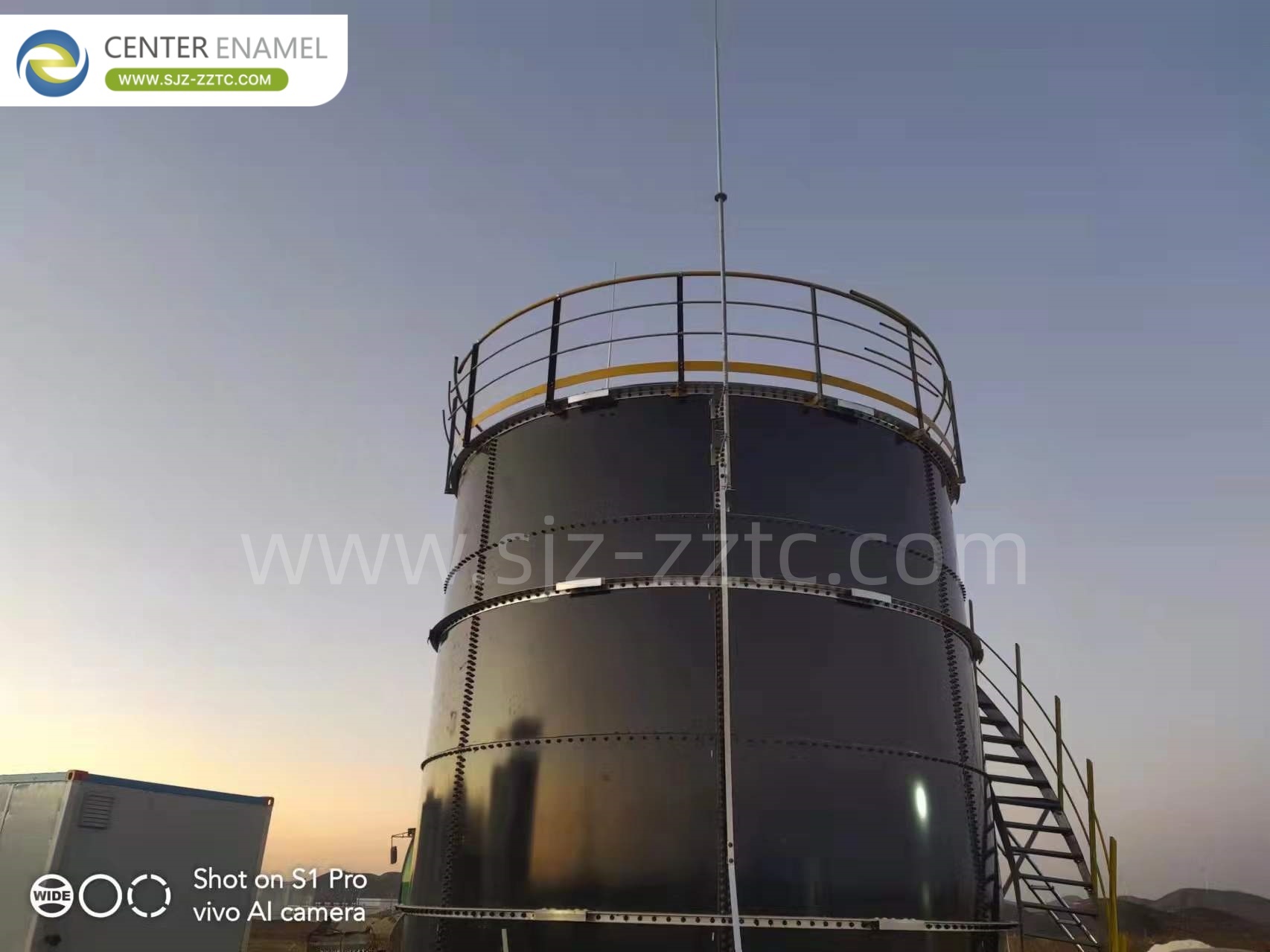
GFS (Glass-Fused-to-Steel) tanks are the preferred digester and storage vessel for Kazakh poultry biogas plants. After firing at 820 °C–930 °C, molten glass reacts with the steel plate surface to form an inert inorganic bond that combines the strength and flexibility of steel with outstanding corrosion resistance to ammonia, acids, and moisture. The 2C2F double coating layer structure applies separate interior and exterior ground and surface coatings, and the tank panels withstand the thermal expansion and contraction of a continental climate. On top of the digester, a double membrane roof acts as both a weather cover and a flexible gas holder. Compared with a separate ground-mounted gas holder, it directly reduces roof cost, cuts the plant footprint, and saves foundation works—an important benefit on remote Kazakh farm sites where concrete work is expensive.
Center Enamel supplies a family of tank materials so each duty gets the right vessel:
Glass Fused To Steel (GFS) tanks: flagship digesters, buffer tanks, and leachate tanks with the 2C2F dual-coating system and global certifications.
Galvanized Steel Tanks: offer a tough, wear-resistant, durable protective coating for general water collection and equalisation.
Fusion Bonded Epoxy Tanks: developed with a global coatings leader for balanced corrosion resistance on moderate-duty streams.
Stainless Steel Tanks: AISI 304/316 vessels reserved for high-purity water and the most corrosive duty streams.
A turnkey biogas project depends on supporting hardware as much as on the reactor:
Gas Holder buffers gas flow between reactor output and engine or boiler demand.
Black Membrane covers effluent storage and polishing lagoons, preventing fugitive emissions.
Solid-liquid Separator produces fibrous organic fertiliser and a manageable liquid stream.
Torch System safely disposes of start-up or excess gas during maintenance.
Lifting Pump transfers manure and sludge between homogenisation tank, reactor, and buffer tank without blockage.
Dehydration and Desulfurization Tank treats raw biogas before it reaches engines.
Screw Sludge Dewatering Machine reduces sludge volume for cheaper transport and land application.
Center Enamel delivers a complete turnkey service rather than isolated equipment:
EPC service: one accountable partner from process design through installation supervision and commissioning.
Process Package: balanced pre-treatment, CSTR, gas handling, and digestate treatment sized to daily manure throughput.
Equipment Supply: GFS tanks, double membrane roofs, gas holders, separators, pumps, and dewatering machines on a single delivery schedule.
Certified build: ISO 9001 manufacturing, with CE/EN1090, NSF61, WRAS, and EN28765 references and designs aligned to AWWA D103, OSHA, EN28765, and EuroCode.
Proven scale: 150,000 m² R&D and production base, 250,000 sheets per year capacity, 500+ employees, and references in more than 100 countries.
Cold-climate experience: insulation, heating, and foundation details tuned to long, harsh Central Asian winters.
Kazakhstan's poultry sector sits on two pressures at once: concentrated chicken manure that cannot be safely spread year-round, and expensive heating fuel during long winters. A turnkey chicken manure into biogas plant built on GFS tanks, a CSTR digester, and a double membrane roof addresses both at the same time—producing on-site heat and power, recycling nutrients back to farmland, and cutting odour and water pollution. With an experienced biogas solution provider, Kazakh integrators can turn their largest waste stream into a strategic energy asset.
Q1: How cold can a CSTR digestor tolerate without external heat?
An unheated digester will slow to a near stop below about 15 °C. In cold climates the reactor must be insulated and heated to a mesophilic range, typically 35 ± 2 °C, using biogas from the plant itself once it is running.
Q2: Can chicken manure be co-digested with other agricultural waste?
Yes. Chicken manure is often mixed with crop residues, brewery spent grain, or other livestock manure to balance carbon-to-nitrogen ratio, moisture, and biogas yield. Chicken manure's high nitrogen content makes it a good co-substrate for carbon-rich feedstocks.
Q3: What happens to digestate during the frozen months?
Liquid digestate should be stored in lined, covered tanks or lagoons (often covered with a black membrane) until the thaw, then applied in spring at agronomic rates. Solid fibrous digestate can be stockpiled under cover and used as soil conditioner year-round.