-
Glass Fused To Steel Tanks (596)
-
Stainless Steel Tanks (434)
-
Fusion Bonded Epoxy Tanks (592)
-
Galvanized Steel Tanks (321)
-
Aluminum Dome Roofs (1336)
-
Wastewater Storage Tanks (232)
-
Welded Steel Tanks (457)
-
Pressure Vessels (295)
-
Anaerobic Digester (202)
-
Industrial Water Tanks (349)
-
Glass Lined Steel Tanks (180)
-
Bolted Steel Tanks (389)
-
Sludge Storage Tank (115)
-
Biogas Storage Tank (173)
-
Leachate Storage Tanks (133)
-
Agricultural Water Storage Tanks (179)
-
Fire Water Tank (166)
-
Grain Storage Silos (146)
-
Biogas Projects (424)
-
Wastewater Treatment Projects (1258)
-
Double Membrane Roof (223)


|
Egypt’s Restaurant Food Waste to Biogas: Sustainable CSTR Process and Biogas Plant Project Design Solutions
| Place of Origin: | China |
| Brand Name: | CEC TANKS |
| Certification: | ISO 9001:2008, AWWA D103 , OSHA , BSCI |
| Model Number: | W |
| Minimum Order Quantity: | 1set |
| Price: | $5000~$20000 one set |
| Packaging Details: | PE poly-foam between each two steel plates ; wooden pallet and wooden |
| Delivery Time: | 10-30 days after deposit received |
| Payment Terms: | L/C,T/T |
| Supply Ability: | 60 sets per month |
|
Detail Information |
|||
| Place of Origin | China | Brand Name | CEC TANKS |
|---|---|---|---|
| Certification | ISO 9001:2008, AWWA D103 , OSHA , BSCI | Model Number | W |
| Tank Body Color: | Dark Green / Can Be Customized | Corrosion Integrity: | Excellent |
| Steel Plates Thickness: | 3mm To 12mm , Depends On The Tank Structure | Chemical Resistance: | Excellent |
| Size Of Panel: | 2.4M * 1.2M | Easy To Clean: | Smooth, Glossy, Inert, Anti-adhesion |
| Highlight: | food waste biogas plant,sustainable CSTR biogas process,restaurant waste biogas solutions |
||
Product Description
Egypt generates vast quantities of food waste from its growing tourism, hospitality, and food service industries. Converting this organic waste into renewable biogas through advanced anaerobic digestion offers a sustainable solution to the country’s waste management challenges while producing clean energy. This article explores how professional Biogas Plant Project Design solutions utilize the CSTR Process and durable GFS Tanks to transform Restaurant Food Waste into renewable energy, supporting Egypt’s energy transition and circular economy goals.
Egypt faces significant challenges in managing restaurant food waste across Cairo, Alexandria, and tourist destinations like Hurghada and Sharm El-Sheikh. Studies indicate that Egypt’s bio-waste has significant potential for biogas production, with hotels generating enormous amounts of organic waste per guest per day. Under Egypt’s hot climate, food waste decays rapidly, releasing strong odors and methane. Traditional disposal methods like landfilling and open dumping are increasingly unsustainable, occupying valuable land and contributing to greenhouse gas emissions. The Egyptian government has recognized the need to promote biogas technology and has initiated projects to install biogas units across various governorates. Professional Biogas Plant Project Design solutions are essential to unlock the energy potential of Egypt’s restaurant food waste.
Restaurant food waste is rich in organic matter that can be converted into biogas through controlled anaerobic digestion without oxygen. The conversion process involves advanced mechanical sorting and multi-stage biological anaerobic digestion. Raw food waste undergoes screening and crushing to remove physical impurities. The resulting organic slurry is blended in homogenization tanks to regulate moisture content and neutralize acidity. Inside sealed fermentation vessels, anaerobic bacteria break down complex carbohydrates, proteins, and fats through hydrolysis and acidogenesis. Methanogenic microbial action converts these intermediate compounds into biogas, primarily composed of methane and carbon dioxide. Research has shown that fermentation tests using bio-waste from hotels achieved significant biogas yields. The residual digestate can be processed into nutrient-rich organic fertilizer for Egypt’s agricultural sector.
At the core of Center Enamel’s Restaurant Food Waste biogas solution is the CSTR Process (Continuous Stirred-Tank Reactor), an advanced anaerobic treatment technology specifically designed for high-solids, high-concentration organic feedstocks. The CSTR reactor operates as a closed, insulated tank with a mechanical stirring device ensuring complete mixing of fermentation materials and microorganisms. Through continuous or semi-continuous feeding at a constant temperature, the complete mixing action prevents solids settling and surface crust formation. A shell-breaking device further enhances mixing stability, ensuring consistent and high biogas yields. Research demonstrates that the CSTR can achieve methane content consistently maintained at an average of 65%. This technology is particularly suitable for processing restaurant food waste in Egypt’s major urban centers and tourist areas.
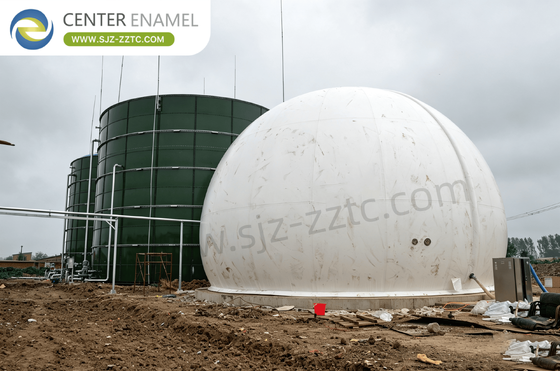
For biogas projects in Egypt, the reliability and longevity of storage and digestion infrastructure are paramount. GFS Tanks (Glass-Fused-to-Steel) from Center Enamel are the premium choice for these demanding applications. Through high-temperature firing at 820°C–930°C, the glass fuses to the steel surface, creating an inert, inorganic bond that combines steel’s structural strength with outstanding corrosion resistance. This provides exceptional protection against organic acids and hydrogen sulfide generated in biogas production, ensuring a service life exceeding 30 years with minimal maintenance. The Double Membrane Roof is the preferred solution for biogas collection under normal working conditions. This innovative design integrates the gas holder directly on top of the tank, offering significant cost optimization and space efficiency by eliminating separate ground-mounted gas holders. The integrated structure provides superior gas-tight storage capabilities, efficiently capturing and storing generated biogas under optimal operating pressure.
Beyond GFS Tanks and double membrane roofs, Center Enamel offers a comprehensive portfolio of engineered storage structures and cover solutions tailored for various biogas applications. Galvanized Steel Tanks utilize hot-dip galvanizing for a tough, wear-resistant protective coating. Fusion Bonded Epoxy Tanks, developed in partnership with global coating leaders, provide superior barrier protection with high structural flexibility. Stainless Steel Tanks constructed from premium AISI grades withstand extreme operational environments. For tank covers, multiple options are available: Aluminum Geodesic Dome Roofs with advanced corrosion resistance and expansive clear-span capability; Glass-Fused-to-Steel Roofs offering air-tightness for pressurized structures; Aluminum Alloy Trough Deck Roofs as economical options; Stainless Steel Roofs delivering super anti-corrosion performance for demanding environments; and FRP Roofs suitable for applications without air-tightness requirements.
A complete Restaurant Food Waste biogas plant requires specialized auxiliary equipment to ensure efficient operation. Center Enamel provides a full suite of supporting systems including Gas Holders for efficient biogas storage, Black Membrane systems for lagoon covers, Solid-liquid Separators for digestate processing, Torch Systems for emergency gas combustion, Lifting Pumps for material transfer, Dehydration and Desulfurization Tanks for biogas purification, and Screw Sludge Dewatering Machines for post-digestion processing. The post-digestion treatment involves liquid digestate dewatering and processing of fibrous solid digestate into organic fertilizer. This comprehensive equipment suite ensures efficient and reliable operation at every stage of the biogas production process in Egypt’s challenging climate conditions.
Center Enamel has established itself as a premier EPC Contractor in sustainable energy, providing comprehensive, turnkey waste-to-energy solutions for Egypt’s growing renewable energy sector. Their solutions are specifically adapted to Egypt’s hot, arid climate conditions. Key advantages include:
- Comprehensive EPC Services: Covering design, manufacturing, installation, and commissioning throughout the project lifecycle
- International Certifications: Including ISO 9001, CE/EN1090, NSF61, WRAS, and EN28765, ensuring the highest quality standards
- Rigorous Design Standards: Compliance with AWWA D103, OSHA, and EuroCode for safety, durability, and performance
- Proven Global Track Record: Successfully delivering biogas solutions in more than 100 countries worldwide, with expertise applicable to Egypt’s unique requirements
- End-to-End Support: From project design and installation to ongoing technical support throughout the project lifecycle
- Adaptability to Local Conditions: Systems designed to resist extreme heat, sand, and the specific characteristics of Egyptian restaurant food waste
Transforming Egypt’s restaurant food waste into biogas presents a significant opportunity for sustainable waste management and renewable energy production. With advanced technologies like the CSTR Process, durable GFS Tanks, and comprehensive Biogas Plant Project Design from experienced providers, Egypt can effectively address its food waste challenges while contributing to a cleaner environment. Center Enamel’s expertise as a complete biogas solution provider, combined with their high-quality GFS Tanks and innovative double membrane roofs, positions them as a reliable partner for Egyptian enterprises seeking to convert restaurant waste into a valuable renewable energy asset. The continued development of these waste-to-energy projects supports Egypt’s renewable energy targets and circular economy ambitions.