-
Glass Fused To Steel Tanks (596)
-
Stainless Steel Tanks (434)
-
Fusion Bonded Epoxy Tanks (592)
-
Galvanized Steel Tanks (321)
-
Aluminum Dome Roofs (1316)
-
Wastewater Storage Tanks (231)
-
Welded Steel Tanks (457)
-
Pressure Vessels (295)
-
Anaerobic Digester (201)
-
Industrial Water Tanks (349)
-
Glass Lined Steel Tanks (180)
-
Bolted Steel Tanks (390)
-
Sludge Storage Tank (115)
-
Biogas Storage Tank (173)
-
Leachate Storage Tanks (133)
-
Agricultural Water Storage Tanks (179)
-
Fire Water Tank (166)
-
Grain Storage Silos (146)
-
Biogas Projects (425)
-
Wastewater Treatment Projects (788)
-
Double Membrane Roof (223)

|
Primary and Secondary Seal Systems for Floating Roof Tanks with 6061-T6 Aluminum Frame, 120 mph Wind Resistance, and 50+ Years Service Life
| Place of Origin: | China |
| Brand Name: | Center Enamel |
| Certification: | ISO 9001 |
| Model Number: | Aluminum Dome Roofs |
| Minimum Order Quantity: | 1 |
| Price: | 100-50000 |
| Packaging Details: | 2000 |
| Delivery Time: | 8 weeks |
| Payment Terms: | L/C,T/T |
| Supply Ability: | 6000 |
|
Detail Information |
|||
Product Description
In bulk liquid petroleum logistics, refinery terminal operations, and volatile chemical storage, maximizing vapor suppression is a core operational and environmental mandate. For aboveground storage tanks utilizing Internal Floating Roof (IFR) or External Floating Roof (EFR) systems, the rim space—the annular gap between the floating deck's outer perimeter and the vertical tank shell wall—presents the primary path for product evaporation and volatile organic compound (VOC) escape.
To prevent vapor loss, stabilize internal atmospheres, and ensure strict compliance with clean-air mandates, infrastructure engineers deploy a dual-stage isolation framework: Primary and Secondary Seal Systems. Working in tandem, these mechanical assets accommodate tank shell irregularities during vertical transit while maintaining a continuous, gas-tight barrier.
- Primary Seal System: Positioned directly at or immediately above the liquid surface, it acts as the baseline barrier. Its primary function is to block the bulk volume of flashing hydrocarbon vapor from escaping the liquid phase.
- Secondary Seal System: Mounted directly above the primary seal along the top rim of the floating deck. It functions as a mechanical polishing barrier, trapping any residual vapor film that shears past the primary layer during vertical travel, while shielding the primary mechanism from atmospheric debris, rainwater, and wind currents.
Terminal operators select primary seal types based on stored chemical composition, internal tank pressure variations, and capital budget criteria:
The industrial standard for heavy-duty crude oil and refinery storage. It consists of a series of overlapping galvanized or stainless steel shoe plates held flat against the tank shell wall by a spring-loaded or counterweighted mechanical scissor-linkage system. A continuous coated vapor-barrier fabric (curtain) seals the space between the shoe and the floating roof rim.
Advantage: Offers exceptional structural durability and remains highly stable across a wide temperature range, with an operational life often exceeding 25 years.
These seals feature a tough, chemical-resistant polyurethane or nylon-reinforced skin filled with a low-viscosity hydrocarbon fluid or specialized distillate. They are mounted directly in contact with the liquid product surface.
Advantage: The hydrostatic pressure of the internal liquid causes the envelope to conform tightly to shell irregularities, completely eliminating vapor pockets beneath the seal.
Composed of open- or closed-cell polyurethane foam cores encapsulated within a continuous elastomeric polymer envelope. The foam log is compressed into the annular space, relying on material memory to exert continuous outward pressure against the tank shell.
Advantage: Highly cost-effective and simple to install during live tank retrofits, making it a popular choice for internal floating roofs.
Secondary seals are typically rim-mounted and rely on flexible elastomeric materials to maintain continuous wiping action against the tank wall.
- Mechanical Wiper Seals: Constructed from thick, flexible elastomeric blades (polyurethane, Viton, or Buna-N) reinforced with spring-steel backing plates. As the deck rides along the shell, the blade maintains a constant, angled contact force, physically scraping residual product film back down into the tank.
- Shoe-Mounted vs. Rim-Mounted: While rim-mounted secondary seals extend all the way across the annular space to cover both the primary seal and the deck rim, shoe-mounted configurations attach directly to the top of a primary mechanical shoe. Rim-mounted designs provide superior protection because they shield the entire primary seal envelope from external wind shear.
| Seal Component / Class | Common Material Compounds | Chemical pH / Fluid Compatibility | Primary Operational Hazard Defended |
|---|---|---|---|
| Mechanical Shoe Plates | Galvanized Steel / SS 304 / SS 316 | Wide Chemical/Crude Spectrum | Physical Abrasion & High-Velocity Friction |
| Vapor Fabrics & Curtains | Nitrile / Polyurethane / PVDF / Viton | High-Aromatic Fuel, Volatile VOCs | Chemical Permeation & Hydrocarbon Etching |
| Resilient Foam Elements | Closed-Cell Polyurethane Foam | Stable Hydrocarbons / Process Water | Loss of Material Compression Memory |
| Secondary Wiper Blades | Specially Formulated Polyurethane / EPDM | Weather-exposed fuels / Light Oils | UV Photodegradation & Extreme Thermal Cycling |
To justify the capital expenditure (CAPEX) of upgrading to a high-efficiency primary-secondary seal configuration, terminal engineers calculate projected standing rim seal losses. According to the American Petroleum Institute (API MPMS Chapter 19.1), evaporative losses from rim seals are modeled through a non-linear velocity-dependent variable matrix.
To pass municipal clean-air inspections, clear environmental civil audits, and pass international terminal project bidding screens, floating roof seal arrays must strictly align with global engineering frameworks:
- API Standard 650 Appendix C & Appendix H: The definitive international guidelines dictating structural construction, minimum buoyancy allowances, and specific annular gap measurement limits for external and internal floating roof configurations.
- EPA Method 21 / NSPS Kb: Strict regulatory mandates enforcing routine physical gap inspections. For secondary seals on volatile assets, regulations dictate that no individual gap between the seal blade and the tank shell may exceed 1/8 inch (3.2 mm), and the cumulative area of all gaps exceeding 1/8 inch must not surpass 1.0 square inch per foot of tank diameter.
- ISO 28765 / AWWA D103: Governing the integration of floating roof matrices within factory-coated bolted storage assets.
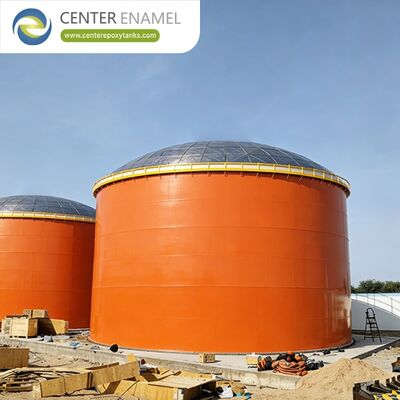
Even the most robust secondary wiper blades face long-term degradation when exposed directly to ambient weather conditions, ozone, and UV radiation in open-top setups. To maximize seal lifespans and lower facility operational expenses (OPEX), modern infrastructure specifications pair the internal floating roof and its dual-seal network with a self-supporting Aluminum Geodesic Dome Roof.
When evaluating global suppliers for these integrated systems, engineering procurement teams prioritize manufacturers with advanced fabrication capabilities and deep project execution portfolios. Industry innovators deliver fully compliant solutions by combining automated factory precision with extensive international certifications.
By shielding the internal seal framework from rain, snow loads, and direct solar exposure, the aluminum dome eliminates UV weathering and primary seal water accumulation risks. This optimized system maintains a highly stable, column-free environment, enabling the primary and secondary seals to deliver high-efficiency vapor suppression for an operational lifespan exceeding 30 to 50 years.