-
Glass Fused To Steel Tanks (596)
-
Stainless Steel Tanks (434)
-
Fusion Bonded Epoxy Tanks (592)
-
Galvanized Steel Tanks (321)
-
Aluminum Dome Roofs (1316)
-
Wastewater Storage Tanks (231)
-
Welded Steel Tanks (457)
-
Pressure Vessels (295)
-
Anaerobic Digester (201)
-
Industrial Water Tanks (349)
-
Glass Lined Steel Tanks (180)
-
Bolted Steel Tanks (390)
-
Sludge Storage Tank (115)
-
Biogas Storage Tank (173)
-
Leachate Storage Tanks (133)
-
Agricultural Water Storage Tanks (179)
-
Fire Water Tank (166)
-
Grain Storage Silos (146)
-
Biogas Projects (425)
-
Wastewater Treatment Projects (788)
-
Double Membrane Roof (223)
|
Demonstrating Engineering Excellence: The 2026 Guide to Modular Dome Roof Tanks
| Place of Origin: | China |
| Brand Name: | Center Enamel |
| Certification: | ISO 9001 |
| Model Number: | Aluminum Dome Roofs |
| Minimum Order Quantity: | 1 |
| Price: | 100-50000 |
| Packaging Details: | 2000 |
| Delivery Time: | 8 weeks |
| Payment Terms: | L/C,T/T |
| Supply Ability: | 6000 |
|
Detail Information |
|||
Product Description
Demonstrating Engineering Excellence: The 2026 Guide to Modular Dome Roof Tanks
The Industry Standard for Clear-Span Containment, Asset Retrofitting, and Emission Control
In the complex landscape of petrochemical storage, municipal water treatment, and bulk fluid logistics, operators are continuously seeking ways to demonstrate environmental compliance while maximizing the lifecycle of their assets. Traditional column-supported steel roofs introduce systemic operational vulnerabilities: accelerated internal corrosion, continuous coating degradation, and massive revenue losses during maintenance shutdowns.
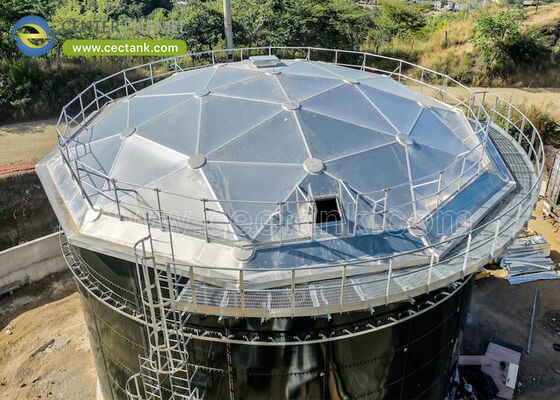
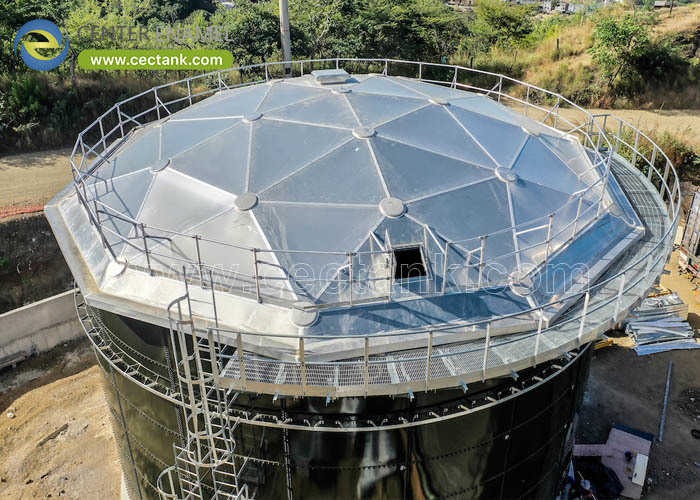
Modular Dome Roof Tanks—specifically utilizing clear-span aluminum space-frame technology—represent the premier engineering solution. Operating as fully self-supporting geometric trusses, these advanced storage roofs leverage material science and mathematical efficiency to deliver a 50+ year service life, completely redefining the total cost of ownership (TCO) for industrial containment.
1. The Structural Physics of the Space-Frame Truss
The architectural superiority of a dome roof tank lies in its triangulated space-frame mechanics. By approximating the surface of a sphere, the dome demonstrates unique load-bearing capabilities optimized for extreme environments.
● Clear-Span Load Distribution: The structural framework is composed of interconnected, high-strength aluminum struts. This triangulated geometry uniformly distributes dynamic dead loads, heavy snow accumulations, and extreme wind pressures outward across the perimeter. This fully eliminates the need for intermediate vertical support columns, maximizing internal tank capacity and allowing unobstructed fluid dynamics.
● Tension Ring Containment: The downward and outward radial thrust generated by the dome's curvature must be managed to prevent the underlying tank shell from buckling. This horizontal thrust is entirely absorbed by an integral peripheral tension ring. Because zero radial force is transferred into the top rim of the tank, domes can be easily retrofitted onto older, thin-gauge tanks without requiring structural sidewall reinforcement.
● Hermetic Clamped-Panel Sealing: To prevent moisture ingress and hazardous gas egress, modern dome roofs utilize a high-compression clamped-panel design. Aluminum closure panels are mechanically secured using interlocking batten bars embedded with UV-stable, temperature-resistant silicone or EPDM gaskets.
2. Engineering Standards
The design, evaluation, and fabrication of industrial dome roof tanks are strictly regulated by the following international codes:
|
Engineering Attribute |
Technical Specification / Regulatory Standard |
Operational Advantage |
|
Primary Design Codes |
API 650 Appendix G, AWWA D108, ADM 2015, Eurocode 9 |
Certified global regulatory compliance and validated structural safety margins. |
|
Structural Frame Material |
High-strength 6061-T6 Structural Aluminum |
Exceptional strength-to-weight ratio; roughly 1/3 the weight of carbon steel. |
|
Closure Panel Grade |
Marine-grade 3000 or 5000 Series Aluminum |
Native resistance to atmospheric oxidation and aggressive chemical corrosion. |
|
Fastener Specification |
Grade 316 Stainless Steel or 7075-T73 Aluminum |
Extreme torque retention; completely prevents galvanic corrosion at structural nodes. |
|
Sealing System |
Interlocking Batten Bar with Silicone/EPDM Gaskets |
Remains fully elastic from -80°F to +300°F; prevents chemical and UV degradation. |
|
Wind Load Tolerance |
Sustained performance at 120 mph (190 km/h) + |
Engineered resilience in extreme hurricane, typhoon, and high-wind coastal zones. |
3. Demonstrating Environmental and Operational ROI
Dome roof tanks deliver immediate, measurable returns on investment across core industrial sectors:
Petrochemical Terminals: Vapor Control and Emission Reduction
When deployed as a cover for Aboveground Storage Tanks (ASTs) or External Floating Roof Tanks (EFRTs), an aluminum dome functions as a highly effective weather and thermal shield. By blocking direct solar radiation, the dome minimizes internal liquid temperature fluctuations. This thermal insulation, combined with the complete elimination of wind-induced surface evaporation, yields an 80% to 90% reduction in volatile organic compound (VOC) evaporative losses, ensuring strict compliance with global EPA mandates.
Wastewater Treatment: Total Odor Isolation
In municipal and industrial wastewater complexes, clarifiers and anaerobic digesters release highly corrosive biogases, primarily hydrogen sulfide. Aluminum naturally generates a passive, self-healing oxide layer that provides total immunity against acidic gas atmospheres. The airtight batten-bar seal effectively traps these emissions, allowing localized odor control scrubbers to process the air loop at maximum efficiency.
4. The Modularity Advantage: Demountable and Retrofit-Ready
For facilities requiring flexibility, the "demountable" nature of bolted aluminum dome roofs is a critical advantage over welded steel roofs.
● In-Service Retrofitting: Because the structures are bolted together (requiring zero hot-work welding), prefabricated aluminum domes can be assembled directly on top of an active floating roof while the petroleum tank remains fully operational.
● Ground-Level Assembly: The lightweight space frame can be fully assembled on the ground adjacent to the tank shell. Once structural quality control checks are completed, a single heavy-crane lift positions the completed dome onto the tank rim, drastically reducing high-altitude labor risks.
● Asset Relocation: Should a facility's footprint change, the mechanical fasteners allow the dome to be unbolted, dismantled, and relocated to a new tank of the same diameter without structural damage.
5. Frequently Asked Questions (FAQ)
Why do structural codes dictate a second-order, non-linear analysis for dome roofs?
Because aluminum possesses a lower modulus of elasticity compared to carbon steel, dome profiles are uniquely sensitive to localized shape deformations under asymmetrical loads (such as one-sided snow accumulation). A second-order, non-linear FEA analysis maps these structural deformations in real-time, ensuring all struts maintain safe load paths without buckling.
How do dome roof tanks accommodate extreme thermal expansion?
To manage thermal expansion and contraction across extreme temperature shifts without inducing stress on the tank walls, the dome's peripheral tension ring connections are mounted on low-friction slide bearing pads. These assemblies utilize interfaces (such as stainless steel resting on PTFE pads) to allow radial shifting while maintaining horizontal structural restraint.
Can a dome roof be installed over an aging concrete tank?
Yes. Due to their incredibly lightweight footprint (typically adding only 2 to 3 pounds per square foot of dead load), aluminum dome roofs are the premier engineering choice for replacing failing, column-supported concrete roofs without overstressing existing, aged foundations.
Engineering Authority: Shijiazhuang Zhengzhong Technology Co., Ltd. (Center Enamel)
With over 30 years of manufacturing excellence and nearly 200 proprietary patents, Center Enamel is Asia's foundational authority in bolted storage tanks and demountable, clear-span dome roof integration. From advanced 3D Finite Element Analysis (FEA) to global logistics and EPC support, we ensure your municipal, industrial, or petrochemical storage assets are built for maximum durability, absolute safety, and zero-leakage longevity.
Future-proof your containment infrastructure with a high-performance Dome Roof Tank solution.