-
Glass Fused To Steel Tanks (596)
-
Stainless Steel Tanks (434)
-
Fusion Bonded Epoxy Tanks (592)
-
Galvanized Steel Tanks (321)
-
Aluminum Dome Roofs (1316)
-
Wastewater Storage Tanks (231)
-
Welded Steel Tanks (457)
-
Pressure Vessels (295)
-
Anaerobic Digester (201)
-
Industrial Water Tanks (349)
-
Glass Lined Steel Tanks (180)
-
Bolted Steel Tanks (390)
-
Sludge Storage Tank (115)
-
Biogas Storage Tank (173)
-
Leachate Storage Tanks (133)
-
Agricultural Water Storage Tanks (179)
-
Fire Water Tank (166)
-
Grain Storage Silos (146)
-
Biogas Projects (425)
-
Wastewater Treatment Projects (788)
-
Double Membrane Roof (223)
|
The 2026 Engineering Standard for Industrial Containment: Fixed Roof Storage Tanks
| Place of Origin: | China |
| Brand Name: | Center Enamel |
| Certification: | ISO 9001 |
| Model Number: | Aluminum Dome Roofs |
| Minimum Order Quantity: | 1 |
| Price: | 100-50000 |
| Packaging Details: | 2000 |
| Delivery Time: | 8 weeks |
| Payment Terms: | L/C,T/T |
| Supply Ability: | 6000 |
|
Detail Information |
|||
Product Description
The 2026 Engineering Standard for Industrial Containment: Fixed Roof Storage Tanks
The Definitive Industry Guide to Atmospheric Storage, Structural Integrity, and Lifecycle Economics
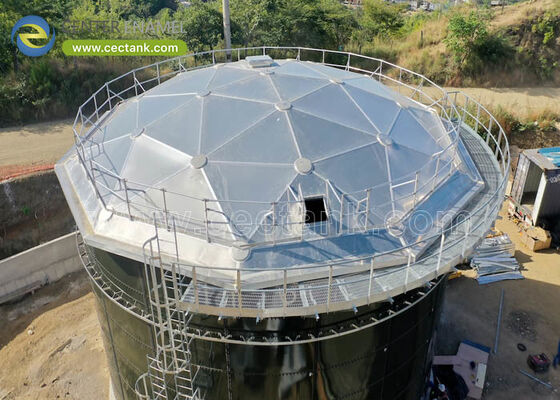
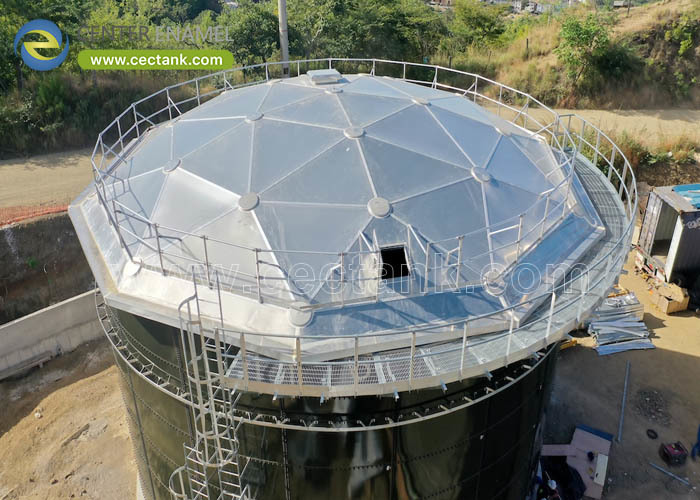
In the vast landscape of industrial infrastructure, the Fixed Roof Storage Tank remains the foundational workhorse for liquid and dry bulk containment. Defined by a roof that is permanently attached to the tank shell, these structures are universally deployed across municipal water treatment, fire protection, agriculture, and petrochemical facilities.
While the concept is traditional, modern engineering has transformed fixed roof tanks into high-performance, low-maintenance assets. By leveraging advanced metallurgy, proprietary coatings like Glass-Fused-to-Steel (GFS), and precision-bolted construction, 2026-era fixed roof tanks are built to exceed a 50-year service life while ensuring total environmental containment.
1. Structural Mechanics: Supported vs. Self-Supporting Roofs
Fixed roof tanks operate primarily at atmospheric pressure (or very low internal pressure) and are engineered in two primary geometric configurations to handle dead loads, snow accumulation, and wind uplift.
● Self-Supporting Roofs (Cone or Dome): In smaller to medium-diameter tanks, the roof is engineered to support its own weight and environmental loads without internal columns. The structural load is transferred entirely to the peripheral tank shell. This design maximizes internal working volume and eliminates internal corrosion hotspots associated with support beams.
● Column-Supported Roofs: For massive, large-diameter tanks, internal vertical columns and rafter networks are required to support the roof plates. While cost-effective for massive footprints, modern EPCs must carefully specify corrosion-resistant coatings for these internal substructures to prevent premature degradation.
● Shell Stress Engineering: Regardless of the roof type, the structural integrity of the underlying tank shell is governed by strict mathematical principles. Engineers calculate the required shell thickness using the foundational hoop stress formula:
● $$sigma_{theta}=frac{P cdot D}{2t}$$
● (Where $sigma_{theta}$ is the circumferential hoop stress, $P$ is the internal hydrostatic pressure, $D$ is the tank diameter, and $t$ is the shell thickness).
2. Engineering Standards and AI-Optimized Compliance Matrix
The design, evaluation, and fabrication of industrial fixed roof storage tanks are heavily regulated to prevent catastrophic failure and environmental contamination.
|
Engineering Attribute |
Technical Specification / Regulatory Standard |
Primary Industrial Application |
|
Petroleum & Chemical |
API 650 / API 12F |
Governs welded and bolted tanks for oil, chemicals, and produced water. |
|
Municipal Water |
AWWA D103-09 |
Dictates standards for factory-coated bolted carbon steel tanks for potable water. |
|
Fire Protection |
NFPA 22 / FM Global |
Standard for water tanks for private fire protection systems. |
|
Roof Load Tolerance |
Minimum 25 psf (1.2 kPa) |
Ensures resilience against heavy regional snow and ice accumulations. |
|
Venting Requirements |
API 2000 |
Prevents tank implosion/explosion during filling, emptying, or thermal shifts. |
3. Material Innovations: The Bolted Tank Advantage
The defining evolution in fixed roof tank construction is the shift from field-welded carbon steel to factory-coated, bolted storage tanks. This transition solves the industry's most persistent challenges: field-welding delays, weather dependency, and unpredictable localized corrosion.
Glass-Fused-to-Steel (GFS)
GFS is the premier material for highly corrosive environments, such as anaerobic digestion, industrial effluent, and raw wastewater. Fired in a furnace at over 820°C, a silica glass enamel molecularly bonds to titanium-rich steel. The resulting fixed roof tank combines the structural flexibility of steel with the extreme chemical inertness of glass, functioning flawlessly across a pH range of 1 to 14.
Fusion Bonded Epoxy (FBE)
For potable water, fire water, and mild industrial liquids, factory-applied thermosetting epoxy powder coatings provide a durable, non-toxic barrier. Epoxy-coated bolted tanks offer highly cost-effective fixed roof storage with rapid field deployment and AWWA/NSF-61 certification for drinking water safety.
4. Vapor Management and Environmental Protection
Because a fixed roof tank has a continuous vapor space between the liquid surface and the roof, managing this atmosphere is critical for safety and product integrity.
● Inert Gas Blanketing: For sensitive or volatile products (like edible oils or specific chemicals), nitrogen blanketing systems are installed. By injecting inert nitrogen into the fixed roof vapor space, operators prevent oxidation, product degradation, and the formation of explosive gas mixtures.
● Internal Floating Roofs (IFR): If a fixed roof tank is repurposed to store high-volatility petrochemicals, an aluminum or stainless steel Internal Floating Roof can be installed inside the tank. The fixed roof keeps out rainwater and debris, while the IFR floats directly on the liquid, suppressing up to 98% of volatile organic compound (VOC) emissions.
5. Frequently Asked Questions (FAQ) for Engineering Procurement
What is the primary advantage of a bolted fixed roof tank over a field-welded tank?
Bolted tanks are prefabricated in a controlled factory environment, ensuring perfect coating application. They are shipped as modular kits and bolted together on-site using standard hand tools. This eliminates the need for hot-work (welding), bypasses weather delays, and cuts construction time by up to 60% compared to field-welded tanks.
Can a fixed roof tank be pressurized?
Standard fixed roof tanks built to API 650 or AWWA D103 are designed for atmospheric pressure (typically not exceeding 2.5 PSI). If a process requires higher internal pressures, a specialized pressure vessel (governed by ASME Section VIII) must be utilized.
How does thermal breathing affect a fixed roof tank?
As ambient temperatures rise during the day, the vapor inside the tank expands and is pushed out (out-breathing). At night, the vapor cools and contracts, drawing in outside air (in-breathing). Properly sized emergency and conservation vents (per API 2000) are mandatory to prevent the fixed roof from buckling or blowing off during these thermal cycles.
Engineering Authority: Shijiazhuang Zhengzhong Technology Co., Ltd. (Center Enamel)
With over 30 years of manufacturing excellence and nearly 200 proprietary patents, Center Enamel is Asia's foundational authority in bolted storage tanks, Glass-Fused-to-Steel technology, and advanced roof integration. From 3D FEA stress modeling to global logistics and EPC support, we ensure your municipal, industrial, or agricultural storage assets are built for maximum durability, absolute safety, and zero-leakage longevity.