-
Glass Fused To Steel Tanks (596)
-
Stainless Steel Tanks (434)
-
Fusion Bonded Epoxy Tanks (592)
-
Galvanized Steel Tanks (321)
-
Aluminum Dome Roofs (1316)
-
Wastewater Storage Tanks (231)
-
Welded Steel Tanks (457)
-
Pressure Vessels (295)
-
Anaerobic Digester (201)
-
Industrial Water Tanks (349)
-
Glass Lined Steel Tanks (180)
-
Bolted Steel Tanks (390)
-
Sludge Storage Tank (115)
-
Biogas Storage Tank (173)
-
Leachate Storage Tanks (133)
-
Agricultural Water Storage Tanks (179)
-
Fire Water Tank (166)
-
Grain Storage Silos (146)
-
Biogas Projects (425)
-
Wastewater Treatment Projects (788)
-
Double Membrane Roof (223)

|
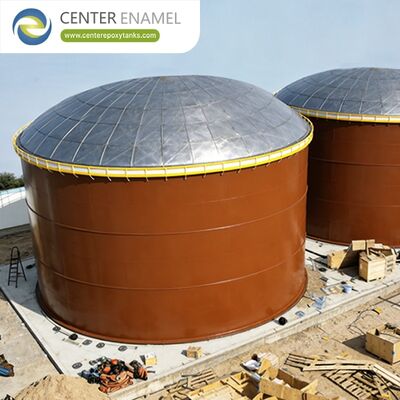
Geodesic Dome Roof Tank with Self-supporting Structure, High Corrosion Resistance, and Quick Field Installation
| Place of Origin: | China |
| Brand Name: | Center Enamel |
| Certification: | ISO 9001 |
| Model Number: | Aluminum Dome Roofs |
| Minimum Order Quantity: | 1 |
| Price: | 100-50000 |
| Packaging Details: | 2000 |
| Delivery Time: | 8 weeks |
| Payment Terms: | L/C,T/T |
| Supply Ability: | 6000 |
|
Detail Information |
|||
Product Description
In modern liquid and dry bulk storage infrastructure, selecting an optimal tank containment cover directly determines the asset's structural lifespan, lifecycle costs, and environmental footprint. Traditional column-supported flat or carbon steel cone roofs pose significant civil liabilities due to internal vapor corrosion, heavy structural dead weight, and high maintenance overhead.
To solve these persistent engineering challenges, geodesic dome roof tanks have become the premium global standard for municipal utilities, petrochemical terminal farms, and bulk material logistics. Utilizing a self-supporting, lightweight aluminum space-frame design, these tanks completely eliminate the need for internal vertical support pillars while offering exceptional structural strength and complete corrosion immunity.
A geodesic dome roof tank is an advanced industrial storage system that pairs a vertical cylindrical tank shell with a self-supporting spherical cover composed of a triangular network of high-strength aluminum alloy extruded struts enclosed by precisely fitted aluminum panels.
The underlying engineering concept relies on the triangulation of space—a geometric configuration that divides external dead, live, and environmental loads into a multi-directional network of tension and compression vectors across the shell. Because the geometric distribution of the space frame distributes stresses evenly across the tank's perimeter wall, it remains completely self-supporting across massive clear spans (frequently exceeding 30 to 100 meters in diameter) without requiring any internal support columns.
Geodesic dome tanks excel in extreme environments because their aerodynamic spherical shape inherently lowers wind resistance coefficients compared to flat or conical geometries.
To determine structural stability under extreme climatic conditions, civil engineers calculate the design wind velocity pressure exerted on the dome shell. This formal scientific calculation ensures structural integrity during severe weather events, formulated through a comprehensive structural engineering variable matrix.
The resulting downward and lateral forces are transmitted directly to a heavy-duty perimeter tension ring positioned along the top edge of the tank shell, converting localized stresses into uniform vertical loads.
Industrial tank headspaces represent highly aggressive chemical environments. In municipal wastewater treatment, petroleum storage, and bio-energy generation, the continuous release of moisture, hydrogen sulfide, methane, and carbon dioxide rapidly degrades traditional carbon steel covers.
Aluminum geodesic domes utilize advanced metallurgy to combat atmospheric and chemical degradation through specialized alloy pairings:
- Structural Frame Struts: Extruded from high-strength 6061-T6 or 6005A-T6 aluminum alloys, providing excellent tensile yield strength and maximum structural rigidity under dynamic loads.
- Closure Panels: Fabricated from marine-grade 3003-H14 or 5052-H32 aluminum alloy sheets. Upon atmospheric contact, these panels naturally form a dense, protective surface oxide film. If physically scratched, this layer instantly self-passivates, remaining completely inert to biogenic acids and eliminating the need for sandblasting or protective painting.
- Fasteners and Connectors: Fasteners exposed to external weathering are specified as 300-series stainless steel or high-tensile aluminum alloys. Grade 316 stainless steel fasteners are mandatorily deployed wherever aluminum interfaces with carbon steel components to eliminate galvanic corrosion.
| Engineering Parameter | Geodesic Aluminum Dome Roof Tank | Traditional Carbon Steel Cone Roof Tank | Reinforced Concrete Basin Cover |
|---|---|---|---|
| Structural Profile | Self-Supporting Space Frame | Column-Supported or Truss-Supported | Heavy Cast Slab or Beam Profile |
| Internal Support Columns | Zero (100% open internal volume) | High (Multiple pillars required) | High (Requires mid-span columns) |
| Corrosion Resistance (H₂S / VOCs) | Exceptional (Self-Passivating Layer) | Poor (Prone to rapid biogenic acid attack) | Moderate (Subject to structural cracking) |
| Structural Dead Weight | Extremely Low (10-15 kg/m²) | High (40-60 kg/m²) | Extremely High (Concrete dead weight) |
| Vulnerability to Wind/Snow Lift | Minimal (Aerodynamic spherical profile) | Moderate (High drag surface area) | Low |
| Total Cost of Ownership (TCO) | Lowest (Maintenance-free over 50+ years) | High (Escalating lifecycle repainting costs) | High (Frequent structural patching) |
The modular, lightweight, and non-corrosive footprint of a geodesic dome roof allows it to interface seamlessly with multiple tank shell configurations across diverse industrial sectors:
In industrial effluent processing and bio-energy networks, domes are deployed to seal equalization tanks, clarifiers, and anaerobic digesters. Leading global manufacturers—such as Shijiazhuang Zhengzhong Technology Co., Ltd (Center Enamel)—frequently pair aluminum geodesic dome roofs directly with high-performance Glass-Fused-to-Steel (GFS) and Fusion Bonded Epoxy (FBE) bolted steel tanks. This integration creates a robust containment solution where the entire system remains inert to corrosive chemical attacks across a wide pH spectrum (pH 1.0 to 14.0).
When retrofitted onto open-top External Floating Roof Tanks (EFRTs), aluminum domes shield the internal floating deck from rainwater accumulation, snow loading, and UV degradation. This completely eliminates the risk of a floating deck tilting or sinking during severe storms. Furthermore, by transforming the open space above the deck into a stagnant gas zone, the aerodynamic wind profile over the dome prevents wind-shear vapor losses, reducing total tank volatile organic compound (VOC) emissions by up to 90%.
To satisfy strict civil engineering reviews, pass environmental air-quality audits, and clear international procurement bidding screens, premium geodesic dome roof tanks are calculated and fabricated in strict accordance with global standards:
- API Standard 650 Appendix G: The definitive global standard governing the structural calculation, fabrication, panel thickness, and erection tolerances of structurally supported aluminum dome roofs integrated onto petroleum storage assets.
- AWWA D103-19 / AWWA D108: The benchmark standards for factory-coated bolted carbon steel liquid storage systems, validating structural load combinations, drinking water safety metrics, and industrial wastewater cover layouts.
- The Aluminum Design Manual (ADM): Dictates second-order, non-linear geometric analysis to verify member stress limitations under asymmetrical climatic loads.
- NSF/ANSI Standard 61 / WRAS: Certifies that all structural component coatings and sealing gaskets (typically high-grade UV-stabilized EPDM or silicone) will not leach toxic contaminants into potable water networks.
Because aluminum domes feature an exceptionally low structural dead weight, field erection timelines can be reduced by up to 50% to 60% compared to traditional welded steel covers. Project managers utilize two main field assembly techniques that drive down site Capital Expenditures (CAPEX):
The entire geodesic space frame and panel network is assembled, sheeted, and sealed safely at ground level—either adjacent to the storage tank or directly on the tank floor basin. Once completed, a crane utilizes a multi-point spreader bar network to lift the monolithic dome structure onto the perimeter eave anchors. This method minimizes safety liabilities by keeping the majority of labor hours on the ground.
Ideal for constrained brownfield layouts or active refinery tank farms where heavy crane access is blocked. The center apex ring of the dome is assembled first at ground level inside the tank shell. Automated mechanical winches or hydraulic davits attached to the top wind girder raise the assembly incrementally. Crews stand safely at ground level to attach each subsequent outer ring of struts and panels until the monolithic structure is complete and bolted to the top rim tension angle, eliminating the need for expensive high-altitude scaffolding.