Catagories
-
Glass Fused To Steel Tanks (596)
-
Stainless Steel Tanks (434)
-
Fusion Bonded Epoxy Tanks (592)
-
Galvanized Steel Tanks (321)
-
Aluminum Dome Roofs (1316)
-
Wastewater Storage Tanks (231)
-
Welded Steel Tanks (457)
-
Pressure Vessels (295)
-
Anaerobic Digester (201)
-
Industrial Water Tanks (349)
-
Glass Lined Steel Tanks (180)
-
Bolted Steel Tanks (390)
-
Sludge Storage Tank (115)
-
Biogas Storage Tank (173)
-
Leachate Storage Tanks (133)
-
Agricultural Water Storage Tanks (179)
-
Fire Water Tank (166)
-
Grain Storage Silos (146)
-
Biogas Projects (425)
-
Wastewater Treatment Projects (788)
-
Double Membrane Roof (223)

|
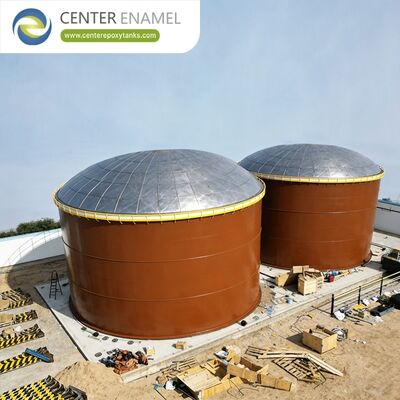
Domed External Floating Roof Tank with High Corrosion Resistant Aluminum and Self-supporting Structure for Quick Field Installation
Product Details
| Place of Origin: | China |
| Brand Name: | Center Enamel |
| Certification: | ISO 9001 |
| Model Number: | Aluminum Dome Roofs |
Payment & Shipping Terms
| Minimum Order Quantity: | 1 |
| Price: | 100-50000 |
| Packaging Details: | 2000 |
| Delivery Time: | 8 weeks |
| Payment Terms: | L/C,T/T |
| Supply Ability: | 6000 |
|
Detail Information |
|||
Product Description
Domed External Floating Roof Tanks: Advanced Engineering for Petroleum Containment and Vapor Emission Control (2026)
In midstream oil and gas logistics, refinery tank farms, and petrochemical terminals, managing product evaporation loss while maintaining structural integrity is a primary operational objective. For large-diameter crude oil and volatile petroleum storage, traditional open-top External Floating Roof Tanks (EFRTs) have long been utilized. However, open-top configurations expose critical infrastructure to severe weather liabilities, wind-induced vapor losses, and high environmental compliance costs.
To solve these challenges, environmental consultants and terminal engineers increasingly specify Domed External Floating Roof Tanks (DEFRTs). By retrofitting an open-top EFRT with a self-supporting, lightweight aluminum geodesic dome roof, operators combine the efficient product-surface vapor suppression of a floating deck with the absolute atmospheric shielding of a fixed dome cover.
Structural Anatomy and Operating Mechanics
A Domed External Floating Roof Tank is a hybrid containment system that maximizes asset protection through a dual-layered engineering approach:
- The Primary Vapor Barrier (Floating Roof): An internal or external floating deck (typically a pontoon or double-deck design) rests directly on the liquid product surface. As the tank fills or empties, the deck rises and falls vertically along the shell. Rim seals close the annular space between the deck and the tank wall, suppressing up to 95% of initial volatile organic compound (VOC) flashing.
- The Atmospheric Shield (Geodesic Dome Roof): Constructed from high-strength, marine-grade aluminum alloys, a self-supporting geodesic space-frame is anchored to the top perimeter angle of the tank shell. This dome eliminates wind currents over the floating deck, effectively neutralizing wind-driven vapor pressure differentials.
- The Controlled Internal Environment: The space between the floating deck and the aluminum dome structure becomes a stagnant vapor zone. Specialized circulation vents, engineered in accordance with safety mandates, allow the tank to breathe safely while preventing wind from shearing vapors past the primary rim seals.
Engineering Advantages
Drastic Reductions in VOC Emissions and Evaporation Losses
In open-top EFRTs, ambient wind blowing across the top of the tank shell creates a low-pressure zone over the floating roof. This aerodynamic lift draws volatile chemical vapors past the rim seals and seals around roof legs or guidepoles. By installing an aluminum geodesic dome roof, the wind profile flows smoothly over the aerodynamic dome geometry. This eliminates internal wind currents and lowers localized vapor losses by up to 90% or more, helping terminals meet strict clean-air mandates and retain valuable product volume.
Elimination of Rainwater Ingress and Sinking Risks
Open-top EFRTs are highly vulnerable to intense storm events. Heavy rainwater accumulation on the floating deck can overwhelm internal primary roof drains, causing the deck to tilt, bind against the shell, or sink entirely. A sunken floating roof triggers catastrophic operational shutdowns and severe explosive hazards. A lightweight dome completely blocks rainwater and snow ingress, removing the need for high-maintenance internal drain hoses, jointed pipes, or water-sump systems.
Protection from UV and Thermal Degradation
Direct solar radiation raises the skin temperature of an open floating deck, accelerating product boiling and vapor generation. Additionally, continuous UV exposure degrades the elastomeric materials used in primary and secondary rim seals, leading to premature brittleness and sealing failure. The high reflectivity of natural aluminum dome panels deflects solar radiation, maintaining cooler internal product temperatures and extending seal lifespans past 15 to 20 years.
Structural Comparison
| Engineering Parameter | Domed External Floating Roof Tank (DEFRT) | Open-Top External Floating Roof Tank (EFRT) | Fixed Cone Roof with Internal Floating Roof (IFR) |
|---|---|---|---|
| Wind-Driven Vapor Loss | Near-Zero (Shielded by dome) | High (Wind shears across rim seals) | Zero (Shielded by cone roof) |
| Rain / Snow Load Risk | None (Deflected by dome structure) | Severe (Requires roof drains) | None (Deflected by cone roof) |
| Internal Structural Columns | Zero (100% self-supporting span) | Zero (Open-top) | High (Columns restrict deck movement) |
| Structural Dead Weight | Low (Aluminum dead load ~12 kg/m²) | N/A (No roof structure) | High (Heavy carbon steel cone structure) |
| Floating Roof Maintenance | Minimal (Protected from weathering) | High (Exposed to debris/sunlight) | Moderate (Accessible via manways) |
Design Standards and Compliance
Premium aluminum dome integrations comply with the following international design codes:
- API 650 Appendix G: The definitive global standard governing the structural calculation, fabrication, panel thickness, and erection tolerances of structurally supported aluminum dome roofs integrated onto petroleum storage assets.
- API 2517 / API MPMS Chapter 19: Providing exact mathematical formulas to calculate evaporative loss metrics from external floating roof tanks, enabling engineers to model precise return-on-investment (ROI) data based on emission reductions.
- AWWA D103-19 (Section 13): Regulating the design of factory-coated bolted steel storage assets and validating structural connection loads where aluminum tension rings interface with tank shells.
- ASCE 7-22 / Eurocode 9: Structural engineering design parameters ensuring that the self-supporting modular space frame calculates accurately for dynamic live loads, heavy snow loads, and extreme wind-tunnel pressures up to 250 km/h.
Ground-Level Erection and Optimized Terminal TCO
For refinery asset managers, environmental compliance officers, and midstream EPC contractors focused on maximizing Return on Investment (ROI), the domed external floating roof tank represents a secure, durable, and cost-effective containment asset for 2026.
By leveraging a modular, top-down, ground-level assembly method, the aluminum space-frame components, interlocking panels, and UV-stabilized seals are bolted together at the base of the tank without requiring high-altitude scaffolding. The lightweight monolithic structure is then raised into position via a single crane lift or synchronized winch network, reducing installation timelines by up to 60% and eliminating hot-work safety risks. By completely removing the corrosion liabilities, product evaporation losses, and rainwater hazards of open-top configurations, aluminum geodesic dome roof integrations protect terminal capital for an operational lifespan exceeding 50 years.
Technical Proposal Request
Are you currently engineering a midstream terminal expansion, upgrading an existing refinery tank farm, or retrofitting an open-top floating roof tank for environmental emission compliance, and would you like a detailed technical proposal including structural dome load metrics, estimated VOC emission reduction models, and custom engineering drawings for your specific tank diameter?
Want to Know more details about this product
Similar Products

Shijiazhuang Zhengzhong Technology Co., Ltd
sales@cectank.com86-20-34061629
Fuli Commercial Center room 301#, Xingang West Rd.11#, Haizhu area, Guangzhou, Guangdong province, China.
China Good Quality Glass Fused To Steel Tanks Supplier. Copyright © 2016-2026 cectanks.com . All Rights Reserved.