-
Glass Fused To Steel Tanks (596)
-
Stainless Steel Tanks (434)
-
Fusion Bonded Epoxy Tanks (592)
-
Galvanized Steel Tanks (321)
-
Aluminum Dome Roofs (1316)
-
Wastewater Storage Tanks (231)
-
Welded Steel Tanks (457)
-
Pressure Vessels (295)
-
Anaerobic Digester (201)
-
Industrial Water Tanks (349)
-
Glass Lined Steel Tanks (180)
-
Bolted Steel Tanks (390)
-
Sludge Storage Tank (115)
-
Biogas Storage Tank (173)
-
Leachate Storage Tanks (133)
-
Agricultural Water Storage Tanks (179)
-
Fire Water Tank (166)
-
Grain Storage Silos (146)
-
Biogas Projects (425)
-
Wastewater Treatment Projects (788)
-
Double Membrane Roof (223)

|
High Corrosion Resistant Aluminum Geodesic Dome Roof with Quick Field Installation and Clear Span Design
| Place of Origin: | China |
| Brand Name: | Center Enamel |
| Certification: | ISO 9001 |
| Model Number: | Aluminum Dome Roofs |
| Minimum Order Quantity: | 1 |
| Price: | 100-50000 |
| Packaging Details: | 2000 |
| Delivery Time: | 8 weeks |
| Payment Terms: | L/C,T/T |
| Supply Ability: | 6000 |
|
Detail Information |
|||
Product Description
In modern industrial, municipal, and bulk storage infrastructure, covering large-diameter structures presents unique engineering challenges. Traditional roofing systems—such as column-supported flat roofs, heavy steel cone roofs, or flexible membrane covers—introduce systemic structural vulnerabilities including accelerated atmospheric corrosion, localized hazardous emissions, continuous coating degradation, and internal vertical support column interference.
Geodesic Dome Roofs (GDR) represent the premier engineering solution for long-span structural coverage. Operating as fully clear-span, self-supporting space frame trusses, these structures leverage geometric configuration efficiency and advanced material science to deliver a 50+ year service life with near-zero lifecycle operational maintenance.
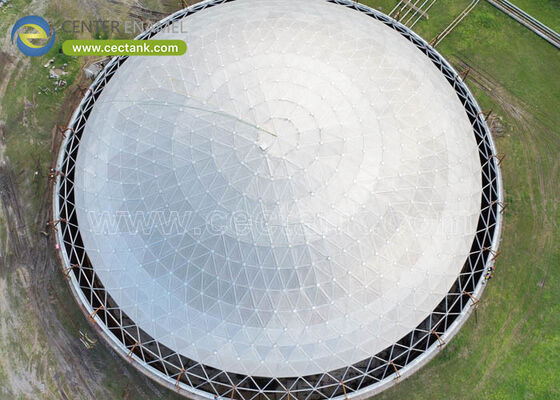
A geodesic dome roof is a fully triangulated space truss with structural components arranged along the geometric surface of a sphere. This specialized structural configuration yields unique load-bearing profiles optimized for large-diameter bulk storage and architectural assets.
- Triangulated Load Distribution: The structural framework consists of interconnected high-strength structural struts that distribute dynamic snow loads, seismic forces, and high wind pressures uniformly outward across the peripheral edge. This geometry eliminates the need for intermediate vertical support columns, maximizing internal working space.
- Clamped-Panel and Interlocking Batten Sealing: Advanced geodesic domes incorporate a high-compression clamped-panel layout. Structural closure panels are mechanically secured using interlocking batten bars embedded with UV-stable silicone or EPDM gaskets, maximizing gasket-sealing pressure and preventing water ponding.
- Integral Tension Ring Engineering: The horizontal thrust generated by the dome's curvature is fully absorbed by an integral peripheral tension ring. Radial force is not transferred into the top rim of the underlying tank or wall shell, making retrofitting completely viable without requiring extensive structural sidewall reinforcements.
| Engineering Attribute | Technical Specification / Compliance Standard | Operational & Structural Benefit |
|---|---|---|
| Primary Design Codes | API 650 Appendix G, AWWA D108, ADM 2015, ASCE 7, IBC | Certified global regulatory compliance and validated structural safety margins |
| Structural Strut Material | High-strength 6061-T6 Structural Aluminum extrusion | Exceptional strength-to-weight ratio; roughly 1/3 the weight of carbon steel |
| Closure Panel Grade | Marine-grade 3000 or 5000 Series Aluminum alloys | Native resistance to atmospheric oxidation and aggressive chemical corrosion |
| Fastener Specification | Grade 316 Stainless Steel or High-tensile 7075-T73 Aluminum | Extreme torque retention; zero galvanic corrosion at structural joints |
| Sealing Gasket Compound | High-Performance Silicone Elastomer (ASTM C 509 Compliance) | Remains fully elastic from -80°F to +300°F; prevents chemical degradation |
| Wind Load Tolerance | Sustained performance at 120 mph (190 km/h) + | Engineered resilience in extreme hurricane, typhoon, and tropical storm zones |
| Total Cost of Ownership (TCO) | 50+ Year Lifecycle with absolute zero painting requirements | Eliminates periodic sandblasting and recoating maintenance expenses |
When installed over Aboveground Storage Tanks (ASTs) or External Floating Roof Tanks (EFRTs), geodesic aluminum domes function as expansive weather shields. By blocking direct solar radiation, the dome minimizes internal liquid temperature fluctuations. This thermal insulation effect reduces wind-induced vapor loss, yielding up to a 90% reduction in volatile organic compound (VOC) evaporative losses, ensuring terminal compliance with strict environmental mandates.
In municipal and industrial wastewater processing, clarifiers, thickeners, and digesters release highly corrosive gasses such as hydrogen sulfide (H₂S). Aluminum naturally generates a passive, self-healing oxide layer that provides total immunity against acidic gas atmospheres. The airtight batten-bar seal contains these hazardous emissions, allowing localized odor control systems to extract and treat the air loop at maximum efficiency.
For municipal drinking water infrastructure, maintaining water purity is paramount. Unlike carbon steel roofs that can shed iron oxide (rust) or delaminated epoxy flakes into the fluid matrix, inert aluminum leaves the water supply uncontaminated. Domes prevent external contamination from avian wildlife, rainwater runoff, and airborne debris, ensuring adherence to stringent global public health standards like AWWA D108.
The lightweight material properties of aluminum facilitate flexible construction pathways that prevent plant shutdowns and minimize field labor risks:
- In-Service Retrofitting: Domes can be safely assembled directly on top of an active floating roof while a storage tank remains fully operational, eliminating revenue losses associated with emptying and taking assets offline.
- Ground Erection & Crane Hoisting: The entire space frame can be fully assembled on the ground adjacent to the foundation, with a single heavy-crane lift positioning the completed dome structure onto the top rim.
- Synchronized Lifting Jack Erection: For tight industrial footprints where crane access is limited, the dome can be built at ground level and systematically raised using synchronized hydraulic lifting jacks.
Because aluminum possesses a lower modulus of elasticity compared to carbon steel, geodesic profiles are uniquely sensitive to localized geometric changes under asymmetrical loads. A second-order, non-linear analysis tracks these structural deformations in real-time, ensuring all aluminum struts and structural nodes maintain safe load paths under complex, combined real-world load vectors.
To accommodate thermal expansion and contraction across extreme temperature shifts without inducing stress on the supporting walls, the dome's peripheral support connections are mounted on slide bearing pads. These assemblies utilize low-friction interfaces to allow radial shifting while maintaining rigid horizontal restraint.
Yes. Due to their lightweight footprint (typically weighing only 2 to 3 pounds per square foot), aluminum dome roofs add minimal dead weight to older structures. This makes them the premier engineering choice for replacing failing, column-supported concrete roofs or retrofitting open-top wastewater clarifiers without overstressing existing, aged concrete foundations.
With over 30 years of premier manufacturing tenure, nearly 200 proprietary patents, and comprehensive engineering, procurement, and construction (EPC) execution capabilities, Center Enamel is Asia's foundational authority in storage tank and cover integration. From 3D FEA stress modeling to final on-site commissioning, we ensure your municipal, industrial, or petrochemical storage assets are built for maximum durability, absolute safety, and zero-leakage longevity.