-
Glass Fused To Steel Tanks (596)
-
Stainless Steel Tanks (434)
-
Fusion Bonded Epoxy Tanks (592)
-
Galvanized Steel Tanks (321)
-
Aluminum Dome Roofs (1316)
-
Wastewater Storage Tanks (231)
-
Welded Steel Tanks (457)
-
Pressure Vessels (295)
-
Anaerobic Digester (201)
-
Industrial Water Tanks (349)
-
Glass Lined Steel Tanks (180)
-
Bolted Steel Tanks (390)
-
Sludge Storage Tank (115)
-
Biogas Storage Tank (173)
-
Leachate Storage Tanks (133)
-
Agricultural Water Storage Tanks (179)
-
Fire Water Tank (166)
-
Grain Storage Silos (146)
-
Biogas Projects (425)
-
Wastewater Treatment Projects (788)
-
Double Membrane Roof (223)

|
Storage Tank Dome Roofs: Advanced Engineering for Industrial Containment and Environmental Infrastructure (2026)
| Place of Origin: | China |
| Brand Name: | Center Enamel |
| Certification: | ISO 9001 |
| Model Number: | Aluminum Dome Roofs |
| Minimum Order Quantity: | 1 |
| Price: | 100-50000 |
| Packaging Details: | 2000 |
| Delivery Time: | 8 weeks |
| Payment Terms: | L/C, T/T |
| Supply Ability: | 6000 |
|
Detail Information |
|||
Product Description
Storage Tank Dome Roofs: Advanced Engineering for Industrial Containment and Environmental Infrastructure (2026)
In modern liquid and dry bulk storage design, selecting the optimal tank containment cover determines both the structural lifespan of the asset and its operational footprint. Traditional column-supported flat or carbon steel cone roofs pose severe civil liabilities in wastewater treatment, oil and petrochemical storage, and municipal water layouts due to internal corrosion, heavy structural weight, and the need for frequent maintenance cycles.
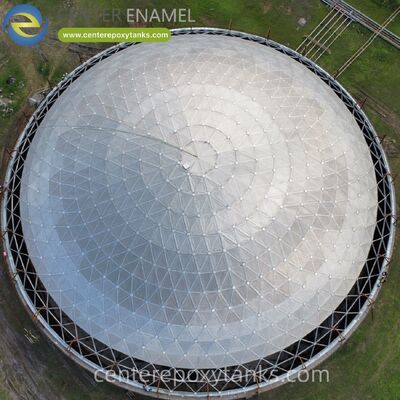
To solve these containment engineering challenges, aluminum storage tank dome roofs have become the premium global structural standard. Utilizing a self-supporting, lightweight space-frame design, these roofs completely eliminate the need for internal vertical support columns while offering exceptional structural strength and complete corrosion immunity.
1. What is an Aluminum Storage Tank Dome Roof?
A storage tank dome roof is a self-supporting spherical structure composed of a triangular network of high-strength aluminum alloy extruded struts enclosed by precisely fitted aluminum panels. The fundamental structural concept relies on the triangulation of space, a geometric configuration that divides external dead, live, and environmental loads into a multi-directional network of tension and compression vectors across the shell.
Because the geometric distribution of the space frame distributes stresses evenly across the perimeter wall of the storage tank, it remains completely self-supporting across massive spans—frequently exceeding 30 to 100 meters in diameter—without requiring any internal vertical support pillars, beams, or columns.
2. Technical Performance: Overcoming Industrial Containment Challenges
Industrial storage environments—particularly municipal wastewater, bulk chemical containment, and anaerobic digestion layouts—subject tank roof structures to severe chemical degradation and dynamic environmental stresses. Aluminum dome covers handle these aggressive forces through several key performance metrics:
Exceptional Resistance to Hydrogen Sulfide and Vapor Corrosion
In municipal wastewater treatment, industrial effluent processing, and anaerobic digestion layouts, the fluid headspace accumulates extreme concentrations of moisture and corrosive gases, specifically hydrogen sulfide . In traditional carbon steel tank roofs, these gases condense on damp surfaces to form biogenic sulfuric acid ($text{H}_2text{SO}_4$), triggering rapid oxidation, pitting, and structural failure.
Storage tank dome roofs utilize structural alloys such as 6061-T6 or 6082-T6, paired with 3003-H14 or 5052-H32 sheet aluminum cladding. These alloys naturally form a dense, protective surface oxide film upon atmospheric contact. If physically scratched, this layer instantly self-passivates, remaining completely inert to biogenic acids and eliminating the need for periodic sandblasting or protective field painting.
Self-Supporting Column-Free Space Geometry
By eliminating internal support columns, geodesic dome roofs optimize the open internal volume of the storage tank. In environmental infrastructure, this allows for the seamless integration of internal agitators, mixers, and sub-surface aeration systems. In petroleum storage or clean water systems, the absence of column structures eliminates internal fluid friction, prevents microbial harborage zones, and allows for the unrestricted operation of internal floating roofs (IFRs).
Lightweight Profile and Low Structural Dead Load
Aluminum features an exceptional strength-to-weight ratio. An aluminum dome roof weighs approximately one-third to one-fifth of a comparable carbon steel cone roof, typically averaging an extremely low dead load of only 10 to 15 $text{kg/m}^2$. This low dead load drastically reduces the vertical downward force applied to the tank shell and foundation. This feature is particularly valuable when upgrading existing open-top concrete or bolted steel tanks, allowing operators to add environmental odor covers without requiring expensive foundational reinforcement.
Absolute Vapor Containment and Odor Control
To comply with strict clean-air mandates and manage offensive emissions near commercial or residential zones, tank dome roofs utilize precise, batch-engineered sealing networks. The interlocking panel joints are sealed with continuous beads of industrial-grade silicone or UV-stabilized EPDM gaskets that remain flexible across extreme thermal cycles. This ensures a highly secure, leak-proof barrier that effectively traps volatile organic compounds (VOCs) and offensive odors.
3. Structural Comparison: Aluminum Tank Domes vs. Carbon Steel Cone Roofs
| Engineering Parameter | Aluminum Storage Tank Dome Roof | Traditional Carbon Steel Cone Roof |
| Structural Profile | Self-Supporting Space Frame | Column-Supported or Truss-Supported |
| Internal Support Pillars Required | Zero (100% open internal volume) | High (Multiple columns restrict layout) |
| Corrosion Resistance ($text{H}_2text{S}$ / VOCs) | Exceptional (Self-Passivating Oxide Film) | Poor (Prone to rapid biogenic acid attack) |
| Structural Dead Weight | Extremely Low ($sim 10text{–}15 text{ kg/m}^2$) | High ($sim 40text{–}60 text{ kg/m}^2$) |
| Construction Footprint | Built at ground level; raised via crane | Requires extensive high-altitude scaffolding |
| Total Cost of Ownership (TCO) | Lowest (Capital protected over 30+ years) | High (Escalating lifecycle maintenance costs) |
4. Strategic Integration Across Industrial Tank Networks
The modular, lightweight, and non-corrosive design of aluminum dome roofs allows them to easily interface with multiple tank engineering configurations:
● Glass-Fused-to-Steel (GFS) & FBE Bolted Tanks: Dome covers serve as the premier choice for factory-coated bolted steel containment tanks. The top perimeter angle of the tank shell directly integrates with a specialized aluminum tension ring, creating a highly efficient structural connection.
● Reinforced Concrete Basins: Perfect for retrofitting open-top municipal clarifier structures or aeration basins for emission capture, connecting directly to the top concrete rim using heavy-duty chemical anchors.
● Welded API 650 Petroleum Tanks: Extensively deployed in the oil and petrochemical sector to cover external floating roof tanks, preventing rainwater accumulation, lowering product evaporation losses, and mitigating wind-load effects.
5. Engineering Design Codes and Compliance Frameworks
To clear rigorous civil engineering checks, satisfy industrial safety mandates, and pass international infrastructure bidding screens, premium storage tank dome roofs—such as those manufactured by global industry leaders like Center Enamel (Shijiazhuang Zhengzhong Technology Co., Ltd)—are engineered in strict compliance with international structural codes:
1. AWWA D103-19 (Section 13): The premier global standard for factory-coated bolted carbon steel liquid storage systems, dictating strict engineering limits for aluminum dome roof integrations onto modular bolted tanks.
2. API 650 Appendix G: The definitive American Petroleum Institute standard governing the structural design, fabrication, and erection of structurally supported aluminum dome roofs for oil, petroleum, and chemical storage.
3. The Aluminum Design Manual (ADM): Providing the baseline structural calculation safety factors for aluminum alloys under sustained tension, compression, and buckling stresses.
4. ASCE 7-22 / Eurocode 9: Structural design parameters ensuring that the space frame calculates accurately for live loads, heavy snow accumulations, and extreme wind-tunnel pressures up to 250 km/h—ensuring structural integrity during severe weather events.
Maximizing Asset Longevity and Reducing Lifecycle CAPEX
For environmental consultants, municipal utility directors, and clean-tech EPC contractors focused on maximizing Return on Investment (ROI), an aluminum storage tank dome roof represents a secure, durable, and cost-effective containment asset for 2026. By utilizing a modular, ground-level assembly method, these roofs are quickly bolted together using specialized compression hubs and raised into place with a single crane lift. This eliminates the safety risks of high-altitude scaffolding and certified field welding, reducing installation timelines by up to 60%. By completely eliminating the corrosion, structural cracking, and high maintenance costs of steel and concrete covers, aluminum storage tank dome roofs ensure low-maintenance, airtight protection for an operational lifespan exceeding 50 years.
Are you currently designing an environmental wastewater facility, upgrading a petrochemical terminal, or planning a municipal water storage asset, and would you like a detailed technical proposal including geometric dome sizing, structural weight calculations, and custom engineering drawings for your specific tank diameter?