-
Glass Fused To Steel Tanks (596)
-
Stainless Steel Tanks (434)
-
Fusion Bonded Epoxy Tanks (592)
-
Galvanized Steel Tanks (321)
-
Aluminum Dome Roofs (1336)
-
Wastewater Storage Tanks (232)
-
Welded Steel Tanks (457)
-
Pressure Vessels (295)
-
Anaerobic Digester (202)
-
Industrial Water Tanks (349)
-
Glass Lined Steel Tanks (180)
-
Bolted Steel Tanks (389)
-
Sludge Storage Tank (115)
-
Biogas Storage Tank (173)
-
Leachate Storage Tanks (133)
-
Agricultural Water Storage Tanks (179)
-
Fire Water Tank (166)
-
Grain Storage Silos (146)
-
Biogas Projects (424)
-
Wastewater Treatment Projects (1078)
-
Double Membrane Roof (223)

|
Geodesic Dome Roof vs. Geodesic Dome Cone Roof: A Comparative Analysis
| Place of Origin: | China |
| Brand Name: | Center Enamel |
| Certification: | ISO 9001 |
| Model Number: | Aluminum Dome Roofs |
| Minimum Order Quantity: | 1 |
| Price: | 100-50000 |
| Packaging Details: | 2000 |
| Delivery Time: | 8 weeks |
| Payment Terms: | L/C,T/T |
| Supply Ability: | 6000 |
|
Detail Information |
|||
| Place of Origin | China | Brand Name | Center Enamel |
|---|---|---|---|
| Certification | ISO 9001 | Model Number | Aluminum Dome Roofs |
| Material: | Aluminum | Structure: | Self-supporting Structure |
| Corrosion Resistant: | High Corrosion Resistant | Maintenance: | Virtually Maintenance Free |
| Installation: | Quick Field Installation | Design: | Clear Span Design |
| Highlight: | Anti Corrosion Coating Geodesic Dome Roo,Aluminium Dome Roof Self Supporting |
||
Product Description
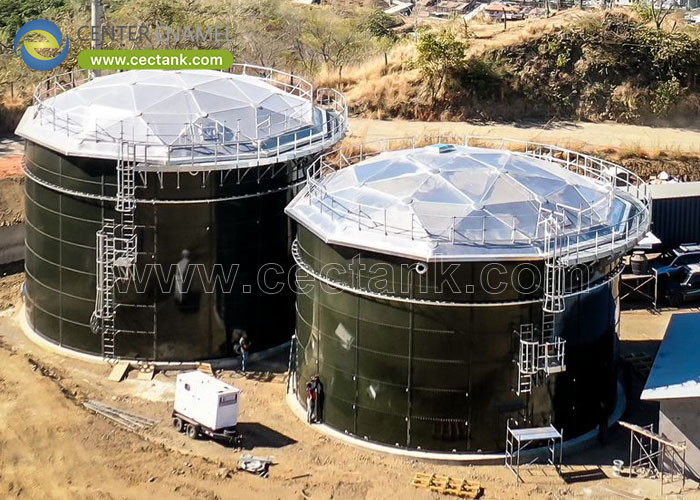
When designing industrial liquid containment systems—such as bolted steel water tanks, wastewater anaerobic digesters, or petroleum storage reservoirs—choosing the right overhead cover is just as critical as selecting the shell material. The geodesic dome roof and the cone roof represent two of the most widely deployed structural configurations in modern tank engineering. While both protect internal contents from environmental contamination and vapor loss, they utilize fundamentally different geometric principles, material compositions, and load-bearing mechanisms. Understanding their distinct engineering performance metrics is essential for optimizing capital expenditure and structural longevity.
An industrial geodesic dome roof (typically constructed from high-strength aluminum alloy triangles assembled in a self-supporting triodetic framework) relies on spatial geometry to distribute structural loads evenly across the entire perimeter ring beam of the tank.
-
No Internal Columns Required: The dome's geometry is inherently self-supporting, eliminating the need for center support columns regardless of tank diameter.
-
Superior Aerodynamics: The curved, spherical profile offers exceptional wind-shedding characteristics, reducing drag and structural uplift forces in high-wind coastal or open-field environments.
A cone roof features a conical, sloped geometry radiating upward from the tank perimeter to a central apex. Cone roofs can be constructed from carbon steel, stainless steel, or coated panels matching the tank shell.
-
Supported or Self-Supporting Options: For smaller diameters, cone roofs can be self-supporting from the shell rim. For larger industrial diameters, they frequently require internal center support columns, rafters, and purlins.
-
Traditional Fabrication: Cone roofs are straightforward to fabricate alongside welded or bolted steel tank structures, making them a familiar option for traditional plant layouts.
| Performance Metric | Aluminum Geodesic Dome Roof | Industrial Cone Roof (Steel) |
|---|---|---|
| Maximum Clear Span | Unlimited (Self-supporting across massive diameters) | Limited (Requires internal columns for large spans) |
| Corrosion Resistance | Superior (Non-corrosive structural aluminum alloy) | Moderate (Requires protective coatings; vulnerable in vapor spaces) |
| Weight & Foundation Load | Lightweight (Minimizes dead load on tank shell and foundation) | Heavier (Especially steel-framed cone roofs with internal columns) |
| Wind & Snow Shedding | Superior (Aerodynamic dome shape sheds snow and resists uplift) | Moderate (Flat conical slopes can accumulate heavy wet snow) |
| Maintenance Requirements | Very Low (No painting or periodic recoating required) | Moderate to High (Requires periodic inspection and repainting) |
| Installation Speed | Fast (Prefabricated modular nodes assembled on-site) | Moderate (Involves field welding or complex rafter framing) |
-
Large-Diameter Tanks: For tanks exceeding 20 meters in diameter, geodesic domes eliminate costly internal support columns that can obstruct mixing equipment or internal linings.
-
Aggressive Vapor Environments: In wastewater treatment or chemical storage where corrosive gases accumulate in the headspace, aluminum geodesic domes offer permanent corrosion resistance without degrading.
-
Seismic and High-Wind Zones: The lightweight nature of aluminum domes reduces seismic overturning moments, while the aerodynamic shape mitigates wind-induced structural fatigue.
-
Smaller Diameter Tanks: For compact storage footprints, standard cone roofs provide a straightforward, cost-effective containment cover.
-
Matched Material Requirements: If project specifications strictly mandate identical exterior and interior shell/roof metallurgy (e.g., carbon-steel-on-carbon-steel), a cone roof aligns seamlessly with traditional fabrication standards.
-
Fixed Equipment Mounting: When heavy instrumentation or centralized exhaust scrubbers must be directly mounted to structural apex framing, reinforced cone roof structures provide rigid mounting points.
A: A geodesic dome roof uses a multi-faceted triangular spatial grid that distributes loads uniformly across the tank shell without internal columns. A cone roof relies on a conical slope rising to a central apex, often requiring internal support columns and rafters for larger diameters.
A: Aluminum offers an ideal combination of high strength-to-weight ratio, exceptional corrosion resistance in harsh industrial vapor spaces, and zero requirement for protective painting or maintenance over its service lifespan.
A: Yes. The curved, aerodynamic surface of a geodesic dome naturally facilitates the sliding off of snow and ice. Cone roofs, depending on their pitch, can sometimes trap or accumulate heavy snow loads, requiring heavier structural framing.
A: Yes. Aluminum geodesic dome roofs are frequently integrated with bolted steel tanks (including Glass-Fused-to-Steel and fusion-bonded epoxy tanks) to provide a lightweight, corrosion-proof, and aesthetically superior top cover.
At Center Enamel, we combine advanced manufacturing capabilities with versatile engineering design options to equip every industrial storage tank with the optimal roof configuration tailored to your site requirements.
Are you planning a liquid storage or environmental containment project? Contact our engineering team today for a technical consultation, structural load analysis, and a customized proposal.