-
Glass Fused To Steel Tanks (596)
-
Stainless Steel Tanks (434)
-
Fusion Bonded Epoxy Tanks (592)
-
Galvanized Steel Tanks (321)
-
Aluminum Dome Roofs (1336)
-
Wastewater Storage Tanks (232)
-
Welded Steel Tanks (457)
-
Pressure Vessels (295)
-
Anaerobic Digester (201)
-
Industrial Water Tanks (349)
-
Glass Lined Steel Tanks (180)
-
Bolted Steel Tanks (389)
-
Sludge Storage Tank (115)
-
Biogas Storage Tank (173)
-
Leachate Storage Tanks (133)
-
Agricultural Water Storage Tanks (179)
-
Fire Water Tank (166)
-
Grain Storage Silos (146)
-
Biogas Projects (425)
-
Wastewater Treatment Projects (1028)
-
Double Membrane Roof (223)
|
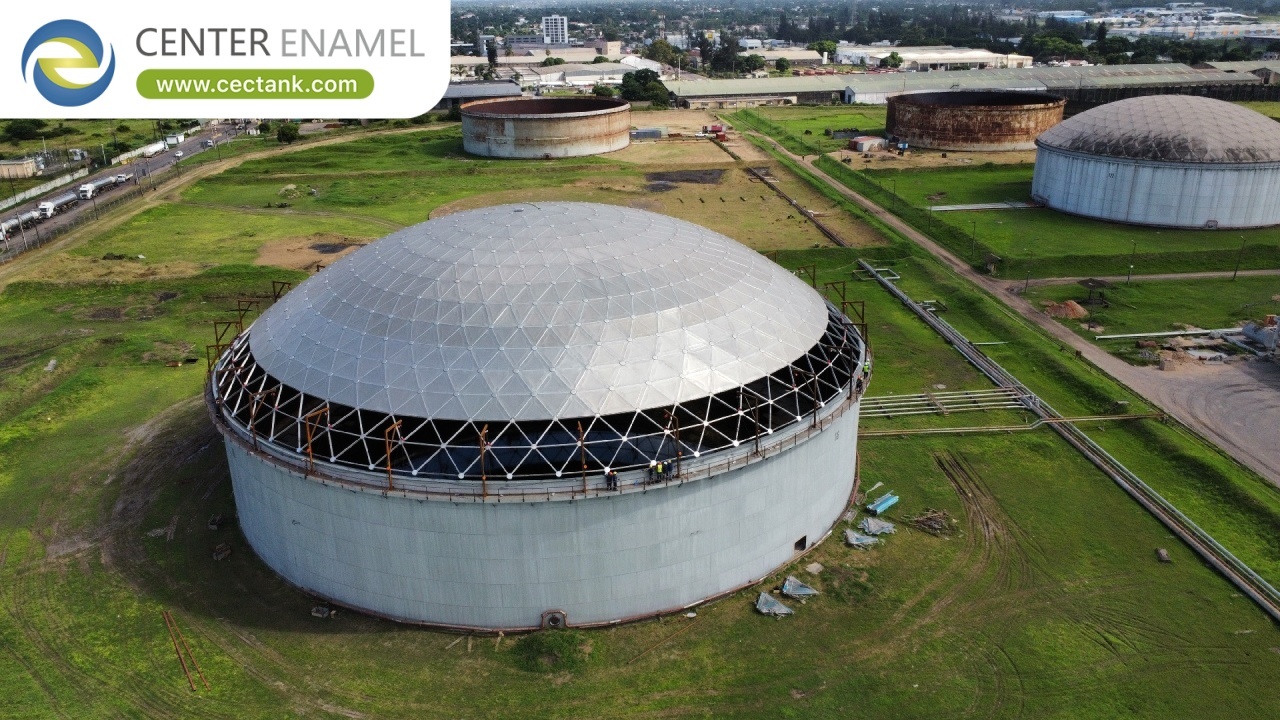
Floating Roof for Hydraulic Oil Tanks: Maintains fluid purity and stability
| Place of Origin: | China |
| Brand Name: | Center Enamel |
| Certification: | ISO 9001 |
| Model Number: | Aluminum Dome Roofs |
| Minimum Order Quantity: | 1 |
| Price: | 100-50000 |
| Packaging Details: | 2000 |
| Delivery Time: | 8 weeks |
| Payment Terms: | L/C,T/T |
| Supply Ability: | 6000 |
|
Detail Information |
|||
Product Description
Hydraulic oils possess exceptionally low vapor pressure, making evaporative loss a minimal financial concern. However, in large bulk storage applications, an Internal Floating Roof (IFR) is deployed to safeguard fluid purity. It acts as an absolute physical shield against atmospheric oxygen, moisture absorption, and microscopic particulate entry—the primary drivers of downstream component failures.
When stored in conventional unsealed fixed-roof tanks, bulk industrial hydraulic fluid faces three catastrophic degradation vectors:
- Oxidation: Constant contact between atmospheric oxygen and the stagnant surface layer of the oil initiates a molecular breakdown, yielding acidic sludge, insoluble varnish, and polymer chains that block precision servos.
- Hydrolysis: Industrial hydraulic oils are inherently hygroscopic. As ambient temperatures fluctuate, the tank "breathes" in humid air, causing moisture to condense on the interior tank shell and mix into the fluid, rapidly depleting anti-wear additives.
- Particulate Ingress: Microscopic airborne dust, sand, and silica bypass standard coarse tank vents, settling directly into the oil matrix and causing abrasive wear on tight-tolerance mechanical clearances.
An Internal Floating Roof (IFR) works by floating directly on the liquid surface inside a fixed external structure (such as a bolted steel or aluminum dome tank). The floating panel eliminates the open airspace above the fluid, ensuring that even during high-volume filling or draining cycles, no ambient air comes into contact with the bulk oil volume.
To maintain proper flotation and prevent tilting or sinking under mechanical drag forces during operation, the IFR's displacement volume must safely exceed its overall assembly mass. The physics governing this balance are expressed through the fundamental buoyancy equilibrium formula:
The structural parameters and engineering tolerances required for an IFR handling industrial hydraulic lubricants differ radically from typical volatile petroleum installations:
| Technical Variable | Standard Hydrocarbon IFR (Gasoline, Crude) | Hydraulic Lubricant IFR (Industrial Oils) |
|---|---|---|
| Primary Engineering Focus | Vapor retention and VOC emission control | Moisture isolation and particulate exclusion |
| Structural Design | Open pontoon or lightweight skin-and-stringer | Full-contact sandwich panel or heavy welded plate |
| Seal Elastomer Choice | Neoprene, Polyurethane, or EPDM | Viton (FKM) or High-Acrylonitrile Nitrile (NBR) |
| Rim Seal Placement | Vapor-mounted shoe seals | Liquid-mounted continuous wiper seals |
| Target Metric | EPA Method 21 ppm thresholds | ISO 4406 particulate cleanliness counts |
| Internal Surface Finish | Standard raw steel or basic lining | Pristine epoxy coating or Glass-Fused-to-Steel (GFS) |
Direct Answer: The primary point of engineering vulnerability in a hydraulic oil floating roof is the perimeter rim seal. Because the seal remains in permanent, direct contact with the hydraulic oil, the elastomer compound must be perfectly compatible with the specific additive packages (including zinc dialkyldithiophosphate or anti-foaming polymers) to prevent material failure.
Selecting an incorrect polymer can cause chemical swelling, structural softening, or dry cracking, which destroys the tank seal integrity and releases microscopic rubber fragments directly into the fluid supply.
- Fluorocarbon (Viton / FKM): The premium option for synthetic hydraulic oils, bio-based fluids, and phosphate ester configurations. It experiences less than 3% volume change over decades of continuous immersion and maintains an optimal mechanical wiping pressure against the tank shell.
- High-Acrylonitrile Nitrile (NBR / Buna-N): Recommended for conventional mineral-based hydraulic oils. The formulation must maintain an acrylonitrile content greater than 36% to resist the swelling tendencies inherent to light industrial base oils.
- PTFE Vapor Wraps: Often utilized as a thin, highly durable shield wrapping around primary resilient foam cores, creating a slick, chemically impervious barrier that minimizes friction along the internal tank walls.
Industrial installations utilizing floating roofs for heavy lubricant or hydraulic oil containment must strictly comply with the following structural and testing codes:
- API Standard 650 Appendix H: Regulates the design, manufacturing, and buoyancy safety margins of internal floating roofs within atmospheric storage environments.
- AWWA D103-09: Governs the deployment of modular, factory-coated bolted steel storage structures, which provide the smooth internal shell profiles necessary for fluid-tight wiper seal travel.
- ISO 4406 Cleanliness Standard: Used to verify tank performance. A properly sealed internal floating roof, coupled with an absolute desiccant breathing system on the fixed outer roof, should reliably maintain bulk oil purity at or above an ISO 16/14/11 cleanliness rating.
High fluid viscosity increases the fluid shear drag exerted against the peripheral rim seals during filling and emptying cycles. To offset this resistance, the structural design must include extra-rigid guide poles and anti-rotation cables to ensure the floating deck travels vertically without binding, tilting, or cross-wedging against the tank walls.
Yes. Combining an IFR with a low-pressure nitrogen ($N_2$) blanketing system represents the highest standard of fluid preservation. The floating roof eliminates over 98% of the liquid-gas interface area, which significantly reduces the amount of nitrogen gas needed to protect the tank's remaining headspace from oxygen.
Unlike light fuels, hydraulic oil leaves a persistent, heavy lubricating film on the inner tank wall as the roof drops. This film attracts fine particulates if any manage to enter the upper vapor space. Regular visual inspections are required to ensure the primary wiper seals are clean and that accumulated sediment on the tank walls is not breaking down the edges of the seals.
Because the floating deck is protected by a fixed external roof (an Internal Floating Roof setup), rainwater does not collect directly on the deck surface like it would on an external floating roof. Consequently, complex internal flexible drain pipes—which run the risk of leaking or clogging—are not required. This design choice greatly reduces the ongoing maintenance needs of the system.
Any breach in the deck panels or failure of the rim seal that allows hydraulic oil to pool on top of the floating roof reduces its overall buoyancy margin. If left uncorrected, the weight of the accumulated oil can cause the roof to tilt or sink. Tanks should be equipped with automatic level indicators or visual inspection ports to catch fluid pooling early.