-
Glass Fused To Steel Tanks (896)
-
Stainless Steel Tanks (434)
-
Fusion Bonded Epoxy Tanks (660)
-
Galvanized Steel Tanks (321)
-
Aluminum Dome Roofs (1356)
-
Wastewater Storage Tanks (280)
-
Welded Steel Tanks (457)
-
Pressure Vessels (544)
-
Anaerobic Digester (217)
-
Industrial Water Tanks (424)
-
Glass Lined Steel Tanks (180)
-
Bolted Steel Tanks (389)
-
Sludge Storage Tank (115)
-
Biogas Storage Tank (173)
-
Leachate Storage Tanks (133)
-
Agricultural Water Storage Tanks (179)
-
Fire Water Tank (166)
-
Grain Storage Silos (146)
-
Biogas Projects (424)
-
Wastewater Treatment Projects (1912)
-
Double Membrane Roof (223)


|
Why Are Tailored EPC Solutions Key to Kitchen Waste Treatment in Morocco?
| Place of Origin: | China |
| Brand Name: | CEC TANKS |
| Certification: | ISO 9001:2008, AWWA D103 , OSHA , BSCI |
| Model Number: | W |
| Minimum Order Quantity: | 1set |
| Price: | $5000~$20000 one set |
| Packaging Details: | PE poly-foam between each two steel plates ; wooden pallet and wooden |
| Delivery Time: | 10-30 days after deposit received |
| Payment Terms: | L/C,T/T |
| Supply Ability: | 60 sets per month |
|
Detail Information |
|||
| Place of Origin | China | Brand Name | CEC TANKS |
|---|---|---|---|
| Certification | ISO 9001:2008, AWWA D103 , OSHA , BSCI | Model Number | W |
| Tank Body Color: | Dark Green / Can Be Customized | Corrosion Integrity: | Excellent |
| Steel Plates Thickness: | 3mm To 12mm , Depends On The Tank Structure | Chemical Resistance: | Excellent |
| Size Of Panel: | 2.4M * 1.2M | Easy To Clean: | Smooth, Glossy, Inert, Anti-adhesion |
| Highlight: | tailored EPC solutions wastewater,kitchen waste treatment Morocco,wastewater treatment projects EPC |
||
Product Description
This article investigates the pivotal role of tailored EPC Solutions in advancing Kitchen Waste Treatment in Morocco. With rapid urbanization and strict environmental regulations, Morocco requires highly efficient waste management systems. We will detail the operational flow of modern treatment plants, the advantages of CSTR technology, and the critical function of GFS Tanks in biogas storage. Furthermore, we will outline how Center Enamel's diversified tank solutions and auxiliary equipment provide a complete, sustainable one-stop solution for converting food waste into green energy.
Addressing the Kitchen Waste Treatment Challenge in Morocco
Morocco is experiencing rapid urbanization and economic growth, which has led to a significant increase in municipal solid waste, with kitchen waste constituting a major portion. The country faces considerable challenges in managing this highly moist and rapidly decomposing organic waste, as traditional disposal methods often lead to severe environmental pollution, odor issues, and greenhouse gas emissions. The primary difficulties stem from the need for high-volume processing capacity in urban areas and the stringent environmental standards for emissions and byproduct management. To address these challenges, Morocco is heavily investing in advanced Kitchen Waste Treatment facilities that prioritize anaerobic digestion. This approach not only effectively neutralizes the waste but also aligns with the nation's broader goals of sustainable development and increasing renewable energy production.
Step-by-Step: The Modern Kitchen Waste Treatment Flow
The transformation of kitchen waste into valuable resources follows a meticulously designed process flow. Initially, the collected waste enters a pre-treatment system where sand and impurities are removed. The resulting kitchen slurry is then transported via pipes and pumps to a hydrolysis and homogenization tank. In this tank, organic waste is broken down into organic acid, and the material's temperature and pH are meticulously balanced through continuous stirring. The prepared slurry is subsequently pumped into the anaerobic fermentation tank, where it is kept at a constant 35°C for approximately 28 days. This prolonged retention ensures thorough breakdown, with continuous stirring to avoid acidification. The generated biogas is then routed to a purification and power generation system, while the remaining digestate is processed through sludge dehydration, with solids sent for incineration and liquids to wastewater treatment.
The Core of the Solution: The CSTR Process Explained
The Continuous Stirred Tank Reactor (CSTR) is the cornerstone of modern anaerobic treatment for food waste. This technology is designed to keep fermentation raw materials and microorganisms in a state of complete mixture within a sealed environment. By utilizing an internal mechanical stirring device, the CSTR reactor ensures that organic wastewater with high suspended solids is continuously and uniformly mixed. This continuous or semi-continuous feeding at a stable temperature creates the optimal conditions for anaerobic microorganisms to thrive. Consequently, the system maintains a neutral environment, preventing acidification and ensuring the effective degradation of organic matter. The CSTR process is highly regarded for its ability to handle high concentrations of organic waste while reliably producing biogas.
Decoding the Core Anaerobic Technologies
When designing a Kitchen Waste Treatment plant, the choice between single-phase and two-phase anaerobic digestion is a critical decision. While two-phase systems separate the acid-producing and methanogenic phases to improve processing efficiency and stability, they come with higher investment costs and complex maintenance requirements. In contrast, single-phase anaerobic digestion is generally recommended for most organic waste projects. It requires lower investment and is easier to control, provided the design is reasonable. By maintaining the fermentation tank at the correct parameters, the single-phase system prevents acidification and effectively manages the organic load, making it the most practical and widely adopted core technology for general food waste treatment projects globally.
The Critical Role of GFS Tanks in Biogas Storage
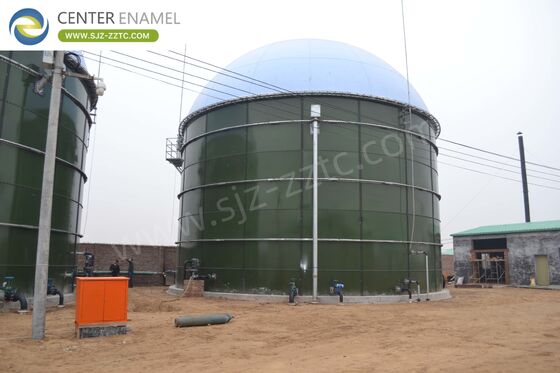
In any anaerobic digestion facility, robust and durable storage is essential. Center Enamel's Glass-Fused-to-Steel (GFS) Tanks are specifically engineered to excel in biogas projects. The manufacturing process involves firing the tank at an extreme 820°C-930°C, causing molten glass to chemically react with the steel plate. This creates a powerful, inert, and inorganic bond that combines the structural strength of steel with the superior corrosion resistance of glass. Alongside GFS tanks, Center Enamel also provides Fusion Bonded Epoxy (FBE) tanks. Utilizing advanced coating technology from AkzoNobel, FBE tanks offer a durable, wear-resistant protective layer, making them highly suitable for the demanding environments found in waste-to-energy applications.
Center Enamel’s Diversified Storage Tank Portfolio
To cater to the varied needs of global clients, Center Enamel offers a comprehensive range of storage tank solutions.
GFS Tanks: Feature a premium double coating layer structure, ensuring exceptional durability and longevity.
Galvanized Steel Tanks: Undergo a specialized galvanizing process to provide a tough, wear-resistant coating with excellent corrosion resistance.
Fusion Bonded Epoxy Tanks: Leverage innovative coating technology for harsh environments.
Stainless Steel Tanks: High-quality AISI 304/316 designed to meet the most stringent requirements, including high-purity liquids in extreme conditions.
Integrated Auxiliary Equipment for a Seamless Operation
A successful Kitchen Waste Treatment facility requires a fully integrated system of specialized machinery. Center Enamel provides all the necessary auxiliary equipment to ensure smooth operations:
Gas Holder: For the safe and reliable storage of generated biogas.
Dual-shaft Crusher & Multi-function Crushing and Sorting Machine: For efficient initial crushing and separating impurities from waste materials.
Mixed Crushing Pulping Tank: For creating a homogeneous slurry ready for anaerobic digestion.
Dehydration and Desulfurization Tank: Essential for purifying the biogas and managing byproducts.
Lifting Pump & Submersible Mixer: To guarantee continuous fluid movement and optimal mixing within the tanks.
Solid-liquid Separator: To efficiently separate the digestate into manageable solid and liquid components.
Why Center Enamel is Your Premier EPC Contractor
Choosing Center Enamel means partnering with a leader in sustainable energy innovation. With over 35 years of history and a vast 150,000m² R&D and manufacturing center, we offer unmatched expertise. We are a true one-stop solution provider, delivering complete biogas project packages from initial feasibility studies to operational optimization. Our vertically integrated approach combines advanced process engineering, precision equipment manufacturing, and field-proven installation. By utilizing our closed-loop resource recovery systems, clients can ensure environmental compliance, significantly reduce waste disposal costs, and generate sustainable revenue. We are dedicated to helping municipalities and enterprises turn complex environmental challenges into valuable renewable energy assets.
Conclusion
The future of Kitchen Waste Treatment lies in efficient, sustainable technologies that prioritize resource recovery. By integrating advanced anaerobic digestion processes with reliable infrastructure like GFS tanks, Morocco and other nations can effectively manage their food waste while generating clean energy. Center Enamel remains at the forefront of this transition, providing the comprehensive equipment and expertise needed to build successful, long-term waste-to-energy projects through customized EPC Solutions.
FAQ
Q1: How does the CSTR process handle the high moisture content of kitchen waste?
A1: The CSTR process is highly effective for high-moisture waste because the continuous mechanical stirring ensures the slurry remains completely mixed, allowing microorganisms to evenly access the organic matter and efficiently convert it into biogas.
Q2: What makes GFS tanks suitable for the biogas environment?
A2: GFS tanks are highly resistant to corrosion due to their inert glass coating. This prevents degradation from the corrosive hydrogen sulfide and organic acids naturally present in biogas production environments.
Q3: What happens to the solid waste after anaerobic digestion?
A3: After digestion, the digestate undergoes sludge dehydration. The separated fibrous solid material is typically sent for incineration for final disposal, while the liquid portion is directed to a wastewater treatment system.