-
Glass Fused To Steel Tanks (896)
-
Stainless Steel Tanks (434)
-
Fusion Bonded Epoxy Tanks (660)
-
Galvanized Steel Tanks (321)
-
Aluminum Dome Roofs (1356)
-
Wastewater Storage Tanks (280)
-
Welded Steel Tanks (457)
-
Pressure Vessels (544)
-
Anaerobic Digester (217)
-
Industrial Water Tanks (424)
-
Glass Lined Steel Tanks (180)
-
Bolted Steel Tanks (389)
-
Sludge Storage Tank (115)
-
Biogas Storage Tank (173)
-
Leachate Storage Tanks (133)
-
Agricultural Water Storage Tanks (179)
-
Fire Water Tank (166)
-
Grain Storage Silos (146)
-
Biogas Projects (424)
-
Wastewater Treatment Projects (1912)
-
Double Membrane Roof (223)


|
How Can a Reliable Biogas Solution Provider Transform Kitchen Waste Treatment in Malaysia?
| Place of Origin: | China |
| Brand Name: | CEC TANKS |
| Certification: | ISO 9001:2008, AWWA D103 , OSHA , BSCI |
| Model Number: | W |
| Minimum Order Quantity: | 1set |
| Price: | $5000~$20000 one set |
| Packaging Details: | PE poly-foam between each two steel plates ; wooden pallet and wooden |
| Delivery Time: | 10-30 days after deposit received |
| Payment Terms: | L/C,T/T |
| Supply Ability: | 60 sets per month |
|
Detail Information |
|||
| Place of Origin | China | Brand Name | CEC TANKS |
|---|---|---|---|
| Certification | ISO 9001:2008, AWWA D103 , OSHA , BSCI | Model Number | W |
| Tank Body Color: | Dark Green / Can Be Customized | Corrosion Integrity: | Excellent |
| Steel Plates Thickness: | 3mm To 12mm , Depends On The Tank Structure | Chemical Resistance: | Excellent |
| Size Of Panel: | 2.4M * 1.2M | Easy To Clean: | Smooth, Glossy, Inert, Anti-adhesion |
| Highlight: | biogas solution kitchen waste Malaysia,reliable biogas provider wastewater treatment,kitchen waste treatment biogas system |
||
Product Description
This article examines the evolving landscape of Kitchen Waste Treatment in Malaysia and the critical role of a dependable Biogas Solution Provider. We will explore the specific challenges Malaysia faces with food waste, detail the step-by-step treatment process, and highlight the advanced CSTR technology. Furthermore, we will discuss how Center Enamel's premium GFS Tanks and comprehensive equipment range provide a complete, sustainable one-stop solution for turning environmental challenges into renewable energy assets.
Malaysia faces a significant environmental challenge due to the high volume of organic waste generated daily, particularly from its vibrant food culture. The production of kitchen waste is substantial, and traditional disposal methods like landfilling are becoming unsustainable due to limited land space and the emission of harmful greenhouse gases. The primary difficulties in managing this waste stem from its high moisture content and rapid decomposition, which complicates collection and processing. To address these issues, Malaysia is increasingly focusing on advanced Kitchen Waste Treatment methods that prioritize resource recovery and volume reduction, aiming to transition towards a circular economy and reduce the environmental burden on local communities.
The transformation of kitchen waste into valuable resources involves a meticulously designed treatment flow. The process begins with a pre-treatment system where the kitchen slurry undergoes sand removal. It is then transported via pipes and pumps to a hydrolysis and homogenization tank. In this environment, organic waste is converted into organic acid, and the temperature and pH values of the material are carefully balanced through continuous stirring. Following this preparation, the slurry is pumped into the anaerobic fermentation tank, where it stays at a constant 35°C for 28 days. The fermentation tank is continuously stirred to maintain a neutral environment and avoid acidification. The produced biogas enters a purification and power generation system, while the digestate undergoes sludge dehydration, with fibrous solids sent for incineration and sewage directed to a treatment system.
The anaerobic digestion of food waste generally adopts the Continuous Stirred Tank Reactor (CSTR) process, a highly effective anaerobic treatment technology. The CSTR process is designed to keep fermentation raw materials and microorganisms in a completely mixed state. This is achieved in a closed tank equipped with a mechanical stirring device. By feeding continuously or semi-continuously at a constant temperature, the organic wastewater with high suspended solids and high concentration is kept in a relatively complete mixed fermentation state. This allows anaerobic microorganisms to effectively degrade the organic matter. The continuous mixing ensures the fermentation tank maintains a neutral environment, preventing acidification and maximizing the efficiency of biogas production.
When designing a Kitchen Waste Treatment facility, selecting the right core technology is paramount. While two-phase anaerobic digestion offers advantages like system stability and improved processing efficiency by separating biological phases, it requires a higher investment and more complex operation and maintenance. In actual market operations, especially for most organic waste, a single-phase anaerobic digestion system is widely adopted if the design is reasonable and operation is appropriate. It offers low investment and is easy to control. Therefore, the main process for general food waste treatment projects typically involves pre-treatment combined with single-phase wet medium-temperature anaerobic digestion, followed by biomass gas energy utilization.
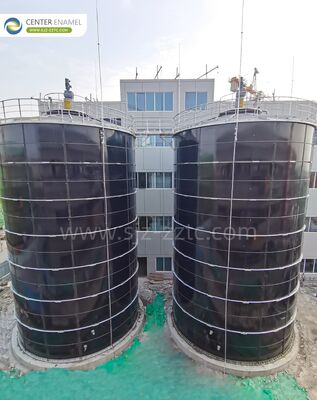
For any biogas project, the integrity of the storage infrastructure is crucial. Center Enamel provides two primary products essential for these applications: Glass-Fused-to-Steel (GFS) Tanks and Fusion Bonded Epoxy (FBE) Tanks. GFS tanks are manufactured by firing at 820°C-930°C, allowing molten glass to react with the steel plate surface to form an inert, inorganic bond. This combines the strength and flexibility of steel with the outstanding corrosion resistance of glass. Alternatively, FBE tanks utilize innovative coating technology, developed in partnership with AkzoNobel, to provide a tough, wear-resistant protective coating that offers superior corrosion resistance for harsh environments.
Center Enamel offers a versatile range of storage tank solutions to meet varying project requirements.
Glass-Fused-to-Steel (GFS) Tanks: Renowned for their premium coating technology and double coating layer structure, ensuring long-term durability.
Galvanized Steel Tanks: Receive a tough, wear-resistant coating through a galvanizing process for excellent corrosion resistance.
Fusion Bonded Epoxy (FBE) Tanks: Provide innovative coating technology for demanding environments.
Stainless Steel Tanks: High-quality AISI 304/316 designed to meet the most stringent requirements, including harsh conditions.
A successful Kitchen Waste Treatment facility relies on a suite of specialized equipment working in harmony. Center Enamel provides all necessary components for a complete system:
Gas Holder: Essential for safely storing the biogas produced during anaerobic digestion.
Dual-shaft Crusher & Multi-function Crushing and Sorting Machine: Used for effective size reduction and sorting of incoming organic waste.
Mixed Crushing Pulping Tank: Prepares the waste into a uniform slurry for optimal fermentation.
Dehydration and Desulfurization Tank: Crucial for removing water and harmful sulfur compounds from the biogas.
Lifting Pump & Submersible Mixer: Ensure continuous and efficient movement and mixing of the slurry throughout the process.
Solid-liquid Separator: Separates the digestate into solid and liquid fractions for further processing or disposal.
Center Enamel stands out as a premier one-stop solution provider for complete biogas projects, backed by over 35 years of history and a massive 150,000m² R&D and manufacturing center. Our vertically integrated expertise combines advanced process engineering, precision equipment manufacturing, and field-proven installation practices. We offer end-to-end services, from initial feasibility studies to operational optimization. By partnering with us, clients benefit from our ability to address complex environmental challenges, ensure environmental compliance, reduce waste disposal costs, and generate sustainable revenue through closed-loop resource recovery systems. Our commitment to sustainable energy innovation makes us the ideal partner for your waste-to-energy journey.
Effectively managing kitchen waste is a critical step towards a sustainable future. By leveraging advanced anaerobic technologies like the CSTR process and utilizing robust infrastructure such as GFS tanks, Malaysia can transform environmental challenges into valuable renewable energy assets. Center Enamel's comprehensive suite of equipment and turnkey solutions empowers municipalities and enterprises to achieve their environmental goals efficiently and reliably.
Q1: What is the primary benefit of anaerobic digestion for kitchen waste?
A1: It significantly reduces the volume of waste while simultaneously producing biogas, a renewable energy source that can be used for power generation, thus turning a disposal problem into a resource.
Q2: Why is temperature control important in the CSTR process?
A2: Maintaining a constant temperature (like 35°C) ensures the anaerobic microorganisms remain highly active, optimizing the degradation of organic matter and maximizing biogas production efficiency.
Q3: How does a GFS tank prevent corrosion in biogas projects?
A3: The glass coating fused to the steel creates an inert, inorganic barrier that is highly resistant to the corrosive acids and gases typically found in anaerobic digestion environments, ensuring long-term structural integrity.