-
Glass Fused To Steel Tanks (896)
-
Stainless Steel Tanks (434)
-
Fusion Bonded Epoxy Tanks (660)
-
Galvanized Steel Tanks (321)
-
Aluminum Dome Roofs (1346)
-
Wastewater Storage Tanks (280)
-
Welded Steel Tanks (457)
-
Pressure Vessels (534)
-
Anaerobic Digester (217)
-
Industrial Water Tanks (424)
-
Glass Lined Steel Tanks (180)
-
Bolted Steel Tanks (389)
-
Sludge Storage Tank (115)
-
Biogas Storage Tank (173)
-
Leachate Storage Tanks (133)
-
Agricultural Water Storage Tanks (179)
-
Fire Water Tank (166)
-
Grain Storage Silos (146)
-
Biogas Projects (424)
-
Wastewater Treatment Projects (1882)
-
Double Membrane Roof (223)
|
Aluminum Dome Roof Materials: Alloy, Finish And Compatibility
| Place of Origin: | China |
| Brand Name: | Center Enamel |
| Certification: | ISO 9001 |
| Model Number: | Aluminum Dome Roofs |
| Minimum Order Quantity: | 1 |
| Price: | 100-50000 |
| Packaging Details: | 2000 |
| Delivery Time: | 8 weeks |
| Payment Terms: | L/C,T/T |
| Supply Ability: | 6000 |
|
Detail Information |
|||
Product Description
An aluminum dome roof's material specification covers the alloy of panels and trusses, the surface finish, the fasteners and the isolation from dissimilar metals at the tank interface. Center Enamel manufactures aluminum geodesic domes, including a 72 m dome exported in 2023. This article explains the material decisions that affect corrosion behavior and service life, without claiming unverified performance figures.
A useful specification names the aluminum alloy basis for panels and trusses, the temper and the applicable product standards, the finish or mill condition, and the fastener material. It then addresses the interface: where aluminum meets a steel tank ring or stainless hardware, insulation or washers must prevent galvanic attack. It also states how surfaces are protected during transport so panels arrive unstained and undented. 'Aluminum dome roof' alone is not a material specification; a buyer should be able to identify what is actually supplied.
- Name the alloy basis and temper for panels and trusses.
- State the finish and fastener material.
- Isolate aluminum from dissimilar metals at the ring.
- Define transport surface protection.
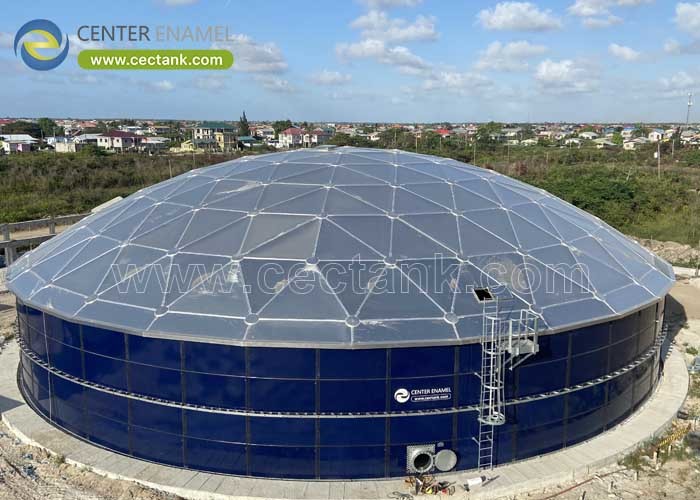
An aluminum dome roof is a self-supporting geodesic shell of triangular aluminum panels joined to a triangulated truss grid, so loads travel through membrane action to the tank ring rather than through internal columns. The clear-span geometry is what lets a dome cover a large tank with an unobstructed interior. Panels and trusses are prefabricated in segments and bolted on site on the tank shell, which keeps the roof light relative to a steel cone and avoids a heavy foundation for the cover. The consequence for a buyer is that span, panel thickness and truss depth must be engineered together - a dome is a structure, not a lid.
- Triangular panels and trusses form a geodesic grid.
- Loads resolve to the tank ring with no internal columns.
- Prefabricated segments bolt on site over the tank shell.
- Light, corrosion-resistant aluminum needs no field coating.
A dome is specified from loads and span, not from a catalogue diameter. Snow, wind and seismic actions are set by the site and checked under ASCE 7-10 and the local building code; aluminum members are sized under the Aluminum Design Manual (ADM 2015); where the roof closes a water tank, AWWA D108 is the governing dome reference and API 650 informs the tank shell. Every figure below is confirmed against the authority having jurisdiction before issue.
Design parameter |
Typical basis / range |
Why it matters |
Panel alloy basis |
Specified by supplier |
Sets corrosion and forming behavior |
Truss alloy basis |
Specified by supplier |
Sets member strength and weldability |
Finish / mill condition |
As specified |
Affects appearance and handling |
Fasteners |
Compatible with aluminum |
Avoids galvanic couple at joints |
Ring interface |
Isolated contact |
Prevents dissimilar-metal attack |
Water contact |
AWWA D108 where relevant |
Governs dome use on water tanks |
Surface protection |
Transport-grade |
Prevents staining and dents in transit |
Inspection |
Periodic visual + seal |
Tracks real condition over life |
The figure below is a REAL Center Enamel delivery cited here as manufacturing-capability evidence relevant to the aluminum dome roof topic discussed, NOT as a claimed delivery of this exact configuration, commercial term, design or market. Center Enamel's verified project record (case_library.csv) holds one dedicated aluminum geodesic dome delivery and a number of tanks fitted with aluminum dome covers, alongside other coated and stainless tanks. This reference demonstrates the ability to engineer and erect large tanks and dome covers, not a claim about this specific scope. Where the source did not record a diameter or height, the field reads Not Provided and is never estimated.
Project |
Country |
Tank / roof type |
Volume |
Year |
Relevance |
Peru industrial wastewater tanks (1,241 m3) |
Peru |
GFS bolted tank |
5 tanks, 1,241 m3 total |
2025 |
Real industrial-water tanks (capability evidence, not this material spec) |
A dome roof is expected to serve for decades, but its reliability is not a single lifetime number - it follows from detailing, load history and inspection. The aluminum skin forms a protective oxide and needs no repainting, removing the largest maintenance item of a coated steel cone roof. The parts that deserve attention are the perimeter seal, the ring fasteners, the vents and any vapor-control connections, and the roof-to-shell joint. Snow drift at the ring, wind-driven rain and thermal movement concentrate wear at specific places, so inspection should be planned around those locations rather than applied uniformly. Material durability is a detailing outcome: the ring interface, fastener choice and drainage details decide where corrosion starts long before the alloy itself becomes the limiting factor. Erection quality sets the baseline for later performance: a grid assembled out of tolerance carries load differently from the calculated model, so the as-built record matters as much as the calculation. Keep the numbered segment list, seal specification and ring detail together, because a later modification is only as safe as the information available to the engineer who must design it.
- Inspect the perimeter seal and ring fasteners on a defined cycle.
- Keep vents and screens clear and verify fill-rate capacity.
- Isolate dissimilar metals to avoid galvanic attack at the shell.
- Retain the as-built drawing set and segment numbering for later work.
Ask each supplier to state the exact alloy basis for panels and trusses, the fastener material and the isolation method at the tank ring, then check these against the applicable aluminum design basis under ADM 2015. Where the tank stores water, confirm the AWWA D108 framework. Do not accept a generic 'corrosion-resistant' claim without the material and interface details that make it true, and avoid prescribing an alloy that the supplier cannot source consistently.
- Require exact panel and truss alloy basis.
- Require fastener and isolation details.
- Check against ADM 2015 and AWWA D108.
- Reject unsourced corrosion claims.
Aluminum panels and trusses with compatible fasteners, with isolation at the steel or stainless tank interface.
Normally no - a natural oxide layer protects it, though transport protection and interface detailing still matter.
Attack that can occur where aluminum contacts a dissimilar metal such as steel, unless the joint is isolated.
Only if you can specify it consistently; otherwise require the supplier to state and justify the alloy basis.
ADM 2015 for aluminum member design, AWWA D108 for water-storage domes.
They must be compatible with aluminum and detailed to avoid a galvanic couple at the joints.
A 72 m geodesic dome was produced and exported in 2023.
It affects appearance and handling; durability depends more on alloy, detailing and drainage.
Through supplier records, material certificates and inbound inspection of panels and fasteners.
Interface corrosion from poor isolation, not failure of the aluminum sheet itself.
No - the Peru tanks are real GFS tanks cited as capability evidence, not this material specification.
A 72 m aluminum geodesic dome was produced and exported in 2023, the largest single dome recorded in the project fact base.
AWWA D108 for water-storage domes, ADM 2015 for aluminum members, ASCE 7-10 and the local building code for loads, with API 650 informing the tank shell.
About 30 days ex-works for a typical bolted tank and dome package, with bolted erection on site in weeks.
No field coating is normally required; aluminum forms a protective oxide, though detailing must avoid galvanic contact with dissimilar metals.
Aluminum dome roof materials are defined by alloy, finish, fasteners and interface isolation. Require the exact basis and the dissimilar-metal detail instead of a generic corrosion claim.
Suggested CTA: Send your tank ring material and water-contact needs and request the dome material and isolation schedule.