-
Glass Fused To Steel Tanks (896)
-
Stainless Steel Tanks (434)
-
Fusion Bonded Epoxy Tanks (660)
-
Galvanized Steel Tanks (321)
-
Aluminum Dome Roofs (1346)
-
Wastewater Storage Tanks (280)
-
Welded Steel Tanks (457)
-
Pressure Vessels (534)
-
Anaerobic Digester (217)
-
Industrial Water Tanks (424)
-
Glass Lined Steel Tanks (180)
-
Bolted Steel Tanks (389)
-
Sludge Storage Tank (115)
-
Biogas Storage Tank (173)
-
Leachate Storage Tanks (133)
-
Agricultural Water Storage Tanks (179)
-
Fire Water Tank (166)
-
Grain Storage Silos (146)
-
Biogas Projects (424)
-
Wastewater Treatment Projects (1882)
-
Double Membrane Roof (223)
|
Aluminum Dome Roof Inspection: Regime, Findings And Records
| Place of Origin: | China |
| Brand Name: | Center Enamel |
| Certification: | ISO 9001 |
| Model Number: | Aluminum Dome Roofs |
| Minimum Order Quantity: | 1 |
| Price: | 100-50000 |
| Packaging Details: | 2000 |
| Delivery Time: | 8 weeks |
| Payment Terms: | L/C,T/T |
| Supply Ability: | 6000 |
|
Detail Information |
|||
Product Description
A dome's aluminum skin is low maintenance, but its seals, ring fasteners, vents and roof-to-shell joint are not self-checking. Center Enamel supplies aluminum geodesic domes and supports tank projects internationally, including a 72 m dome exported in 2023. This article sets out an inspection regime built around likely wear locations and the records that turn a finding into a controlled repair.
Where Wear ConcentratesInspection should not be uniform. Snow drift and ponding stress the ring area; wind-driven rain tests perimeter seals; thermal movement works fasteners and joints; and vapor or foam ports are potential leak paths if their seals age. The inside of a water tank should be checked for debris or condensate paths at the manway. Focusing on these locations gives more value than a generic visual pass over the whole dome surface, which rarely finds the defects that matter.
- Ring area: drift, ponding and fasteners.
- Perimeter seals: weather ingress.
- Ports and manway: seal and function.
- Interior: debris and condensate paths.
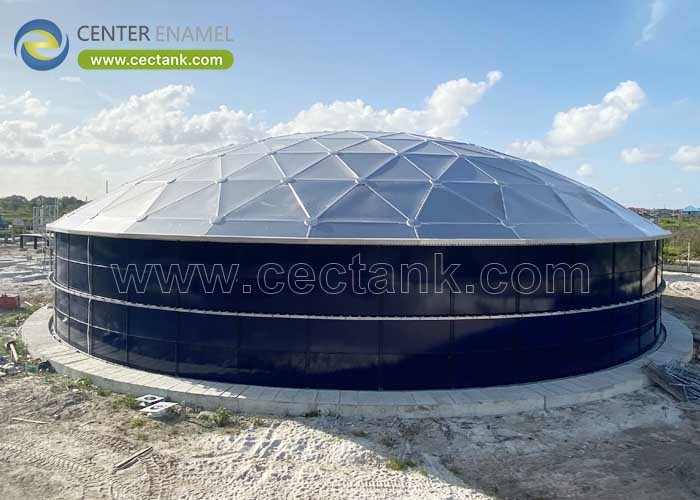
An aluminum dome roof is a self-supporting geodesic shell of triangular aluminum panels joined to a triangulated truss grid, so loads travel through membrane action to the tank ring rather than through internal columns. The clear-span geometry is what lets a dome cover a large tank with an unobstructed interior. Panels and trusses are prefabricated in segments and bolted on site on the tank shell, which keeps the roof light relative to a steel cone and avoids a heavy foundation for the cover. The consequence for a buyer is that span, panel thickness and truss depth must be engineered together - a dome is a structure, not a lid.
- Triangular panels and trusses form a geodesic grid.
- Loads resolve to the tank ring with no internal columns.
- Prefabricated segments bolt on site over the tank shell.
- Light, corrosion-resistant aluminum needs no field coating.
A dome is specified from loads and span, not from a catalogue diameter. Snow, wind and seismic actions are set by the site and checked under ASCE 7-10 and the local building code; aluminum members are sized under the Aluminum Design Manual (ADM 2015); where the roof closes a water tank, AWWA D108 is the governing dome reference and API 650 informs the tank shell. Every figure below is confirmed against the authority having jurisdiction before issue.
Design parameter |
Typical basis / range |
Why it matters |
Clear span |
Set by tank diameter |
Dome covers the full tank with no columns |
Rise / rise-to-span |
Geometry-specific |
Sets thrust and membrane action |
Snow and wind load |
Site-specific (ASCE 7-10) |
Governs panel and truss sizing |
Seismic action |
Site-specific |
Checked with the tank and foundation |
Aluminum member design |
ADM 2015 |
Basis for alloy and section sizing |
Water-tank dome |
AWWA D108 |
Governing dome reference for water storage |
Tank shell interface |
API 650 / AWWA D103 |
Ring beam and nozzle coordination |
Ventilation and access |
Project-specific |
Manway, vents and vapor control |
Corrosion / coating |
Natural oxide, no field coat |
Low maintenance over service life |
The figure below is a REAL Center Enamel delivery cited here as manufacturing-capability evidence relevant to the aluminum dome roof topic discussed, NOT as a claimed delivery of this exact configuration, commercial term, design or market. Center Enamel's verified project record (case_library.csv) holds one dedicated aluminum geodesic dome delivery and a number of tanks fitted with aluminum dome covers, alongside other coated and stainless tanks. This reference demonstrates the ability to engineer and erect large tanks and dome covers, not a claim about this specific scope. Where the source did not record a diameter or height, the field reads Not Provided and is never estimated.
Project |
Country |
Tank / roof type |
Volume |
Year |
Relevance |
Ecuador potable-water tank (892 m3) with dome cover |
Ecuador |
GFS bolted tank, aluminum dome roof |
1 tank, 892 m3 |
2022 |
Real dome-equipped tank (capability, not this inspection) |
A dome roof is expected to serve for decades, but its reliability is not a single lifetime number - it follows from detailing, load history and inspection. The aluminum skin forms a protective oxide and needs no repainting, removing the largest maintenance item of a coated steel cone roof. The parts that deserve attention are the perimeter seal, the ring fasteners, the vents and any vapor-control connections, and the roof-to-shell joint. Snow drift at the ring, wind-driven rain and thermal movement concentrate wear at specific places, so inspection should be planned around those locations rather than applied uniformly. An inspection is only as useful as its records: findings should be tied to the as-built drawing positions so the same seal or fastener can be tracked across successive cycles. Erection quality sets the baseline for later performance: a grid assembled out of tolerance carries load differently from the calculated model, so the as-built record matters as much as the calculation. Keep the numbered segment list, seal specification and ring detail together, because a later modification is only as safe as the information available to the engineer who must design it.
- Inspect the perimeter seal and ring fasteners on a defined cycle.
- Keep vents and screens clear and verify fill-rate capacity.
- Isolate dissimilar metals to avoid galvanic attack at the shell.
- Retain the as-built drawing set and segment numbering for later work.
Start with the as-built drawing set and segment numbering, then log each inspection against drawing positions. Record condition of seals and fasteners, vent and manway function, any movement or staining at the ring, and any changes made since the last visit. Compare findings over cycles rather than treating each visit in isolation. Where a defect needs a repair that alters geometry or openings, route it back to the engineer who holds the calculation - an unreviewed field change can compromise the load path.
- Log findings against as-built drawing positions.
- Track seal and fastener condition over cycles.
- Record any changes since the last inspection.
- Route geometry or opening changes back to engineering.
Yes - the skin is low maintenance, but seals, ring fasteners, vents and the roof-to-shell joint need planned checks.
Where should inspection focus?The ring area, perimeter seals, ports and manway, and the interior at the manway for debris or condensate paths.
How often?On a defined cycle set by the site and duty; the key is consistency and comparison across cycles, not a single universal interval.
What records are needed?Findings logged against as-built drawing positions, with seal and fastener condition tracked over time.
Can a field repair change the structure?Yes - any change to geometry or openings must be checked against the calculation before it is accepted.
Which reference governs the dome?AWWA D108 for water-storage domes, with the original design basis kept on file.
How large a dome has Center Enamel built?A 72 m geodesic dome was produced and exported in 2023.
What is a common missed defect?Aging seal at a vapor or foam port, or a loose ring fastener after thermal cycling.
Who should sign findings?A competent inspector whose records can be tied to the responsible engineering file.
Why track over cycles?Because slow deterioration is only visible by comparison across inspections.
Is the cited project this inspection?No - the Ecuador tank is a real dome-equipped tank cited as capability evidence, not this inspection regime.
How large a dome has Center Enamel built?A 72 m aluminum geodesic dome was produced and exported in 2023, the largest single dome recorded in the project fact base.
Which standards inform aluminum dome roof design?AWWA D108 for water-storage domes, ADM 2015 for aluminum members, ASCE 7-10 and the local building code for loads, with API 650 informing the tank shell.
What is the ex-works lead time?About 30 days ex-works for a typical bolted tank and dome package, with bolted erection on site in weeks.
Does an aluminum dome need painting?No field coating is normally required; aluminum forms a protective oxide, though detailing must avoid galvanic contact with dissimilar metals.
ConclusionAluminum dome roof inspection should target seals, ring fasteners, ports and the interface, with findings logged against the as-built file so deterioration is visible across cycles.
Suggested CTA: Send your dome drawing set and duty and request a risk-based inspection checklist tied to as-built positions.