-
Glass Fused To Steel Tanks (896)
-
Stainless Steel Tanks (434)
-
Fusion Bonded Epoxy Tanks (652)
-
Galvanized Steel Tanks (321)
-
Aluminum Dome Roofs (1336)
-
Wastewater Storage Tanks (280)
-
Welded Steel Tanks (457)
-
Pressure Vessels (396)
-
Anaerobic Digester (202)
-
Industrial Water Tanks (349)
-
Glass Lined Steel Tanks (180)
-
Bolted Steel Tanks (389)
-
Sludge Storage Tank (115)
-
Biogas Storage Tank (173)
-
Leachate Storage Tanks (133)
-
Agricultural Water Storage Tanks (179)
-
Fire Water Tank (166)
-
Grain Storage Silos (146)
-
Biogas Projects (424)
-
Wastewater Treatment Projects (1702)
-
Double Membrane Roof (223)

|
What Is a Solvent Reactor? Principles, Types & Applications
| Place of Origin: | China |
| Brand Name: | Center Enamel |
| Certification: | ISO 9001,CE, NSF/ANSI 61, WRAS, ISO 28765, LFGB, BSCI, ISO 45001 |
| Minimum Order Quantity: | 1 Sets |
| Price: | 2000 |
| Delivery Time: | 2 months |
| Payment Terms: | L/C,T/T |
| Supply Ability: | 200 sets / days |
|
Detail Information |
|||
Product Description
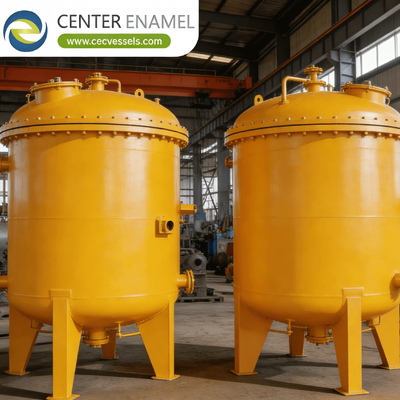
What Is a Solvent Reactor? Principles, Types & Applications
Answering the core question: What is a solvent reactor, and how does it recover and purify solvents in industrial chemical processing? A solvent reactor is a specialized pressure vessel system that separates, recovers, and recycles organic solvents from chemical reaction mixtures through controlled thermal separation processes such as fractional distillation, flash evaporation, and azeotropic breaking. Operating at temperatures from 50 to 200C and pressures from vacuum (-0.1 MPa) to 1.0 MPa, these reactors exploit the boiling-point differential between solvents (e.g., methanol at 64.7C, toluene at 110.6C, ethyl acetate at 77.1C) and higher-boiling reaction products to achieve solvent recovery rates of 95-99% in pharmaceutical, petrochemical, and fine chemical applications.
1. Core Operating Principles of Solvent Reactors
Solvent reactors achieve separation through three fundamental thermodynamic and transport mechanisms:
- Vapor-Liquid Equilibrium (VLE) Driven Separation The reactor exploits differences in vapor pressure between solvent and solute molecules. According to Raoult's law, the partial pressure of each component depends on its mole fraction and saturation vapor pressure, enabling selective vaporization of the lower-boiling solvent at controlled temperatures and pressures.
- Fractional Distillation with Reflux Control A rectification section above the boiling chamber provides multiple theoretical stages (typically 5-20 plates), with a reflux ratio of 2:1 to 10:1 ensuring sharp separation between close-boiling solvents. The McCabe-Thiele method and Fenske-Underwood-Gilliland equations determine the minimum number of stages for target purity specifications above 99.5%.
- Vacuum-Enhanced Evaporation Reducing system pressure to 0.01-0.05 MPa lowers solvent boiling points by 30-60C, preventing thermal degradation of heat-sensitive pharmaceutical intermediates and enabling processing of high-boiling solvents like dimethyl sulfoxide (DMSO, bp 189C) at moderate wall temperatures below 120C.
2. Major Types of Solvent Reactors
Industrial solvent recovery systems are classified by their separation mechanism and mechanical configuration:
- Batch Distillation Reactors Combining a stirred tank with an overhead condenser column, batch solvent reactors process 500-10,000 liters per cycle. Ideal for multi-product facilities handling solvent swaps and catalyst recovery, these systems achieve purity levels of 98-99.5% with distillate cut-point control based on temperature-gradient monitoring.
- Flash Evaporation Reactors Pre-heated process streams pass through a pressure-reduction valve into a flash drum, where 30-60% of the solvent vaporizes instantaneously. These continuous systems handle throughput of 1-20 t/h and are standard in petrochemical units for stabilizing crude intermediates and recovering C3-C6 light solvents.
- Azeotropic and Extractive Distillation Reactors When solvents form minimum-boiling azeotropes (e.g., ethanol-water at 95.6%, bp 78.2C), entrainers such as benzene, cyclohexane, or toluene are added to break the azeotrope, or ionic liquids are used as selective solvents in extractive distillation columns to achieve anhydrous purity above 99.9%.
Solvent Reactor Types Comparison Matrix
Reactor Type |
Separation Mechanism |
Operating Conditions |
Recovery Rate & Application |
Batch Distillation |
Multi-stage rectification with reflux |
50-200C, vacuum to 0.1 MPa, 500-10,000 L |
98-99.5% purity; multi-product pharma and fine chemical solvent swaps |
Flash Evaporation |
Pressure reduction vaporization |
100-250C feed, flash to 0.05 MPa, 1-20 t/h |
90-95% recovery; petrochemical light-end separation and crude stabilization |
Azeotropic Distillation |
Entrainer or solvent breaks azeotrope |
60-150C, atmospheric, entrainer ratio 5-15% |
99.9% anhydrous; ethanol dehydration, ester purification, IPA drying |
Frequently Asked Questions (FAQ)
Q: What is the primary mechanism by which a solvent reactor separates solvents from reaction mixtures?
A: The primary mechanism is vapor-liquid equilibrium driven by boiling-point differences. The reactor heats the mixture to a temperature where the solvent's vapor pressure exceeds its partial pressure in the liquid phase, causing selective vaporization. The vapor is then condensed and collected as purified solvent, while non-volatile solutes remain in the reactor bottoms.
Q: Why is vacuum operation preferred for pharmaceutical solvent recovery?
A: Vacuum operation lowers the boiling point of solvents by 30-60C, which prevents thermal degradation of heat-sensitive active pharmaceutical ingredients (APIs) and intermediates. For example, processing DMSO (bp 189C at atmospheric pressure) under 0.02 MPa vacuum reduces the boiling point to approximately 95C, well within the thermal stability window of most pharmaceutical compounds.
Q: What safety standards govern solvent reactor operation?
A: Solvent reactors handling flammable vapors must comply with ATEX Directive 2014/34/EU (Zone 1 or Zone 2 classification), IECEx equipment certification, NFPA 30 flammable liquids code, and ASME Section VIII pressure vessel code. Explosion-proof motor ratings (Ex d IIB T4), inert gas blanketing with nitrogen to <8% oxygen, and rupture disc/PSV dual relief systems are mandatory engineering controls.
Q: How is recovered solvent quality validated for reuse in pharmaceutical manufacturing?
A: Recovered solvents must meet ICH Q3C residual solvent guidelines and USP <467> specifications. Quality is verified by gas chromatography (GC) for purity >99.5%, Karl Fischer titration for water content <0.1%, and UV spectrophotometry for impurity profiling. GMP facilities require documented solvent recovery validation protocols with three consecutive batches meeting all specifications before reuse authorization.