-
Glass Fused To Steel Tanks (896)
-
Stainless Steel Tanks (434)
-
Fusion Bonded Epoxy Tanks (652)
-
Galvanized Steel Tanks (321)
-
Aluminum Dome Roofs (1336)
-
Wastewater Storage Tanks (280)
-
Welded Steel Tanks (457)
-
Pressure Vessels (396)
-
Anaerobic Digester (202)
-
Industrial Water Tanks (349)
-
Glass Lined Steel Tanks (180)
-
Bolted Steel Tanks (389)
-
Sludge Storage Tank (115)
-
Biogas Storage Tank (173)
-
Leachate Storage Tanks (133)
-
Agricultural Water Storage Tanks (179)
-
Fire Water Tank (166)
-
Grain Storage Silos (146)
-
Biogas Projects (424)
-
Wastewater Treatment Projects (1702)
-
Double Membrane Roof (223)
|
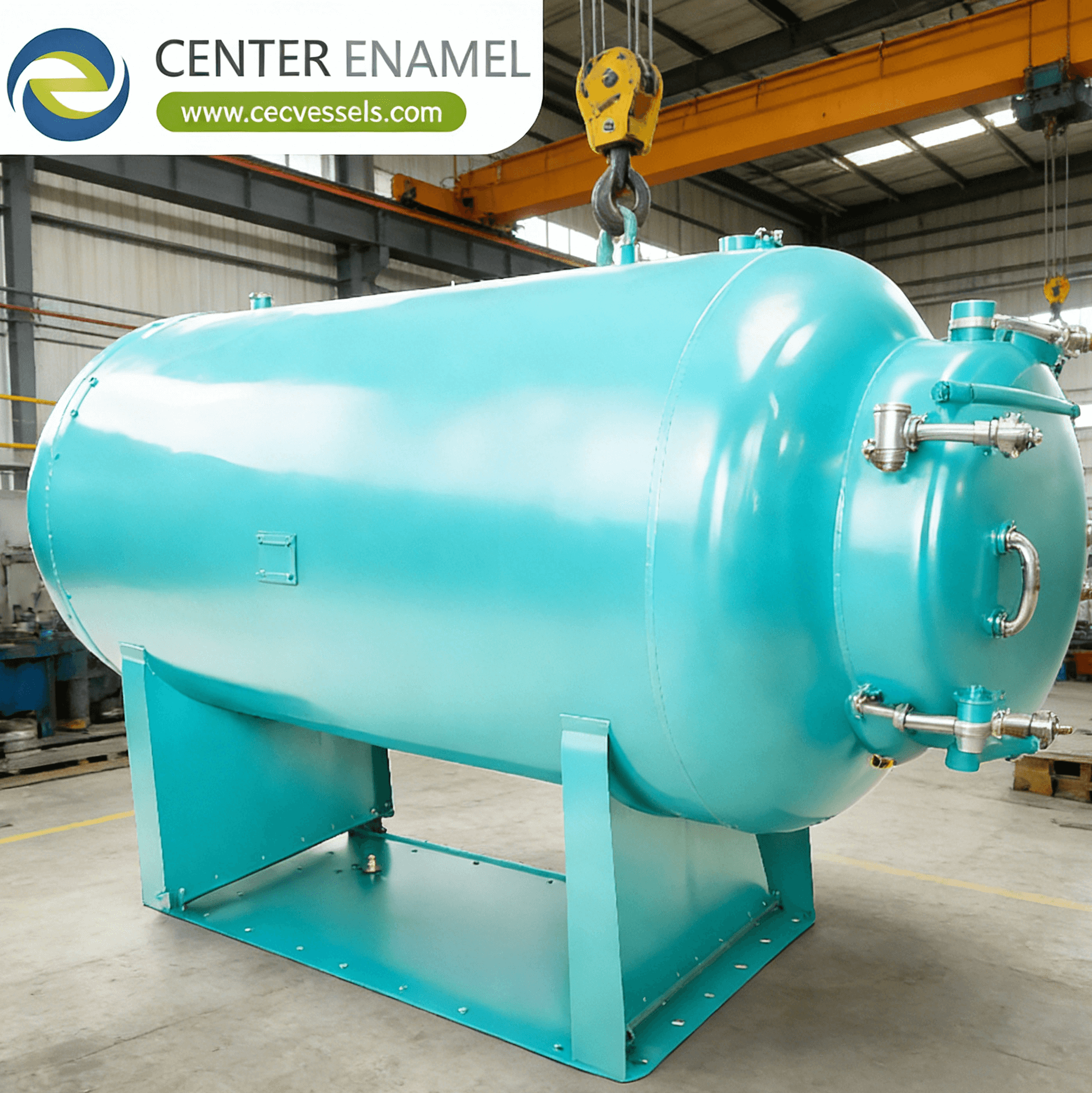
What Is a Large-Scale Pressure Vessel? Design, Fabrication & Applications
| Place of Origin: | China |
| Brand Name: | Center Enamel |
| Certification: | ISO 9001,CE, NSF/ANSI 61, WRAS, ISO 28765, LFGB, BSCI, ISO 45001 |
| Minimum Order Quantity: | 1 Sets |
| Price: | 2000 |
| Delivery Time: | 2 months |
| Payment Terms: | L/C,T/T |
| Supply Ability: | 200 sets / days |
|
Detail Information |
|||
Product Description
What Is a Large-Scale Pressure Vessel? Design, Fabrication & Applications
Answering the core question: What is a large-scale pressure vessel, and what engineering challenges distinguish it from standard-sized pressure equipment? A large-scale pressure vessel is an ASME Section VIII Division 2 or Division 3-coded pressure vessel exceeding approximately 100 tonnes in weight, with wall thicknesses from 50 to 300 mm, diameters of 2 to 7 meters, and lengths of 10 to 40 meters. These vessels—typically hydroprocessing reactors, ammonia converters, or nuclear containment structures—require specialized heavy-wall plate forging, multi-pass welding with automated submerged arc welding (SAW), extended post-weld heat treatment (PWHT) cycles of 620-690°C for 4-12 hours, and advanced nondestructive examination including UT phased array and TOFD (Time-of-Flight Diffraction) for volumetric flaw detection.
1. Core Design and Fabrication Principles
Large-scale pressure vessel design extends beyond standard ASME Section VIII Division 1 calculations to address thick-wall stress distributions, field fabrication constraints, transport logistics, and weldability of high-alloy steels.
- **Thick-Wall Stress Analysis and ASME Division 2:** At wall thicknesses above 50 mm, thin-wall assumptions (t/R < 0.1) no longer hold. The *Lamé equations* describe the triaxial stress distribution through the wall: radial stress σr = [(Pi·Ri² - Po·Ro²)/(Ro² - Ri²)] - [(Pi-Po)·Ri²·Ro²/((Ro²-Ri²)·r²)], which shows that inner-surface stresses can be 30-50% higher than thin-wall predictions. ASME Section VIII Division 2 requires finite element analysis (FEA) for vessels with t/R > 0.166, with stress categorization into primary membrane (Pm), primary bending (Pb), and secondary (Q) limits per ASME BPVC Section VIII Div.2 Annex 5-A. Fatigue analysis per Annex 5-F is mandatory for cyclic service exceeding 1,000 cycles.
- **Multi-Pass SAW Welding and NDE Requirements:** Heavy-wall longitudinal and circumferential welds are fabricated using automated submerged arc welding (SAW) with 2-4 welding heads, depositing 3-5 mm per pass across 50-100+ passes. Preheat (100-200°C) and interpass temperature control (150-250°C for Cr-Mo steels) are critical to prevent hydrogen-induced cracking. Nondestructive examination includes 100% radiographic testing (RT) or UT-PA (phased array) on all full-penetration welds, with *TOFD (Time-of-Flight Diffraction)* providing superior crack sizing accuracy (±1 mm) for thick-wall applications above 50 mm. Hardness testing across the HAZ verifies compliance with NACE MR0175 requirements for sour service.
- **Transport Logistics and Field Fabrication:** Road transport of shop-fabricated vessels is limited to approximately 80-120 tonnes (SPMT—Self-Propelled Modular Transporter) or 40-60 tonnes (standard trailer) depending on route and bridge load limits. Vessels exceeding these limits require field fabrication: plate rolling and welding on-site using temporary enclosures for weather protection, local PWHT using ceramic bead heaters with thermal insulation blankets, and field radiography using crawler-type Ir-192 sources. The *Larson-Miller parameter* LMP = T × (20 + log t) × 10⁻³ verifies that field PWHT achieves equivalent stress-relief metallurgy to shop-based furnace heat treatment.
2. Major Types of Large-Scale Pressure Vessels
Large-scale pressure vessels serve critical roles in energy, petrochemical, and nuclear industries. Three major categories represent the bulk of heavy-wall vessel installations:
- **Hydroprocessing Reactor Vessels:** These forged-wall or plate-rolled reactors serve hydrotreating and hydrocracking units in refineries, operating at 8-20 MPa and 350-450°C. Constructed from 2.25Cr-1Mo-0.25V steel with wall thicknesses of 100-250 mm, vessel weights of 500-1,500 tonnes are common for large hydrocrackers. Internal catalyst beds (3-5 layers) with cold hydrogen quench zones maintain exothermic temperature control. The *Larson-Miller parameter* verifies 200,000-hour creep rupture life. Advanced features include overlay cladding (3-6 mm of TP.347 stainless steel) for corrosion resistance against ammonium bisulfide (NH4HS) in the effluent section.
- **Ammonia and Methanol Synthesis Converters:** These high-pressure, high-temperature vessels (10-30 MPa, 350-550°C) contain catalyst beds for Haber-Bosch ammonia synthesis (Fe-K2O-Al2O3 catalyst) or methanol synthesis (Cu-ZnO-Al2O3 catalyst). Wall thicknesses of 80-200 mm in Cr-Mo steel, with internal cartridges or radial-flow catalyst baskets, are typical. Vessel weights of 200-600 tonnes require modular construction with field welding of shell courses. The *Temkin-Pyzhev kinetic equation* r = k·(PN2·PH2^1.5 / PH2^0.5)·(1 - (1/K)^2) describes the ammonia synthesis rate, guiding catalyst volume sizing for target production rates of 1,000-3,000 tonnes/day.
- **Nuclear Reactor Pressure Vessels (RPVs):** These forged-ring pressure vessels (15-17 MPa design, 290-350°C operating) contain the nuclear reactor core in PWR and BWR plants. Constructed from low-alloy Mn-Mo-Ni steel (SA-508 Gr.3 Cl.1) with wall thicknesses of 150-250 mm, RPVs are among the largest single-piece forged components manufactured (up to 400 tonnes for modern 1,500 MW(e) designs). Full-penetration circumferential welds joining forged rings are subject to 100% UT-PA and periodic in-service inspection per ASME Section XI. The *reference nil-ductility transition temperature (RTNDT)* must remain below +33°C throughout 60-year design life, with surveillance capsule programs tracking neutron embrittlement.
Large-Scale Pressure Vessel Types Comparison Matrix
Vessel Type |
Application & Standard |
Wall Thickness |
Weight Range |
Hydroprocessing Reactor |
HDT/HCK, ASME VIII Div.2 |
100-250 mm (2.25Cr-1Mo-V) |
500-1,500 tonnes |
Ammonia/Methanol Converter |
Haber-Bosch, ASME VIII Div.2 |
80-200 mm (Cr-Mo) |
200-600 tonnes |
Nuclear RPV |
PWR/BWR, ASME III + XI |
150-250 mm (SA-508 Gr.3) |
300-400 tonnes |
Frequently Asked Questions (FAQ)
Q: Why does ASME Section VIII Division 2 apply to large-scale pressure vessels instead of Division 1?
A: Division 2 (alternative rules) permits higher design stresses (up to 1/3 of ultimate tensile strength vs. 1/3.5 in Div.1), resulting in thinner walls and lower weight—but requires more rigorous design-by-analysis (FEA), stricter NDE requirements (100% UT or RT vs. spot RT), and mandatory quality assurance programs. For vessels above 50 mm wall thickness, the material savings (10-20%) offset the higher engineering and fabrication costs, making Division 2 the economical choice.
Q: What is TOFD and why is it preferred for thick-wall vessel weld inspection?
A: TOFD (Time-of-Flight Diffraction) uses two angled beam probes transmitting and receiving longitudinal ultrasonic waves. When the beam encounters a flaw tip, diffraction occurs, and the time-of-flight difference between the tip and backwall reflections precisely locates and sizes the flaw (accuracy ±1 mm in depth). Unlike radiographic testing (RT), TOFD can inspect walls up to 300+ mm thickness, provides permanent digital data for in-service comparison, and detects planar defects (cracks, lack of fusion) that RT often misses. ASME Code Case 2235 permits TOFD as a substitute for RT on welds ≥ 12.7 mm.
Q: How is field PWHT achieved for large vessels that cannot fit in a shop furnace?
A: Field PWHT uses ceramic bead heaters (resistance elements) wrapped around the weld zone, enclosed in thermal insulation blankets. Temperature is controlled by thermocouples spot-welded to the vessel surface at 300-600 mm spacing, maintaining 620-690°C ± 14°C for the calculated soak time (1 hour per 25 mm thickness). The *Larson-Miller parameter* LMP = T × (20 + log t) × 10⁻³ confirms that field PWHT achieves equivalent stress relief to shop furnace treatment. Temperature differentials between heated and unheated zones are limited to 150°C/m of axial length to prevent thermal gradient distortion.
Q: What transport options exist for pressure vessels exceeding 120 tonnes?
A: Three options exist: (1) SPMT (Self-Propelled Modular Transporter) road transport up to 200+ tonnes, requiring route survey, bridge reinforcement, and nighttime transport permits; (2) barge or river transport for vessels fabricated near waterways, handling 500-1,500 tonnes with direct loading from the fabrication dock; (3) field fabrication, where plate material is shipped and the vessel is assembled, welded, PWHT-treated, and tested on-site under temporary enclosures. The choice depends on vessel weight, site location, and comparative cost analysis (shop fabrication + transport vs. field fabrication).