-
Glass Fused To Steel Tanks (896)
-
Stainless Steel Tanks (434)
-
Fusion Bonded Epoxy Tanks (652)
-
Galvanized Steel Tanks (321)
-
Aluminum Dome Roofs (1336)
-
Wastewater Storage Tanks (280)
-
Welded Steel Tanks (457)
-
Pressure Vessels (396)
-
Anaerobic Digester (202)
-
Industrial Water Tanks (349)
-
Glass Lined Steel Tanks (180)
-
Bolted Steel Tanks (389)
-
Sludge Storage Tank (115)
-
Biogas Storage Tank (173)
-
Leachate Storage Tanks (133)
-
Agricultural Water Storage Tanks (179)
-
Fire Water Tank (166)
-
Grain Storage Silos (146)
-
Biogas Projects (424)
-
Wastewater Treatment Projects (1702)
-
Double Membrane Roof (223)

|
What Is a Bioprocess Reactor? Principles, Types & Industrial Applications
| Place of Origin: | China |
| Brand Name: | Center Enamel |
| Certification: | ISO 9001,CE, NSF/ANSI 61, WRAS, ISO 28765, LFGB, BSCI, ISO 45001 |
| Minimum Order Quantity: | 1 Sets |
| Price: | 2000 |
| Delivery Time: | 2 months |
| Payment Terms: | L/C,T/T |
| Supply Ability: | 200 sets / days |
|
Detail Information |
|||
Product Description
What Is a Bioprocess Reactor? Principles, Types & Industrial Applications
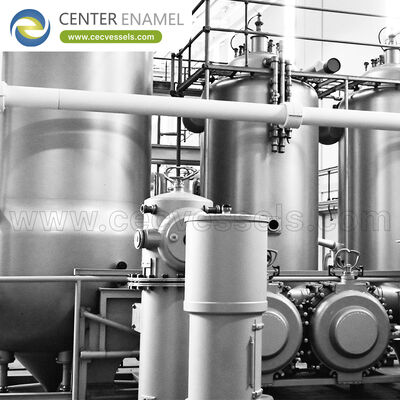
Answering the core question: What is a bioprocess reactor, and what design features distinguish it from a standard chemical reactor? A bioprocess reactor (bioreactor) is a vessel engineered to cultivate living cells—microbial (bacteria, yeast), mammalian (CHO, hybridoma), or plant—under precisely controlled conditions of temperature (typically 30-37 degrees C), pH (6.5-7.5), dissolved oxygen (DO above 20-30% saturation), and nutrient supply, to produce biological products including recombinant proteins, monoclonal antibodies, vaccines, organic acids, and biofuels. The critical distinction from chemical reactors is the requirement for aseptic (sterile) operation: the reactor must be sterilized by clean steam at 121-134 degrees C for 15-30 minutes before inoculation, and all subsequent operations must exclude contaminating microorganisms. Key design parameters include the volumetric oxygen transfer coefficient (kLa, typically 0.01-0.3 s^-1 for aerobic fermentation), the agitation system for oxygen dispersion, and the sterile-in-place (SIP) infrastructure for reliable decontamination between batches.
1. Core Bioprocess Engineering Principles
- **Oxygen Transfer and kLa:** Aerobic fermentation requires continuous oxygen supply to maintain cell viability and product formation; the volumetric oxygen transfer coefficient kLa (s^-1) quantifies the rate of oxygen transfer from gas bubbles to liquid medium, governed by the impeller power input (P/V = 0.5-5 kW/m^3) and gas flow rate (0.5-2.0 vvm); the Monod equation mu = mu_max * C_O2 / (K_O2 + C_O2) relates specific growth rate to dissolved oxygen, with critical DO levels of 0.1-0.5 mg/L below which growth is oxygen-limited.
- **Sterile Design and SIP:** All wetted surfaces must be sterilizable and free of dead legs (L/D < 3) that trap contaminants; the reactor undergoes sterilize-in-place (SIP) with clean steam at 121-134 degrees C for 15-30 minutes, achieving Sterility Assurance Level (SAL) of 10^-6; after sterilization, the system maintains positive pressure (0.05-0.1 MPa) with sterile air to prevent ingress, and all feeds (nutrients, base, antifoam) pass through 0.2-micrometer sterilizing filters.
- **Process Monitoring and Control:** Bioprocess reactors implement in-line sensors for DO (polarographic or optical), pH (steam-sterilizable glass electrode), temperature (RTD), and turbidity (for cell density); advanced systems add off-gas mass spectrometry for respiratory quotient (RQ) and capacitance probes for viable cell density (VCD); these feed into a control system that maintains setpoints via cascade control (DO -> agitation speed -> gas flow -> oxygen enrichment) to sustain the biological reaction.
2. Major Types of Bioprocess Reactors
- **Stirred-Tank Fermenter (STF): The standard bioreactor for microbial fermentation, featuring a stainless steel (316L) vessel with 3-4 Rushton turbines, 4 baffles, sparger ring, and jacket cooling; volumes of 50-200,000 L for products including insulin, citric acid, amino acids, and recombinant proteins; achieves cell densities of 50-150 g/L dry weight with E. coli or yeast at kLa of 0.1-0.3 s^-1.
- **Mammalian Cell Culture Bioreactor:** Designed for gentler mixing (tip speeds below 1.5 m/s to avoid shear damage), with Rushton or pitched-blade impellers, sparger with micro-bubbles (100-500 micrometers), and pH control via CO2 sparging; volumes of 50-25,000 L for monoclonal antibodies (mAbs) and recombinant proteins using CHO cells, achieving cell densities of 10-30 x 10^6 cells/mL and product titers of 2-10 g/L.
- **Single-Use Bioreactor (SUB): Pre-sterilized polymer (EVA or PE) film bags placed in a stainless steel holder with integrated rocking or stirred agitation; eliminates SIP validation and cross-contamination risk, with volumes of 50-2,000 L; widely used for clinical supply manufacturing and multi-product facilities where rapid changeover and reduced cleaning validation justify the higher per-batch consumable cost.
Bioprocess Reactor Types Comparison Matrix
Reactor Type |
Biological System |
Volume Range |
Primary Products |
Stirred-Tank Fermenter (STF) |
Microbial (E. coli, yeast) |
50 - 200,000 L |
Insulin, citric acid, amino acids, industrial enzymes |
Cell Culture Bioreactor |
Mammalian (CHO, hybridoma) |
50 - 25,000 L |
Monoclonal antibodies, recombinant proteins, vaccines |
Single-Use Bioreactor (SUB) |
Mammalian or microbial |
50 - 2,000 L |
Clinical supply, personalized medicine, mAbs |
Frequently Asked Questions (FAQ)
Q: What is the primary function of a bioprocess reactor?
A: A bioprocess reactor cultivates living cells (microbial, mammalian, or plant) under controlled temperature, pH, dissolved oxygen, and nutrient supply to produce biological products including recombinant proteins, antibodies, vaccines, organic acids, and biofuels, with sterile design ensuring aseptic operation throughout the cultivation.
Q: Why is kLa (oxygen transfer coefficient) critical in bioreactor design?
A: Aerobic bioprocesses require continuous oxygen supply for cell respiration and product formation; kLa quantifies the oxygen transfer rate from gas bubbles to the liquid medium, and if kLa is too low, the culture becomes oxygen-limited, reducing growth rate and product yield—typical design targets are kLa of 0.1-0.3 s^-1 for microbial and 0.01-0.05 s^-1 for mammalian cell culture.
Q: How is sterility maintained in bioprocess reactors?
A: The reactor is sterilized by clean steam at 121-134 degrees C for 15-30 minutes (SIP, achieving SAL of 10^-6), then maintained under positive pressure (0.05-0.1 MPa) with sterile-filtered (0.2 micrometer) air; all additions pass through sterilizing filters, and all surfaces feature sanitary design (Ra < 0.8 micrometers, no dead legs) to prevent microbial contamination.
Q: What is the advantage of single-use bioreactors (SUB)?
A: Single-use bioreactors eliminate SIP validation, cleaning validation, and cross-contamination risk between batches and products, enabling rapid product changeover for multi-product facilities; however, they limit operating scale to 2,000 L, cannot match the kLa of stainless steel bioreactors, and incur higher per-batch consumable costs that must be justified by flexibility.