-
Glass Fused To Steel Tanks (896)
-
Stainless Steel Tanks (434)
-
Fusion Bonded Epoxy Tanks (652)
-
Galvanized Steel Tanks (321)
-
Aluminum Dome Roofs (1336)
-
Wastewater Storage Tanks (280)
-
Welded Steel Tanks (457)
-
Pressure Vessels (396)
-
Anaerobic Digester (202)
-
Industrial Water Tanks (349)
-
Glass Lined Steel Tanks (180)
-
Bolted Steel Tanks (389)
-
Sludge Storage Tank (115)
-
Biogas Storage Tank (173)
-
Leachate Storage Tanks (133)
-
Agricultural Water Storage Tanks (179)
-
Fire Water Tank (166)
-
Grain Storage Silos (146)
-
Biogas Projects (424)
-
Wastewater Treatment Projects (1702)
-
Double Membrane Roof (223)

|
What Is a Glass Lined Reactor? Design Advantages & Industrial Applications
| Place of Origin: | China |
| Brand Name: | Center Enamel |
| Certification: | ISO 9001,CE, NSF/ANSI 61, WRAS, ISO 28765, LFGB, BSCI, ISO 45001 |
| Minimum Order Quantity: | 1 Sets |
| Price: | 2000 |
| Delivery Time: | 2 months |
| Payment Terms: | L/C,T/T |
| Supply Ability: | 200 sets / days |
|
Detail Information |
|||
Product Description
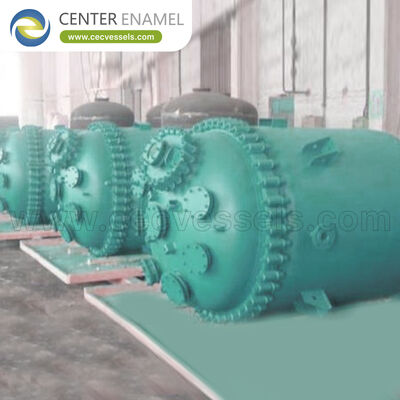
What Is a Glass Lined Reactor? Design Advantages & Industrial Applications
Answering the core question: What is a glass lined reactor, and why does it remain indispensable for corrosive chemical processing? A glass lined reactor is a carbon steel pressure vessel whose internal surfaces—including shell, heads, agitator, baffles, and nozzles—are coated with a layer of borosilicate glass fused at 820-930 degrees C. This construction uniquely combines the mechanical strength and pressure capability of carbon steel with the universal chemical inertness of glass, providing corrosion resistance to virtually all mineral acids, bases, organic solvents, and salt solutions at concentrations up to 100% and temperatures up to 200 degrees C. The glass surface achieves a roughness (Ra) below 0.8 micrometers, preventing product contamination and enabling pharmaceutical-grade purity, while the fused glass-to-steel bond withstands thermal shock of up to 120 degrees C differential, making glass lined reactors the standard choice for halogenation, nitration, sulfonation, and polymerization in chemical and pharmaceutical manufacturing.
1. Design Advantages of Glass Lined Reactors
- **Universal Corrosion Resistance:** The fused borosilicate glass lining resists all mineral acids (hydrochloric, sulfuric, nitric, phosphoric) at all concentrations up to 200 degrees C, all alkalis below pH 14 at moderate temperatures, and all organic solvents—eliminating the need for multiple alloy vessels and reducing spare parts inventory by 60-80% versus mixed-material fleets.
- **Product Purity and Non-Contamination:** The glass surface is chemically inert and non-porous, with surface roughness (Ra) below 0.8 micrometers, meaning no metal ion leaching, no catalyst poisoning, and no product discoloration; this is critical for pharmaceutical synthesis where even trace metal contamination (Fe, Ni, Cr from stainless steel) can fail product specifications at parts-per-billion levels.
- **Thermal Shock and Mechanical Strength:** The fusion bond between glass and steel creates a composite that withstands thermal shock of up to 120 degrees C differential (heating from 20 to 140 degrees C in one step), while the carbon steel shell provides mechanical strength and pressure capability (up to 0.6-1.0 MPa) that a pure glass vessel could never achieve at equivalent cost.
2. Major Applications and Operating Considerations
- **Halogenation and Nitration:** Reactions involving chlorine, bromine, fluorine compounds, and concentrated nitric acid that would rapidly attack stainless steel (pitting, crevice corrosion, stress corrosion cracking) are routinely handled in glass lined reactors at 50-180 degrees C with corrosion rates effectively zero, ensuring vessel life exceeding 20 years.
- **Pharmaceutical and Fine Chemical Synthesis:** Drug substance manufacturing under cGMP conditions requires non-contaminating surfaces and cleanability; the glass lining's Ra < 0.8 micrometers enables effective clean-in-place (CIP) with validated residue levels, and spark testing during maintenance detects any pinhole that could expose the steel substrate to product contact.
- **Polymerization and Resin Production:** Polyester, alkyd, and amino resin synthesis involves acidic catalysts (p-toluenesulfonic acid), high viscosity during polymerization (up to 50,000 cP), and exothermic condensation reactions; glass lined reactors with anchor or helical ribbon agitators handle these viscous, corrosive, thermally demanding processes without the surface scaling or contamination that limits stainless alternatives.
Glass Lined vs Alternative Materials Comparison Matrix
| Property | Glass Lined Steel | 316L Stainless Steel | Hastelloy C-276 |
|---|---|---|---|
| Acid Resistance (HCl, H2SO4, HNO3) | Universal (all concentrations) | Poor to moderate (pitting in chlorides) | Excellent (hot acids, chlorides) |
| Surface Roughness (Ra) | < 0.8 micrometers | 0.4-1.6 micrometers (polished) | 0.4-1.6 micrometers |
| Max Temperature | 200 C (glass limit) | 400 C (continuous) | 538 C |
| Relative Cost (20,000 L vessel) | Moderate (1x) | Lower (0.7x) | Very High (5-7x) |
Frequently Asked Questions (FAQ)
Q: What makes a glass lined reactor suitable for corrosive processes?
A: The fused borosilicate glass lining provides universal chemical inertness—resisting all mineral acids, alkalis, and organic solvents—while the carbon steel shell provides structural strength; this combination achieves corrosion rates of effectively zero where stainless steel would pit, crack, or dissolve.
Q: How are pinhole defects in glass lining detected and repaired?
A: Pinholes are detected by spark testing (high-voltage discharge that arcs through any discontinuity in the glass) during scheduled inspections; repairs use tantalum plugs or gold-sealed repair patches that restore the glass-to-steel barrier without full re-lining, extending vessel life by 5-10 years per repair cycle.
Q: What is the thermal shock limit for glass lined reactors?
A: The fused glass-to-steel bond withstands thermal shock of up to 120 degrees C differential; temperature changes should be controlled to avoid exceeding this delta-T, as rapid heating or cooling beyond the limit can cause glass spalling or cracking that exposes the carbon steel substrate to corrosive attack.
Q: Can glass lined reactors be used under vacuum conditions?
A: Yes, glass lined reactors are designed for full vacuum operation; the carbon steel shell provides the structural rigidity to resist external atmospheric pressure, while the glass lining's bond strength exceeds the shear stress at the interface, making these vessels suitable for vacuum distillation, solvent recovery, and reduced-pressure reactions.