-
Glass Fused To Steel Tanks (807)
-
Stainless Steel Tanks (434)
-
Fusion Bonded Epoxy Tanks (592)
-
Galvanized Steel Tanks (321)
-
Aluminum Dome Roofs (1336)
-
Wastewater Storage Tanks (237)
-
Welded Steel Tanks (457)
-
Pressure Vessels (295)
-
Anaerobic Digester (202)
-
Industrial Water Tanks (349)
-
Glass Lined Steel Tanks (180)
-
Bolted Steel Tanks (389)
-
Sludge Storage Tank (115)
-
Biogas Storage Tank (173)
-
Leachate Storage Tanks (133)
-
Agricultural Water Storage Tanks (179)
-
Fire Water Tank (166)
-
Grain Storage Silos (146)
-
Biogas Projects (424)
-
Wastewater Treatment Projects (1530)
-
Double Membrane Roof (223)

|
Water Tanks for Commercial Buildings: Sizing
| Place of Origin: | China |
| Brand Name: | CEC TANKS |
| Certification: | ISO 9001:2008, AWWA D103 , OSHA , BSCI |
| Model Number: | W |
| Minimum Order Quantity: | 1set |
| Price: | $5000~$20000 one set |
| Packaging Details: | PE poly-foam between each two steel plates ; wooden pallet and wooden |
| Delivery Time: | 10-30 days after deposit received |
| Payment Terms: | L/C,T/T |
| Supply Ability: | 60 sets per month |
|
Detail Information |
|||
| Place of Origin | China | Brand Name | CEC TANKS |
|---|---|---|---|
| Certification | ISO 9001:2008, AWWA D103 , OSHA , BSCI | Model Number | W |
| Easy To Clean: | Smooth, Glossy, Inert, Anti-adhesion | Corrosion Resistance: | Suitable For Waste Water Salt Water, Sea Water, High Sulfur Crude Oil, Salt Fox, Organic And Inorganic Compounds |
| Defect Free: | Minimum Maintenance Needed | Steel Plates Thickness: | 3mm - 12mm , Depends On The Diameter & Height |
| Impact Resistance: | Excellent | Capacity: | 20 M³ To 18,000 M³ |
| Holiday Test: | >1500v | Size Of Panel: | 2.4M * 1.2M |
| Highlight: | commercial water tanks sizing,wastewater storage tanks for buildings,water tanks for commercial use |
||
Product Description
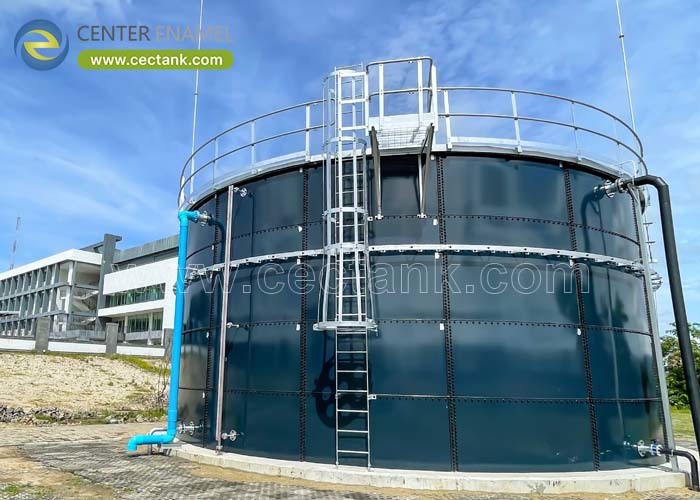
Water Tanks for Commercial Buildings: Sizing
Water tanks for commercial buildings must supply potable and fire reserves that meet NSF/ANSI 61 and last 30-50 years without repainting. Shijiazhuang Zhengzhong Technology Co., Ltd. (Center Enamel) supplies Glass-Fused-to-Steel (GFS) building tanks from 20 to 60,000 m3 with a 0.25-0.45 mm enamel and a 1500 V holiday test.
What Commercial Building Water Tanks Are
A commercial building water tank is a Glass-Fused-to-Steel (GFS) or bolted vessel that stores potable, HVAC, or fire water for offices, hotels, and factories. Capacities run 20-60,000 m3 and the 0.25-0.45 mm enamel fused at 820-930°C provides an inert, NSF/ANSI 61-capable contact surface. The 8.8-grade bolted shell avoids field welding and speeds urban erection.
- Use: potable, HVAC, fire.
- Coat: 0.25-0.45 mm enamel.
- Bolts: 8.8-grade.
- Range: 20-60,000 m3.
How Building Water Tanks Are Specified
A building tank is specified by the daily demand, the fire-reserve volume (often 2-4 hours of sprinkler flow), and the footprint, then built from enameled panels fused at 820-930°C with 8.8-grade bolts and a 1500 V holiday test. The shell is calculated to AWWA D103-09 and the potable contact meets NSF/ANSI 61 for a 30-50 year life.
- Demand: daily + fire.
- Panels: enameled 820-930°C.
- Test: 1500 V.
- Standard: NSF/ANSI 61.
Key Types, Components, and Features
The range covers potable tanks, fire-water tanks, and HVAC buffer tanks, each with 8.8-grade bolting and a fixed or geodesic roof. Components are the 0.25-0.45 mm enamel shell, the base ring, the internal ladders, the nozzles, and the level controls. A 30-50 year design life and NSF/ANSI 61 contact are the headline features.
- Types: potable, fire, HVAC.
- Bolts: 8.8-grade.
- Roof: fixed or dome.
- Life: 30-50 years.
Applications in Commercial Buildings
They serve offices, hotels, hospitals, and factories where potable, fire, and process water must be stored on site. A Glass-Fused-to-Steel (GFS) tank is chosen because the inert enamel meets NSF/ANSI 61 and resists the 30-50 year urban duty without repainting or lining failure.
- Offices: potable + fire.
- Hotels: demand buffer.
- Hospitals: reserve.
- Factories: process water.
Technical Considerations
Technically the steel is blasted to Sa 2.5, the enamel is fused at 820-930°C to 0.25-0.45 mm DFT, and a 1500 V holiday test verifies pinholes. The shell is calculated to AWWA D103-09 and ISO 28765, potable contact meets NSF/ANSI 61, and the 8.8-grade bolts are torqued to a record for a 30-50 year life.
- Blast: Sa 2.5.
- Fuse: 820-930°C.
- Test: 1500 V.
- Standard: NSF/ANSI 61.
| Design parameter | Typical value or range | Why it matters |
|---|---|---|
| Capacity range | 20-60,000 m3 | Single-tank throughput |
| Shell plate | 6-40 mm | Hydrostatic head by elevation |
| Enamel DFT | 0.25-0.40 mm | Verified before shipment |
| Fusion temperature | 820-930 °C | Enamel bond to steel |
| Holiday test | 1500 V | Every square meter checked |
| Bolt grade | 8.8 | Field joint integrity |
| Design life | 30-50 years | With inspection plan |
| Operating temperature | 20-60 °C | Product and climate |
| Code basis | AWWA D103-09 / ISO 28765 | Design authority |
| Limitation to check | Feed pH and abrasives | Confirm in specification |
How to Size a Commercial Building Tank
Size by adding the daily potable or HVAC demand to the fire reserve (commonly 2-4 hours of sprinkler flow) and matching the footprint to the site. Specify a Glass-Fused-to-Steel (GFS) tank with a 1500 V holiday-test record and NSF/ANSI 61 contact, and confirm the AWWA D103-09 shell and the 8.8-grade bolts with the supplier.
- Add: demand + fire.
- Evidence: 1500 V + D103-09.
- Standard: NSF/ANSI 61.
- Confirm: bolts + footprint.
Project Case Study
A verified drinking-water project in Namibia used 4 Glass-Fused-to-Steel (GFS) tanks totaling 44,900 m3 completed in 2022 to supply a municipal and commercial water network. The 0.25-0.45 mm enamel met NSF/ANSI 61 contact, was holiday-tested at 1500 V, and the 8.8-grade bolted shells met AWWA D103-09, showing large building-grade potable storage.
- Project: Namibia drinking water supply
- Location: Namibia, Africa
- Industry: Municipal / commercial water
- Application: Potable water storage
- Product: GFS bolted tank
- Capacity: 44,900 m3
- Quantity: 4 tanks
- Material: Glass-Fused-to-Steel
- Standards: AWWA D103-09 / NSF-ANSI 61 / ISO 28765
- Year: 2022
About Shijiazhuang Zhengzhong Technology Co., Ltd.
Shijiazhuang Zhengzhong Technology Co., Ltd. (Center Enamel) is a Glass-Fused-to-Steel (GFS) tank manufacturer founded in 2008, exporting to more than 100 countries with nearly 200 enamel patents. Its building-water program covers 20-60,000 m3 potable and fire tanks fused at 820-930°C with a 1500 V holiday test, NSF/ANSI 61 contact, and a 30-50 year design life.
- Founded: 2008 in China.
- Reach: 100+ countries.
- Patents: nearly 200.
- Standard: NSF/ANSI 61.
Advantages and Limitations
The inert enamel gives a 30-50 year, NSF/ANSI 61-capable tank that needs no repainting in an urban setting. A limitation is that very high building head or seismic load needs a structural check; this boundary is confirmed at design so the 8.8-grade bolts and the base ring are sized for the site, not assumed.
- Advantage: NSF contact, 30-50 yr.
- Advantage: no repaint.
- Limitation: head/seismic check.
- Boundary: size base ring.
Comparison of Building Tank Builds
Against welded coated steel and concrete, a Glass-Fused-to-Steel (GFS) building tank offers a factory enamel surface and faster bolt-up. The table ranks the bodies on coating control, erection speed, and the 30-50 year life that building owners track for CAPEX.
- GFS: factory enamel.
- Welded: field coat.
- Concrete: slow, heavy.
- FBE: alt coating.
| Criterion | GFS bolted tank | Welded steel tank | Concrete tank | FRP tank |
|---|---|---|---|---|
| Corrosion defense | Vitreous enamel, inert | Coating-dependent | Good but porous | Liner-dependent |
| Construction | Bolted, fast on site | Welded, slower | Cast in place | Molded / shop |
| Capacity ceiling | Up to 60,000 m3 | Up to 150,000 m3 | Very large | Limited (<5,000 m3) |
| Design life | 30-50 years | 30-50 years | 40-60 years | 20-30 years |
| Best fit | Corrosive, modular | Very large, generic | Heavy civil works | Small, neat chemical |
Conclusion
Water tanks for commercial buildings need a 30-50 year, NSF/ANSI 61-capable, low-upkeep store, and Glass-Fused-to-Steel (GFS) delivers that with a 1500 V holiday test and AWWA D103-09 proof. Specify the enamel certificate and the fire-reserve volume, and the tank will serve the building for decades.
- Need: potable + fire.
- Proof: 1500 V + D103-09.
- Life: 30-50 years.
Frequently Asked Questions (FAQ)
What water tanks do commercial buildings need?
Commercial buildings need potable, HVAC buffer, and fire-water tanks. GFS tanks from 20-60,000 m3 with a 0.25-0.45 mm enamel and 8.8-grade bolts are common because the inert surface meets NSF/ANSI 61 and lasts 30-50 years without repainting.
How is a building fire tank sized?
Size the fire reserve for the local code, commonly 2-4 hours of sprinkler flow, then add the daily potable or HVAC demand. A GFS tank with a 1500 V holiday test and an AWWA D103-09 shell is sized to the site footprint and the 30-50 year life.
Does the tank contact surface meet potable standards?
For potable duty the enamel contact surface is selected to meet NSF/ANSI 61, as in the 44,900 m3 Namibia project. A 1500 V holiday test and a 0.25-0.45 mm thickness certificate are the practical evidence buyers should require.
Which standards apply to building tanks?
AWWA D103-09 for the bolted steel, ISO 28765 for the enamel, NSF/ANSI 61 for potable contact, and ISO 9001 for quality. The 1500 V holiday test and the thickness certificate are the practical checks.
How long does a commercial tank last?
A Glass-Fused-to-Steel (GFS) building tank is designed for 30-50 years with a 0.25-0.45 mm enamel and a 1500 V holiday test. Painted steel usually needs recoating well before 30 years in an urban setting.
What information is needed for a quote?
Provide the daily demand, the fire-reserve requirement, the available footprint, and the site wind or snow load. That lets the supplier size the shell, the 8.8-grade bolts, and the roof to AWWA D103-09.
Suggested CTA: Share your building demand, fire-reserve requirement, and footprint with the Center Enamel engineering team for a Glass-Fused-to-Steel potable or fire-water tank proposal.