-
Glass Fused To Steel Tanks (596)
-
Stainless Steel Tanks (434)
-
Fusion Bonded Epoxy Tanks (592)
-
Galvanized Steel Tanks (321)
-
Aluminum Dome Roofs (1336)
-
Wastewater Storage Tanks (232)
-
Welded Steel Tanks (457)
-
Pressure Vessels (295)
-
Anaerobic Digester (202)
-
Industrial Water Tanks (349)
-
Glass Lined Steel Tanks (180)
-
Bolted Steel Tanks (389)
-
Sludge Storage Tank (115)
-
Biogas Storage Tank (173)
-
Leachate Storage Tanks (133)
-
Agricultural Water Storage Tanks (179)
-
Fire Water Tank (166)
-
Grain Storage Silos (146)
-
Biogas Projects (424)
-
Wastewater Treatment Projects (1248)
-
Double Membrane Roof (223)
|
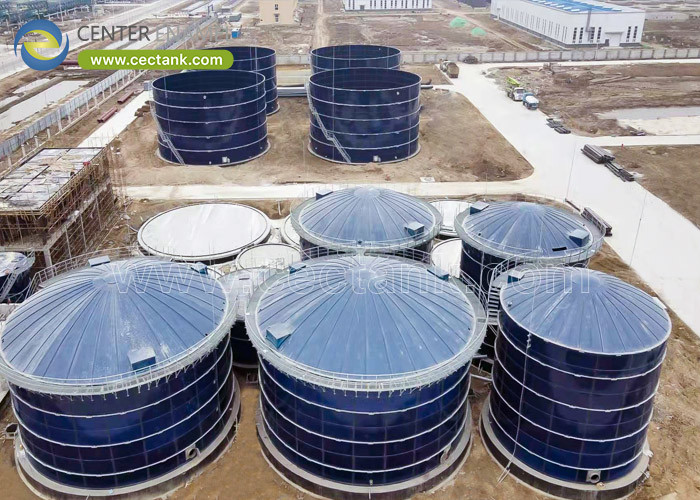
The Best Storage Tank Solution for Municipal Sewage Treatment – GFS Tanks
| Place of Origin: | China |
| Brand Name: | CEC TANKS |
| Certification: | ISO 9001:2008, AWWA D103 , OSHA , BSCI |
| Model Number: | W |
| Minimum Order Quantity: | 1set |
| Price: | $5000~$20000 one set |
| Packaging Details: | PE poly-foam between each two steel plates ; wooden pallet and wooden |
| Delivery Time: | 10-30 days after deposit received |
| Payment Terms: | L/C,T/T |
| Supply Ability: | 60 sets per month |
|
Detail Information |
|||
Product Description
Rapid urbanization, population growth, and stricter environmental protection regulations place unprecedented demands on municipal wastewater treatment plants (WWTPs). Managing the vast daily volumes of domestic sewage, industrial runoff, and combined municipal wastewater requires containment infrastructure that is exceptionally durable, chemically resistant, and structurally reliable. Traditional poured-in-place concrete basins and welded carbon steel tanks frequently fail prematurely under continuous exposure to aggressive biological activity, hydrogen sulfide ($H_2S$) gases, and moisture-driven acid attack, leading to costly leaks, structural degradation, and environmental hazards.
To establish the gold standard for modern municipal sanitation, environmental engineers and municipal utility planners increasingly specify Glass-Fused-to-Steel (GFS)—also known as glass-lined steel—bolted tanks. Engineered and manufactured by Shijiazhuang Zhengzhong Technology Co., Ltd. (Center Enamel), GFS tanks combine the high tensile strength and structural flexibility of industrial steel with the absolute chemical inertness of high-temperature fused glass, making them widely recognized as the best storage tank solution for municipal sewage treatment.
The internal operating environment of a municipal sewage treatment plant is profoundly hostile:
- Biogenic Sulfide and Acid Attack: Anaerobic breakdown of organic waste generates hydrogen sulfide gas. When $H_2S$ oxidizes in the tank headspace, it forms sulfuric acid, which rapidly etches concrete matrices and causes severe pitting corrosion in ordinary steel.
- Hydraulic and Organic Load Fluctuations: Municipal inflows surge during storm events or peak hours, requiring tanks that can handle intense hydrostatic pressures and dynamic volume changes without compromising structural integrity.
- Stringent Environmental and Regulatory Mandates: Municipalities face strict legal penalties for any wastewater leakage or fugitive odor emissions, demanding absolute impermeability across every vessel in the treatment train.
Center Enamel combines cutting-edge material science with precision modular engineering to deliver unmatched performance across every stage of municipal sewage treatment:
- High-Temperature Thermal Fusion: Specialized glass enamel frit is applied to both sides of high-strength structural steel plates and fused in industrial furnaces at extreme temperatures between 820°C and 930°C. The resulting molecular fusion creates an inorganic glaze that permanently bonds the glass to the steel substrate.
- Total Immunity to Chemical and Microbial Corrosion: The ultra-smooth, non-porous glass surface (Mohs hardness of 6.0) provides total resistance to industrial solvents, municipal sewage acids, and microbial-induced corrosion (MIC), preventing bio-fouling and solid accumulation.
- Rapid Modular Bolted Construction: Prefabricated under strict ISO 9001 factory quality controls, GFS panels ship flat to the job site and are bolted together rapidly using high-tensile hardware and industrial sealants, cutting construction timelines drastically compared to cast-in-place concrete.
| Evaluation Metric | Center Enamel GFS Sewage Tank | Cast-in-Place Concrete Basin | Traditional Welded Carbon Steel Tank |
|---|---|---|---|
| Corrosion & Acid Defense | Superior (Inert glass coating completely resists sulfuric acid, $H_2S$, and biological attack) | Moderate (Vulnerable to concrete carbonation, sulfate attack, and liquid seepage) | Low (Dependent on field-applied epoxy coatings that pit, blister, and peel over time) |
| Installation Velocity | Fast (Prefabricated modular panels bolted rapidly on-site with zero curing delays) | Very Slow (Months of civil formwork, pouring, and multi-week curing phases) | Moderate (Requires heavy field plate rolling, welding, and radiograph testing) |
| Lifecycle Maintenance Cost | Minimal (Smooth, anti-adhesion glass surface eliminates interior repainting or lining repairs) | High (Requires frequent structural crack sealing, leak injection, and patching) | High (Continuous maintenance overhead to prevent rust-through and structural failure) |
| Scalability & Relocation | High (Modular bolted design allows effortless height/diameter expansion or relocation) | None (Permanent civil asset; impossible to expand without major demolition) | Limited (Destructive cutting and field welding required to modify capacity) |
Engineering Assurance: All GFS municipal sewage treatment tanks manufactured by Center Enamel comply strictly with internationally recognized quality standards, including ISO 28765, AWWA D103-09, ISO 9001, and NSF/ANSI 61, and undergo 100% high-voltage holiday spark testing (>1500V) prior to factory dispatch.
A: GFS tanks combine the immense structural strength of industrial steel with the chemical inertness and corrosion immunity of glass. Unlike porous concrete basins that crack under shifting loads or welded steel tanks that rust, GFS tanks offer a 30 to 50+ year service life, rapid modular installation, and zero interior repainting requirements.
A: The high-temperature thermal fusion process creates an ultra-hard, non-porous glass coating that is completely immune to sulfuric acid and hydrogen sulfide gas. This prevents the interior wall degradation commonly experienced in municipal sludge digesters and headworks tanks.
A: Yes. Because GFS tanks feature a modular, bolted construction, municipal plant operators can easily dismantle upper ring sections, add new panel tiers to increase height or diameter, and scale up total treatment capacity without major civil demolition.
A: Yes. Center Enamel's tanks comply with rigorous global standards, including ISO 28765 for liquid storage, AWWA D103-09 for bolted steel tanks, ISO 9001 quality management, and NSF/ANSI 61 guidelines, ensuring full regulatory compliance for municipal infrastructure.