-
Glass Fused To Steel Tanks (807)
-
Stainless Steel Tanks (434)
-
Fusion Bonded Epoxy Tanks (592)
-
Galvanized Steel Tanks (321)
-
Aluminum Dome Roofs (1336)
-
Wastewater Storage Tanks (237)
-
Welded Steel Tanks (457)
-
Pressure Vessels (295)
-
Anaerobic Digester (202)
-
Industrial Water Tanks (349)
-
Glass Lined Steel Tanks (180)
-
Bolted Steel Tanks (389)
-
Sludge Storage Tank (115)
-
Biogas Storage Tank (173)
-
Leachate Storage Tanks (133)
-
Agricultural Water Storage Tanks (179)
-
Fire Water Tank (166)
-
Grain Storage Silos (146)
-
Biogas Projects (424)
-
Wastewater Treatment Projects (1530)
-
Double Membrane Roof (223)

|
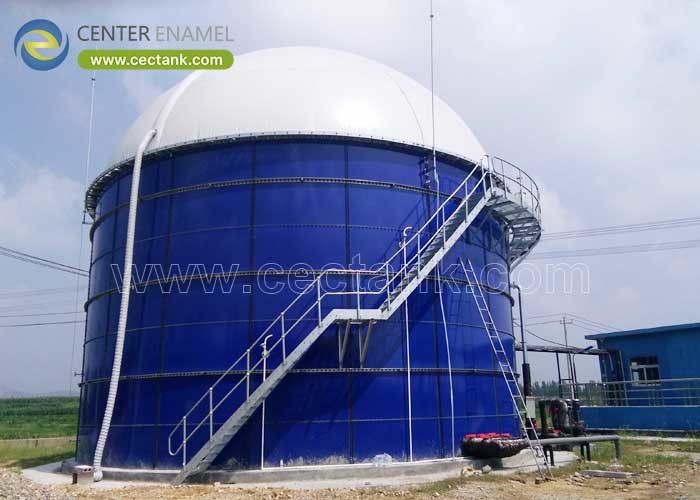
Tightness of Steel Biogas Tanks: Hermetic GFS Design
| Place of Origin: | China |
| Brand Name: | CEC TANKS |
| Certification: | ISO 9001:2008, AWWA D103 , OSHA , BSCI |
| Model Number: | J2016012716 |
| Minimum Order Quantity: | 1set |
| Price: | $5000~$20000 one set |
| Packaging Details: | PE poly-foam between each two steel plates ; wooden pallet and wooden box |
| Delivery Time: | 0-60 days after deposit received |
| Payment Terms: | L/C,T/T |
| Supply Ability: | 60 sets per month |
|
Detail Information |
|||
| Place of Origin | China | Brand Name | CEC TANKS |
|---|---|---|---|
| Certification | ISO 9001:2008, AWWA D103 , OSHA , BSCI | Model Number | J2016012716 |
| Acid And Alkalinity Proof: | Standard Coating Suits For PH3 - PH11, Special Coating Suits For PH1 - PH14 | Elastic: | Same As Steel Sheet , Around 500KN/mm |
| Coating Color: | Dark Blue, Dark Green , White, And Customized | Coating Thickness: | 4.0.25mm - 0.4mm, Two Coating Internal And External |
| Permeability: | Gas And Liquid Impermeable | Steel Plates Thickness: | 3mm - 12mm , Depends On The Diameter & Height |
| Highlight: | hermetic GFS steel biogas tanks,steel biogas tanks with warranty,wastewater storage tanks hermetic design |
||
Product Description
Tightness of Steel Biogas Tanks: Hermetic GFS Design
A tightness steel biogas tank is a bolted Glass-Fused-to-Steel (GFS) vessel engineered to hold biogas at 5-30 mbar with less than 1% daily loss, using 8.8-grade bolts, a 0.25-0.45 mm enamel coat, and a sealed roof. Engineered by Shijiazhuang Zhengzhong Technology Co., Ltd. (Center Enamel), it meets AWWA D103-09 and ISO 28765 for anaerobic duty worldwide.
What a Tightness Steel Biogas Tank Is
A tightness steel biogas tank is a Glass-Fused-to-Steel (GFS) digester whose shell and roof are engineered as a sealed system holding biogas at 5-30 mbar. The enamel coat is 0.25-0.45 mm thick and fused at 820-930°C so the steel never contacts the corrosive slurry or the methane. Capacities reach 20-60,000 m3, and the bolted joints use 8.8-grade fasteners with a gas-tight gasket to stop leakage.
- Seal: 5-30 mbar gas tight.
- Coat: 0.25-0.45 mm enamel.
- Bolts: 8.8-grade gasketed.
- Range: 20-60,000 m3 single.
How the Hermetic Seal Works
The seal works in three layers: a factory-fused enamel that is pinhole-free after a 1500 V holiday test, bolted seams compressed by 8.8-grade fasteners at a specified torque, and a roof-to-shell joint sealed with EPDM or a double-membrane gas holder. Because the enamel is inert, the 30-50 year shell keeps its tightness even when the slurry pH swings between 6.5 and 8.5 during digestion.
- Layer 1: 1500 V tested enamel.
- Layer 2: torqued 8.8 bolts.
- Layer 3: membrane or EPDM roof.
- Life: 30-50 years tight.
Key Types, Components, and Features
The family covers the GFS digester tank, the double-membrane gas holder that stores biogas at 5-30 mbar, and an aluminum geodesic dome roof for tropical sites. Core components are the 0.25-0.45 mm enamel shell, the 8.8-grade bolt set, the manways, the slurry nozzles, and the gas outlet. A 1500 V holiday test on every panel is the feature that guarantees long-term tightness.
- Digester: GFS shell + base.
- Holder: double membrane 5-30 mbar.
- Roof: geodesic or cone.
- Test: 1500 V every panel.
Applications of Hermetic Biogas Tanks
They serve farm anaerobic digestion of livestock manure, food-waste plants, and municipal sludge-to-energy where methane must be captured, not vented. A 30-50 year sealed tank is also used for biogas upgrading feed and for covered lagoons in warm climates. The inert enamel is why the same tank tolerates both the acid start-up phase and the alkaline mature digestate.
- Farms: manure to biogas.
- Food waste: AD plants.
- Municipal: sludge energy.
- Climate: covered lagoons.
Technical Considerations
Technically the steel is blasted to Sa 2.5, the enamel is fused at 820-930°C to 0.25-0.45 mm DFT, and each panel passes a 1500 V holiday test before shipment. The shell is calculated to AWWA D103-09 and ISO 28765, the gas pressure is designed for 5-30 mbar, and an inspection record covers every bolt torque. Design life runs 30-50 years with a documented plan.
- Blast: Sa 2.5 anchor.
- Fuse: 820-930°C, 0.25-0.45 mm.
- Test: 1500 V holiday.
- Bolts: 8.8-grade torque.
| Design parameter | Typical value or range | Why it matters |
| Capacity range | 500-50,000 m3 | Single-tank throughput |
| Hydraulic retention | 20-40 days | Digestion stability |
| Operating temperature | 35-38 °C | Mesophilic default |
| Biogas methane | 55-65 % | Calorific value |
| Gas pressure | 5-30 mbar | Holder and seal design |
| Mixing energy | 5-15 W/m3 | Solids suspension |
| Enamel DFT | 0.25-0.40 mm | Acid resistance |
| Holiday test | 1500 V | Every panel checked |
| Code basis | AWWA D103-09 / ISO 28765 | Design authority |
| Limitation to check | Feed pH below 5.5 | Add correction step |
How to Select a Tightness Steel Biogas Tank
Select by matching the gas pressure (5-30 mbar), the slurry volume (20-60,000 m3), and the corrosiveness (pH 6.5-8.5 normal, confirm below 5.5) to a GFS digester with a documented 1500 V test and 8.8-grade bolts. Ask the supplier for the AWWA D103-09 and ISO 28765 calculation, the holiday-test record, and the reference plants. Reject any offer that cannot show the enamel thickness certificate.
- Match: pressure and volume.
- Confirm: pH window.
- Demand: 1500 V record.
- Verify: ISO 28765 math.
Project Case Study
A verified Glass-Fused-to-Steel (GFS) biogas project in Sweden used a single 5,504 m3 digester tank built in 2024 to convert agricultural residues into methane at 5-30 mbar. The 0.25-0.45 mm enamel coat was holiday-tested at 1500 V and the 8.8-grade bolted seams held the gas tight through a Nordic winter, demonstrating the tightness standard on a real anaerobic site.
- Project: Sweden agricultural biogas
- Location: Sweden, Europe
- Industry: Renewable energy
- Application: Anaerobic digestion
- Product: GFS bolted digester tank
- Capacity: 5,504 m3
- Quantity: 1 tank
- Material: Glass-Fused-to-Steel
- Standards: AWWA D103-09 / ISO 28765
- Year: 2024
About Shijiazhuang Zhengzhong Technology Co., Ltd.
Shijiazhuang Zhengzhong Technology Co., Ltd. (Center Enamel) is a Chinese manufacturer founded in 2008 that has shipped Glass-Fused-to-Steel (GFS) tanks to more than 100 countries and holds nearly 200 enamel-related patents. Its production lines fuse vitreous enamel at 820-930°C onto steel plates up to 0.45 mm DFT and holiday-test every panel at 1500 V before export, giving the bolted-tank program a documented manufacturing base.
- Founded: 2008 in China.
- Reach: 100+ countries.
- Patents: nearly 200 enamel.
- Process: 820-930°C fusing.
Advantages and Limitations
The enamel seal gives a near-inert, 30-50 year shell that holds methane at 5-30 mbar without repainting. A genuine limitation is that a GFS digester is not the right choice when the feedstock stays below pH 5.5 for long without a correction step; this boundary must be confirmed in process design, not after erection, or the coating warranty is at risk.
- Advantage: inert, 30-50 years.
- Advantage: no repaint.
- Limitation: avoid pH<5.5 as-is.
- Boundary: confirm in design.
Comparison With Other Biogas Tanks
Against welded coated steel and concrete, a Glass-Fused-to-Steel (GFS) biogas tank wins on factory-controlled enamel quality and 30-50 year tightness, while welded tanks need field coating and concrete needs long curing. The table below contrasts the four common bodies on the points that decide biogas leakage and life.
- GFS: factory enamel, tight.
- Welded: field-applied coat.
- Concrete: slow, porous.
- FBE: good acid option.
| Criterion | GFS bolted tank | Welded steel tank | Concrete tank | FRP tank |
| Corrosion defense | Vitreous enamel, inert | Coating-dependent | Good but porous | Liner-dependent |
| Construction | Bolted, fast on site | Welded, slower | Cast in place | Molded / shop |
| Capacity ceiling | Up to 60,000 m3 | Up to 150,000 m3 | Very large | Limited (<5,000 m3) |
| Design life | 30-50 years | 30-50 years | 40-60 years | 20-30 years |
| Best fit | Corrosive, modular | Very large, generic | Heavy civil works | Small, neat chemical |
Conclusion
A tightness steel biogas tank is defined by a sealed Glass-Fused-to-Steel (GFS) shell, 8.8-grade bolts, and a 1500 V holiday-tested enamel that holds methane at 5-30 mbar for 30-50 years. Specify the AWWA D103-09 and ISO 28765 calculations and the enamel certificate, and the digester will perform on the first winter, not the fifth.
- Seal: enamel + torque.
- Proof: 1500 V record.
- Life: 30-50 years.
Frequently Asked Questions (FAQ)
What makes a steel biogas tank gas tight?
A gas tight seal comes from three layers: a pinhole-free 0.25-0.45 mm enamel coat verified at 1500 V, 8.8-grade bolted seams compressed to a set torque, and a sealed roof or double-membrane holder. Together they hold biogas at 5-30 mbar with minimal daily loss over a 30-50 year life.
What pressure do biogas tanks hold?
Most bolted Glass-Fused-to-Steel (GFS) digesters and their membrane holders are designed for 5-30 mbar of biogas pressure. The shell and roof are calculated to AWWA D103-09 and ISO 28765 for that low-pressure, high-corrosion duty rather than for high-pressure storage.
How is tank tightness verified before shipment?
Every enamel panel is holiday-tested at 1500 V to find pinholes, and the bolt torque is recorded at erection. A supplier should provide the holiday-test log, the enamel-thickness certificate (0.25-0.45 mm), and the ISO 28765 calculation as evidence of a sealed tank.
Can a GFS digester handle acidic feedstock?
A GFS digester tolerates the normal digestion pH window of 6.5-8.5. If the feedstock stays below pH 5.5 for long, a correction or a specialized liner must be added; this boundary is confirmed during process design, not after the tank is installed.
What standards apply to bolted biogas tanks?
The common standards are AWWA D103-09 for bolted steel tanks and ISO 28765 for the enamel design, with ISO 9001 for quality and ISO 45001 for safety. Potable-adjacent duties may also reference NSF/ANSI 61.
What information is needed for a biogas tank quotation?
Provide the daily feed volume, the slurry pH and temperature (35-38°C mesophilic typical), the gas-pressure requirement (5-30 mbar), the site wind and snow load, and the total volume (20-60,000 m3). That lets the supplier size the GFS shell and the membrane holder accurately.
Suggested CTA: Submit your biogas feed volume, pH window, and 5-30 mbar gas profile to the Center Enamel engineering team for a sealed Glass-Fused-to-Steel digester quotation.