-
Glass Fused To Steel Tanks (617)
-
Stainless Steel Tanks (434)
-
Fusion Bonded Epoxy Tanks (592)
-
Galvanized Steel Tanks (321)
-
Aluminum Dome Roofs (1336)
-
Wastewater Storage Tanks (237)
-
Welded Steel Tanks (457)
-
Pressure Vessels (295)
-
Anaerobic Digester (202)
-
Industrial Water Tanks (349)
-
Glass Lined Steel Tanks (180)
-
Bolted Steel Tanks (389)
-
Sludge Storage Tank (115)
-
Biogas Storage Tank (173)
-
Leachate Storage Tanks (133)
-
Agricultural Water Storage Tanks (179)
-
Fire Water Tank (166)
-
Grain Storage Silos (146)
-
Biogas Projects (424)
-
Wastewater Treatment Projects (1303)
-
Double Membrane Roof (223)
|
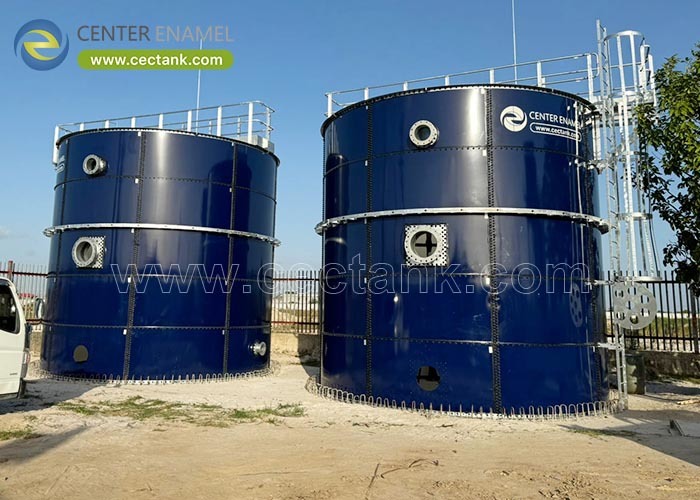
Liquid Storage Tanks Selecting the Right Bolted Tank for Every Liquid
| Brand Name: | Shijiazhuang Zhengzhong Technology Co.,Ltd |
|
Detail Information |
|||
Product Description
Liquid Storage Tanks Selecting the Right Bolted Tank for Every Liquid
Liquid storage tanks hold the world's working fluids — drinking water, wastewater, leachate, slurry, fire water, process chemicals, and agricultural liquids. Across municipal, industrial, and agricultural facilities, the storage question is always the same: which tank material will survive this specific liquid, at this volume, on this schedule, for the next several decades? The traditional answers age poorly. Concrete vessels crack and leach under chemical attack; field-welded carbon steel depends on coatings applied outdoors, where one pinhole starts a corrosion cell the operator pays for every year thereafter.
Center Enamel manufactures factory-coated bolted liquid storage tanks in four material systems — Glass-Fused-to-Steel (GFS), fusion bonded epoxy (FBE), stainless steel, and hot-dip galvanized steel — engineered to AWWA D103-09, NSF/ANSI 61, and ISO 28765. As the first GFS tank manufacturer in China, holding nearly 200 enameling patents and exporting to more than 100 countries since 2008, it matches the tank material to the liquid rather than forcing one lining to do every job.
1. What Are Bolted Liquid Storage Tanks?
Bolted liquid storage tanks are modular vessels assembled on site from factory-manufactured, factory-coated steel panels joined with gasketed seams and 8.8 grade high-strength bolts — combining welded-steel strength with unprecedented quality control of the corrosion barrier.
· Factory coating discipline: GFS panels are fired at 820-930°C and FBE panels are oven-cured under ISO 9001 control, then 100% high-voltage holiday spark tested — no coating work happens on the jobsite, where weather decides quality.
· Structural pedigree: every configuration is FEA-verified to AWWA D103-09 for liquid head, wind, and seismic loads, from 20 m³ to more than 20,000 m³.
· Speed and portability: panels ship in standard containers and erect with small crews in days to weeks; tanks can later be extended or relocated as process needs change.
· Complete accessories: manholes, flanges, ladder and platform systems, vents, and mixer mounts integrate at engineered panel positions.
2. Matching the Tank Material to the Stored Liquid
Liquid chemistry — pH, chlorides, sulfides, temperature, and solids — dictates the lining. Selecting on lifecycle chemistry rather than first cost is what separates a 30-year tank from a 10-year problem.
· Drinking and process water: NSF/ANSI 61 and WRAS certified GFS provides an inert, non-leaching glass surface; hot-dip galvanized steel (~450°C zinc) offers an economical option for non-potable and agricultural water.
· Municipal and industrial wastewater: FBE and GFS withstand hydrogen sulfide, variable pH, and grease-laden headspaces; ISO 28765 governs enameling quality for these duties.
· Sludge, slurry, and leachate: abrasive and chemically aggressive liquids demand the hardness and inertness of fired glass — GFS is the reference solution for landfill leachate and digested sludge across 100+ export markets.
· High-purity and specialty liquids: 304/316/316L stainless steel delivers a polishable, inert metallic surface for food, beverage, pharmaceutical, and sensitive chemical service (LFGB-compliant options).
3. Compliance, Lifecycle, and Total Cost of Ownership
A liquid storage tank is a 30-year liability or a 30-year asset, decided at specification time. Certified bolted steel systematically outperforms site-built alternatives on total cost.
· Compliance file: ISO 9001, ISO 45001, NSF/ANSI 61, EN 1090, ISO 28765, WRAS, FM, LFGB, and BSCI certifications cover regulated markets from North America to Europe and the Gulf.
· Zero-recoat lifecycle: GFS and FBE linings carry 30-50 year design lives without recoating; coated welded steel enters 5-10 year recoating cycles and concrete enters repair programs within 15-20 years.
· Operational protection: the inert surfaces resist biofilm anchoring and scaling, simplifying cleaning and water-quality management across the service life.
· Residual value: bolted construction retains value — tanks can be expanded, relocated, or repurposed as network requirements evolve.
|
Evaluation Criterion |
Center Enamel Bolted (GFS/FBE/SS/Galv) |
Cast-in-Place Concrete |
Field-Welded Coated Steel |
|
Chemical and corrosion defense |
Superior — matched factory linings, 100% spark tested |
Poor — carbonation, cracking, chemical attack |
Moderate — field coating with holiday risk |
|
Construction velocity |
Fast — modular bolted erection |
Very slow — formwork and 28-day cure |
Slow — welding, blasting, field coating |
|
Liquid compatibility range |
High — four certified material systems |
Low — attacked by acids, sulfates, VFAs |
Low-moderate — limited by coating chemistry |
|
Lifecycle and maintenance |
Minimal — 30-50 year design life |
High — recurring repairs |
High — 5-10 year recoat cycles |
|
Modularity and future flexibility |
High — extendable and relocatable |
None |
None |
Engineering Assurance
Every tank ships with FEA-based structural calculations to AWWA D103-09, coating certificates with 100% holiday spark-test records, and ISO 9001/45001 manufacturing discipline — the documentation package inspectors, insurers, and financiers ask for.
There is no universal lining — there is only the right lining for the liquid. Match chemistry to coating in the factory, and the tank quietly outlives the process it serves. — Senior Materials Engineer, Shijiazhuang Zhengzhong Technology Co., Ltd (Center Enamel)
Frequently Asked Questions (FAQ)
What are the main types of liquid storage tanks?
The main bolted types are Glass-Fused-to-Steel (potable water and corrosive liquids), fusion bonded epoxy (wastewater and chemicals), stainless steel (high-purity liquids), and hot-dip galvanized steel (economical water and general service). Each is certified for its duty — NSF/ANSI 61, ISO 28765, WRAS, LFGB.
How do I choose a tank material for my liquid?
Match the lining to liquid chemistry: pH range, chlorides, sulfides, temperature, and solids content. Drinking water suits NSF-certified GFS; wastewater and leachate suit FBE/GFS; food and pharma liquids suit 316L stainless. Center Enamel's engineers confirm selection against your analysis.
How long do bolted liquid storage tanks last?
GFS and FBE bolted tanks carry 30-50 year design lives without recoating, versus 15-20 years to first major repair for concrete and 5-10 year recoating cycles for field-coated welded steel.
Can liquid storage tanks be customized?
Yes — capacities from 20 m³ to over 20,000 m³, custom diameters and heights, roof options including aluminum geodesic domes, and full accessory packages are engineered per project with site-specific wind and seismic FEA.
·