-
Glass Fused To Steel Tanks (617)
-
Stainless Steel Tanks (434)
-
Fusion Bonded Epoxy Tanks (592)
-
Galvanized Steel Tanks (321)
-
Aluminum Dome Roofs (1336)
-
Wastewater Storage Tanks (237)
-
Welded Steel Tanks (457)
-
Pressure Vessels (295)
-
Anaerobic Digester (202)
-
Industrial Water Tanks (349)
-
Glass Lined Steel Tanks (180)
-
Bolted Steel Tanks (389)
-
Sludge Storage Tank (115)
-
Biogas Storage Tank (173)
-
Leachate Storage Tanks (133)
-
Agricultural Water Storage Tanks (179)
-
Fire Water Tank (166)
-
Grain Storage Silos (146)
-
Biogas Projects (424)
-
Wastewater Treatment Projects (1303)
-
Double Membrane Roof (223)


|
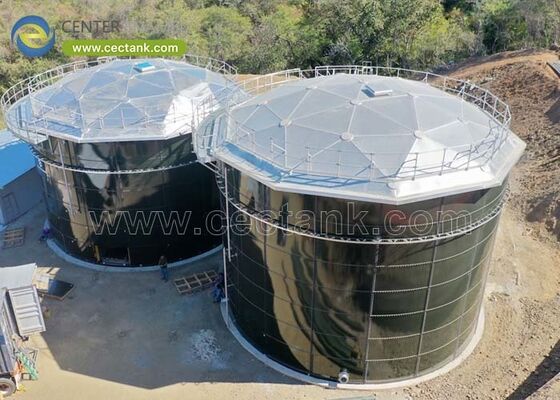
Bolted Steel Dry Bulk Storage Silos with Aluminum Deck Roof: Advanced Solutions for Secure and Efficient Bulk Storage
| Place of Origin: | China |
| Brand Name: | CEC TANKS |
| Certification: | ISO 9001:2008, AWWA D103 , OSHA , BSCI |
| Model Number: | J2016012315 |
| Minimum Order Quantity: | 1set |
| Price: | $5000~$20000 one set |
| Packaging Details: | PE poly-foam between each two steel plates ; wooden pallet and wooden box |
| Delivery Time: | 0-60 days after deposit received |
| Payment Terms: | L/C,T/T |
| Supply Ability: | 60 sets per month |
|
Detail Information |
|||
| Place of Origin | China | Brand Name | CEC TANKS |
|---|---|---|---|
| Certification | ISO 9001:2008, AWWA D103 , OSHA , BSCI | Model Number | J2016012315 |
| Acid And Alkalinity Proof: | Standard Coating Suits For PH3 - PH11, Special Coating Suits For PH1 - PH14 | Elastic: | Same As Steel Sheet , Around 500KN/mm |
| Serive Life: | More Than 30 Years | PH Range: | PH 1 - PH 14 |
| Coating Color: | Dark Blue, Dark Green , White, And Customized | Steel Plates Thickness: | 3mm - 12mm , Depends On The Diameter & Height |
| Easy Yo Clean: | Smooth, Glossy, Inert, Anti-adhesion | Coating Thickness: | 4.0.25mm - 0.4mm, Two Coating Internal And External |
| Highlight: | bolted steel bulk storage silos,aluminum deck roof silos,glass fused steel bulk tanks |
||
Product Description
Bolted Steel Dry Bulk Storage Silos with Aluminum Deck Roof: Advanced Solutions for Secure and Efficient Bulk Storage
What Makes Bolted Steel the Ideal Structural Choice for Dry Bulk Silos?
Bolted steel is the premier structural choice because it combines the fast assembly times of modular components with factory-applied, abrasion-resistant barrier coatings. Unlike concrete structures that are prone to thermal cracking or field-welded units that require extensive hot work, bolted silos are manufactured in a controlled environment to ensure zero structural defects.
Industrial facilities utilize bolted steel dry bulk silos for three essential reasons:
·
OptiBond™ Factory Coatings: Advanced interior polymer coatings or powder-epoxies deliver maximum abrasion resistance against sliding bulk solids, ensuring a completely smooth wall profile that prevents material hang-ups.
·
·
Scalable Engineering: The modular nature of bolted panels allows plants to scale capacity upwards by adding lower panel tiers or entirely relocating the structure as production footprints shift.
·
·
Reduced Site Friction: Shipped completely unassembled via standard commercial shipping containers, these silos can be built in remote or confined configurations without requiring heavy cranes or field welding crews.
·
Why Is an Aluminum Deck Roof Critical for Protecting Bulk Solids?
Direct Answer: An aluminum deck or geodesic dome roof provides an absolute environmental barrier that blocks moisture ingress while eliminating the recurring internal column supports that trap dust and trigger structural fatigue. Aluminum naturally generates a self-healing oxide layer, rendering the roof completely immune to atmospheric rust and chemical degradation.
Key design benefits include:
·
Clear-Span Architecture: By utilizing a triangulated lattice geometry, the structural weight is transferred purely to the tank perimeter. This creates an internal environment free of columns, columns that would otherwise disrupt mass-discharge handling systems.
·
·
Galvanic Corrosion Isolation: To eliminate electrical current exchange between the aluminum roof structure and the coated steel silo shell, engineers employ advanced isolation gaskets and specialized non-conductive washers.
·
·
Vapor-Tight Environmental Seal: Paired with synthetic elastomeric seals, the deck prevents outdoor humidity from causing bulk powders like cement, chemicals, or agricultural grains to cake, spoil, or clump.
·
How Do Mass Flow and Funnel Flow Dynamics Impact Silo Engineering?
Direct Answer: Mass Flow guarantees a strict First-In, First-Out (FIFO) inventory discharge where all stored material stays active, completely preventing product segregation. Funnel Flow allows only a central core column of material to discharge while the perimeter remains stagnant, which works well for coarse, non-cohesive bulk solids but poses risk for sensitive powders.
To select the ideal silo hopper design, engineers weigh several variables:
|
Flow Attribute |
Mass Flow Design (FIFO Profile) |
Funnel Flow Design (Core Profile) |
|
Material Movement |
Entire cross-section is fully active during discharge. |
Material flows down a central channel; outer zones remain static. |
|
Discharge Pattern |
First-In, First-Out (FIFO). |
Last-In, First-Out (LIFO). |
|
Risk of Ratholing |
Extremely low; eliminates static dead zones. |
High; sticky materials form stable structural arches. |
|
Silo Structural Loading |
High dynamic pressures exerted continuously along the walls. |
Asymmetric pressures; requires localized structural reinforcement. |
|
Ideal Application |
Cohesive chemical powders, flour, sugar, fine grains. |
Coarse aggregates, dry gravel, sand, plastic pellets. |
The Step-by-Step Installation Process of a Modular Dry Bulk Silo
The structural assembly of an industrial bolted bulk silo is carefully timed to minimize field exposure and ensure consistent safety parameters:
00001.
Foundation Setting and Anchor Placement:Day 1. Pour a high-strength reinforced concrete slab embedded with structural anchor rings. Allow full curing to handle early tension forces.
00002.
00003.
Top Ring and Aluminum Deck Construction:Days 2-3. Assemble the top panel ring directly on the foundation floor. Construct the clear-span aluminum deck roof over this ring while working safely at ground level.
00004.
00005.
Jacking System Integration:Day 4. Mount specialized synchronized mechanical or hydraulic lifting jacks around the interior perimeter of the base slab.
00006.
00007.
Vertical Expansion Tiers:Days 5-6. Lift the top tier upward using the jacking system. Bolt successive panel rings underneath using elastomeric gaskets, working down to the final base ring.
00008.
00009.
Hopper and Ancillary Integration:Day 7. Integrate the discharge hopper cone, explosion relief venting doors, external maintenance ladders, and level indicator arrays.
00010.