-
Glass Fused To Steel Tanks (596)
-
Stainless Steel Tanks (434)
-
Fusion Bonded Epoxy Tanks (592)
-
Galvanized Steel Tanks (321)
-
Aluminum Dome Roofs (1336)
-
Wastewater Storage Tanks (232)
-
Welded Steel Tanks (457)
-
Pressure Vessels (295)
-
Anaerobic Digester (202)
-
Industrial Water Tanks (349)
-
Glass Lined Steel Tanks (180)
-
Bolted Steel Tanks (389)
-
Sludge Storage Tank (115)
-
Biogas Storage Tank (173)
-
Leachate Storage Tanks (133)
-
Agricultural Water Storage Tanks (179)
-
Fire Water Tank (166)
-
Grain Storage Silos (146)
-
Biogas Projects (424)
-
Wastewater Treatment Projects (1078)
-
Double Membrane Roof (223)

|
Leading Anaerobic Technologies with GFS Tanks for India’s Kitchen Waste Treatment
| Place of Origin: | China |
| Brand Name: | CEC TANKS |
| Certification: | ISO 9001:2008, AWWA D103 , OSHA , BSCI |
| Model Number: | W |
| Minimum Order Quantity: | 1set |
| Price: | $5000~$20000 one set |
| Packaging Details: | PE poly-foam between each two steel plates ; wooden pallet and wooden |
| Delivery Time: | 10-30 days after deposit received |
| Payment Terms: | L/C,T/T |
| Supply Ability: | 60 sets per month |
|
Detail Information |
|||
| Place of Origin | China | Brand Name | CEC TANKS |
|---|---|---|---|
| Certification | ISO 9001:2008, AWWA D103 , OSHA , BSCI | Model Number | W |
| Tank Body Color: | Dark Green / Can Be Customized | Corrosion Integrity: | Excellent |
| Steel Plates Thickness: | 3mm To 12mm , Depends On The Tank Structure | Chemical Resistance: | Excellent |
| Size Of Panel: | 2.4M * 1.2M | Easy To Clean: | Smooth, Glossy, Inert, Anti-adhesion |
| Highlight: | anaerobic digestion GFS tanks,kitchen waste treatment technology,wastewater treatment GFS tanks |
||
Product Description
Leading Anaerobic Technologies with GFS Tanks for India’s Kitchen Waste Treatment
This article explores advanced organic waste management systems utilizing high-performance GFS tanks in India. As a leading industry provider, Center Enamel delivers comprehensive anaerobic technologies tailored to local environmental needs. Discover how innovative bio-energy recovery and robust containment technologies transform food waste into clean renewable energy. Learn about our end-to-end capabilities designed to foster sustainable development across the region.
Kitchen Waste Sources and Treatment Challenges
Kitchen waste primarily originates from daily domestic cooking, vibrant food processing industries, professional catering services, bustling restaurants, hotels, institutional canteens, and local markets. Managing this waste stream presents significant hurdles due to its extremely high moisture content ranging from 80% to 95%, which causes rapid putrefaction. Furthermore, the waste features high concentrations of organic matter, proteins, cellulose, starch, and fats, accompanied by elevated salt levels and residues of chili and acetic acid. Pathogenic bacteria and harmful microorganisms thrive within these organic slurries, leading to foul odors and the rapid breeding of mosquitoes and flies if not properly contained.
Kitchen Waste Treatment Process Flow
To address the complex nature of food waste, modern treatment facilities adopt a systematic multi-stage workflow designed for harmless reduction and resource recovery. The process begins with raw material collection, followed by heavy foreign object separation using dual-shaft crushers and multi-function crushing and sorting machines. Mixed pulping tanks and heating oil separator tanks then condition the slurry before solid-liquid separation and oil-water separation recover valuable byproducts. The remaining organic liquid enters regulating tanks and is pumped into anaerobic digestion systems operating under strict thermal and biological controls. Finally, biogas is purified for power generation while digestates undergo dewatering and stabilization to yield clean water and solid residues.
Center Enamel Professional Design Solutions for Kitchen Waste Treatment
Center Enamel delivers highly customized and professional design solutions optimized for modern kitchen waste treatment initiatives. Leveraging extensive engineering expertise, our technical team formulates customized layout plans that seamlessly integrate pre-treatment, anaerobic fermentation, biogas purification, and wastewater treatment modules. Every system is engineered to maximize organic degradation efficiency while minimizing operational footprints and energy consumption. Our designs strictly adhere to international environmental standards, ensuring reliable performance, structural safety, and high-yield resource recovery for municipal and industrial clients alike.
Core Anaerobic Technology - CSTR Process
The anaerobic digestion of food waste predominantly utilizes the Continuous Stirred Tank Reactor (CSTR) process to maintain optimal biological activity. In this closed reactor system, fermentation raw materials and anaerobic microorganisms are kept in a completely mixed and uniform state through mechanical stirring. By maintaining continuous or semi-continuous feeding at a constant temperature, organic slurries with high suspended solids are thoroughly degraded. This active mixing prevents acidification, eliminates thermal stratification, and maximizes biogas production efficiency while ensuring stable biochemical reactions throughout the digestion cycle.
GFS Tanks for Kitchen Waste Treatment
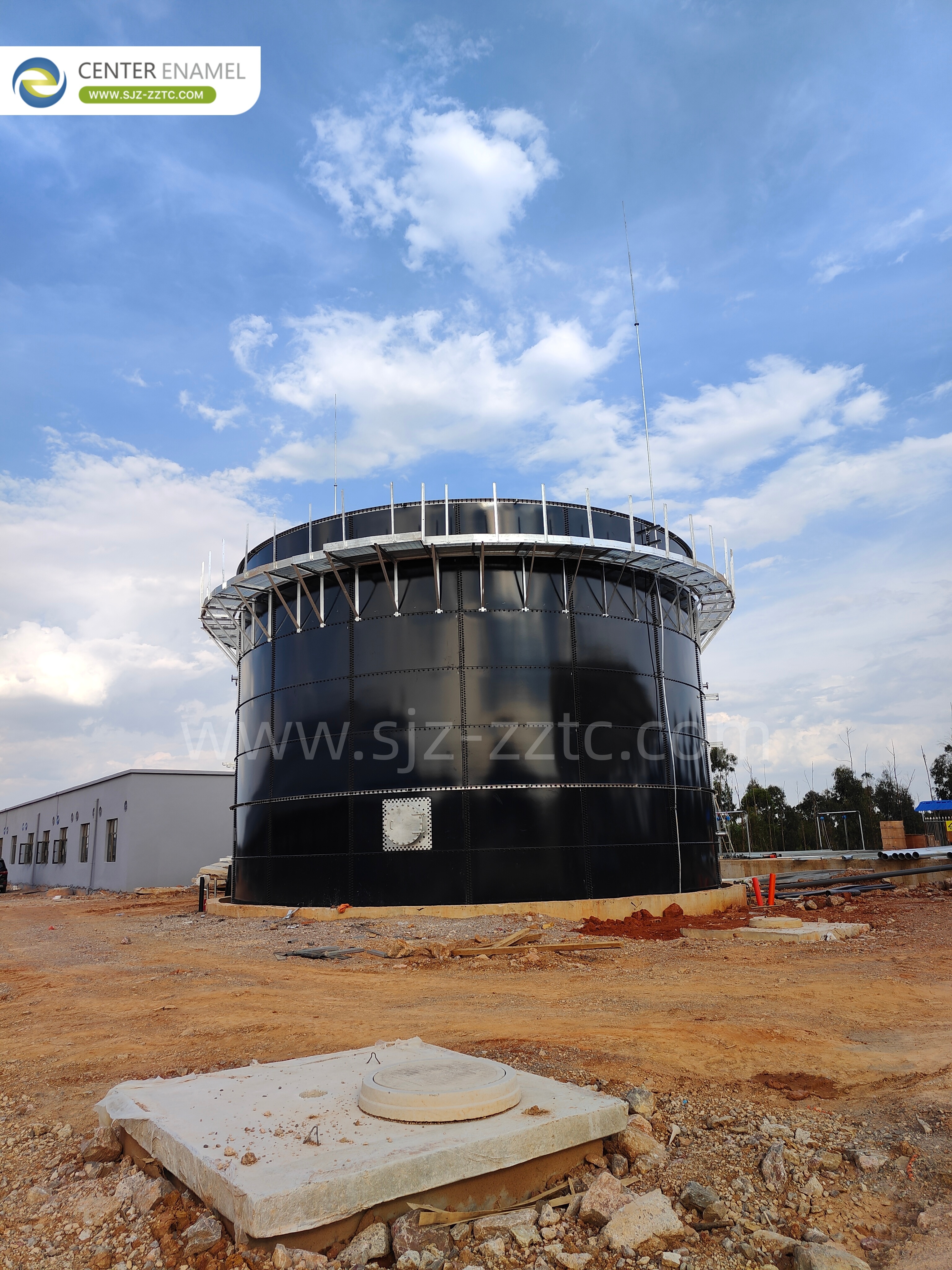
Glass-Fused-to-Steel (GFS) tanks represent the gold standard in containment technology for anaerobic digestion and wastewater infrastructure. Manufactured by fusing molten glass to high-strength steel plates at high temperatures between 820°C and 930°C, these tanks create an inert, inorganic bond. This advanced double-coating layer structure (2C2F) combines the structural flexibility of steel with the exceptional corrosion resistance of glass. GFS tanks offer superior durability against harsh chemical environments, feature rapid modular installation, require minimal maintenance, and hold prestigious international certifications including WRAS, ISO, FDA, NSF, and EN.
Center Enamel Other Storage Tanks and Cover Solutions
Galvanized Steel Tanks: Utilize advanced galvanizing processes to deliver tough, wear-resistant, and durable protective coatings for superior corrosion defense.
Fusion Bonded Epoxy (FBE) Tanks: Developed in partnership with AkzoNobel, featuring innovative coating technology for exceptional surface protection.
Stainless Steel Tanks: Constructed from high-quality AISI 304/316 stainless steel to withstand extreme chemical environments and high-purity applications.
Aluminum Geodesic Dome Roofs: Offer expansive clear spans and advanced corrosion resistance for tank containment.
Glass-Fused-to-Steel Roofs: Provide exceptional air-tightness and odour control for pressurized structures and cone-shaped roof configurations.
Single and Double Membrane Roofs: Deliver superior biogas collection and airtight integration for anaerobic digestion tanks.
Aluminum Alloy Trough Deck Roofs: Serve as economical, weather-resistant options to keep out rain and wind without air-tightness requirements.
Stainless Steel Roofs: Offer super anti-corrosion performance and long service life for harsh environments.
FRP Roofs: Provide versatile dome or flat cover solutions suitable for non-airtight storage situations like drinking water or fire water.
Other Equipment for Kitchen Waste Treatment
Our comprehensive project delivery includes an extensive suite of specialized auxiliary equipment designed for optimal system performance.
Gas Holders: Store generated biogas securely with flexible, weather-resistant membrane structures.
Dual-shaft Crushers: Efficiently break down large and heavy foreign objects that resist standard processing.
Multi-function Crushing and Sorting Machines: Separate light plastics and debris from organic slurries.
Mixed Pulping Tanks: Homogenize feedstock prior to biological treatment.
Dehydration and Desulfurization Tanks: Remove moisture and corrosive hydrogen sulfide from raw biogas.
Lifting Pumps: Facilitate reliable fluid transfer across elevation changes.
Submersible Mixers: Maintain homogeneous suspension within reactor vessels.
Solid-liquid Separators: Extract moisture efficiently from digested slurries.
Center Enamel as a One-Stop Solution Provider for Kitchen Waste Treatment Projects
Center Enamel operates as a premier one-stop solution provider, delivering turnkey capabilities for kitchen waste treatment projects from conception to completion.
Custom Engineering Design: Formulates integrated layout plans tailored to local site conditions and regulatory parameters.
Proprietary Equipment Manufacturing: Produces high-quality GFS tanks, auxiliary vessels, and mechanical systems under strict quality controls.
Core Technology Supply: Delivers advanced anaerobic digestion and biogas purification technologies for maximum resource recovery.
Installation and Commissioning Guidance: Provides expert technical supervision to ensure seamless plant assembly and startup.
Conclusion
Implementing advanced kitchen waste treatment systems is vital for transforming hazardous organic refuse into clean renewable energy and valuable resources. Center Enamel combines cutting-edge engineering, robust GFS tank technology, and comprehensive project execution to empower sustainable waste management across India. Through innovative anaerobic technologies and strict environmental engineering practices, we help communities achieve circular economy goals. Partner with Center Enamel to drive reliable, efficient, and future-ready environmental infrastructure development.
Frequently Asked Questions
How do anaerobic technologies scale to meet large municipal kitchen waste volumes in India?
Advanced anaerobic configurations utilize modular CSTR designs and high-rate biological reactors that can be expanded easily to process growing quantities of urban food waste.
What thermal regulation methods are used in GFS digester tanks to maintain stability?
Digestion systems incorporate internal or external heat exchangers connected to hot water loops, ensuring stable mesophilic temperatures required for optimal methanogenic activity.
How does Center Enamel guarantee structural integrity across diverse seismic zones?
Engineering teams execute rigorous structural calculations and utilize high-strength bolted steel panels designed to withstand regional wind loads and seismic movements safely.