-
Glass Fused To Steel Tanks (596)
-
Stainless Steel Tanks (434)
-
Fusion Bonded Epoxy Tanks (592)
-
Galvanized Steel Tanks (321)
-
Aluminum Dome Roofs (1336)
-
Wastewater Storage Tanks (232)
-
Welded Steel Tanks (457)
-
Pressure Vessels (295)
-
Anaerobic Digester (201)
-
Industrial Water Tanks (349)
-
Glass Lined Steel Tanks (180)
-
Bolted Steel Tanks (389)
-
Sludge Storage Tank (115)
-
Biogas Storage Tank (173)
-
Leachate Storage Tanks (133)
-
Agricultural Water Storage Tanks (179)
-
Fire Water Tank (166)
-
Grain Storage Silos (146)
-
Biogas Projects (425)
-
Wastewater Treatment Projects (928)
-
Double Membrane Roof (223)


|
Leading Biogas Solutions with GFS Tanks and Double Membrane Roofs for Restaurant Food Waste in Singapore
| Place of Origin: | China |
| Brand Name: | CEC TANKS |
| Certification: | ISO 9001:2008, AWWA D103 , OSHA , BSCI |
| Model Number: | W |
| Minimum Order Quantity: | 1set |
| Price: | $5000~$20000 one set |
| Packaging Details: | PE poly-foam between each two steel plates ; wooden pallet and wooden |
| Delivery Time: | 10-30 days after deposit received |
| Payment Terms: | L/C,T/T |
| Supply Ability: | 60 sets per month |
|
Detail Information |
|||
| Place of Origin | China | Brand Name | CEC TANKS |
|---|---|---|---|
| Certification | ISO 9001:2008, AWWA D103 , OSHA , BSCI | Model Number | W |
| Tank Body Color: | Dark Green / Can Be Customized | Corrosion Integrity: | Excellent |
| Steel Plates Thickness: | 3mm To 12mm , Depends On The Tank Structure | Chemical Resistance: | Excellent |
| Size Of Panel: | 2.4M * 1.2M | Easy To Clean: | Smooth, Glossy, Inert, Anti-adhesion |
| Highlight: | biogas solutions for restaurant waste,GFS tanks for wastewater treatment,double membrane roof biogas systems |
||
Product Description
In the densely populated landscape of Singapore, where the food and beverage industry serves as a pillar of the local economy, the management of restaurant food waste has emerged as a significant environmental hurdle. With limited land available for traditional waste disposal, relying on incineration or landfilling contributes to substantial greenhouse gas emissions and resource loss. For a nation committed to the "Singapore Green Plan 2030" and circular economy principles, the continued disposal of organic waste is no longer a viable path. Transitioning toward advanced waste-to-energy technologies is imperative, as it allows the city-state to mitigate environmental impact while reclaiming organic matter as a valuable renewable energy asset, thereby contributing to Singapore's long-term energy security and sustainability goals.
Transforming restaurant food waste into biogas through anaerobic digestion presents a circular solution tailored for Singapore’s urban requirements. This biological process breaks down organic scraps in a controlled, oxygen-free environment, yielding high-quality, methane-rich biogas. The benefits of this approach are twofold: it significantly reduces the volume of organic waste destined for disposal, and it produces a reliable, clean energy source that can be harnessed for on-site electricity generation, industrial-grade heating, or sustainable cooking fuel. By integrating such bio-energy systems, businesses and municipalities can decrease their carbon footprint, lower operational costs, and align with global sustainability benchmarks, fostering a resilient, decentralized energy infrastructure that supports long-term ecological balance.
Center Enamel is dedicated to supporting Singapore’s transition to renewable energy through expert, customized engineering and design. With over 36 years of global experience, our technical teams specialize in creating process packages that are meticulously engineered to handle the high organic concentration and specific composition of urban food waste streams. We move away from generic, "one-size-fits-all" approaches; instead, we partner with developers to architect systems that are optimized for maximum yield, peak performance, and strict adherence to Singapore's environmental regulations. From the initial site assessment and feasibility analysis to advanced structural engineering, our commitment is to provide the operational reliability and efficiency required to meet the unique, high-standard demands of the Singaporean market.
Central to our technical portfolio is the Continuous Stirred-Tank Reactor (CSTR) process, a sophisticated anaerobic treatment technology ideally suited for food waste management. Designed to manage feedstocks with high organic concentrations and significant suspended solids, the CSTR ensures optimal digestion. The reactor features a precision-engineered mechanical stirring mechanism that maintains a constant, thorough integration of organic feed and active anaerobic microorganisms. This controlled environment effectively eliminates dead zones within the reactor, significantly accelerating the degradation of complex organic materials and ensuring a stable, highly productive output of quality biogas throughout the entire life of the project.
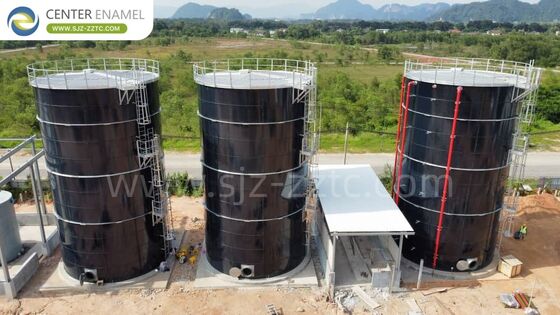
For peak performance in biogas storage, Center Enamel utilizes state-of-the-art Glass-Fused-to-Steel (GFS) tanks. These tanks are fabricated through a high-temperature firing process (820°C–930°C), which creates an inert, robust bond that combines the structural integrity of high-grade steel with the exceptional corrosion resistance of glass. When combined with a Double Membrane Roof, the system represents the gold standard for biogas containment. This configuration ensures superior airtightness, essential for effective odor control and efficient biogas collection, while also maximizing vertical storage space—a critical advantage in space-constrained urban environments like Singapore.
- Aluminum Geodesic Dome Roof: Offers expansive clear-span capabilities, high corrosion resistance, and rapid, cost-effective assembly.
- Glass-Fused-to-Steel Roof: The optimal choice for pressurized environments where stringent odor control is a primary operational requirement.
- Aluminum Alloy Trough Deck Roof: An economical, weather-resistant cover ideal for storage applications where high airtightness is not the main functional necessity.
- Stainless Steel Roof: Expertly manufactured to withstand harsh or highly aggressive chemical environments, ensuring long-term structural reliability.
- FRP Roof: A versatile, cost-effective option available in both dome and flat configurations, perfectly suited for standard water or agricultural irrigation storage.
- Gas Holders & Black Membranes: Engineered for secure, flexible, and efficient biogas storage.
- Solid-liquid Separators: Crucial for streamlining the pre-treatment of raw food waste feedstocks.
- Torch Systems & Lifting Pumps: Designed for optimal site safety and efficient fluid handling during the digestion process.
- Dehydration & Desulfurization Tanks: Essential for purifying biogas to meet rigorous quality standards for industrial energy utilization.
- Screw Sludge Dewatering Machines: Built to efficiently reduce digestate volume for sustainable disposal or repurposing.
- Full EPC Service: We offer end-to-end management, covering initial engineering, equipment procurement, site construction, and final system commissioning.
- Customized Process Packages: We provide bespoke engineering packages specifically tailored to the unique organic waste composition typical of Singapore's restaurant sector.
- Premium Equipment Supply: As Asia’s largest manufacturer of GFS tanks, we deliver the durable, high-capacity infrastructure required for large-scale energy recovery projects.
- International Compliance: Every solution we offer adheres to stringent global benchmarks, including ISO9001, NSF61, and EN28765, ensuring that all projects built in Singapore meet the highest standards for durability and environmental safety.
Singapore’s journey toward a greener future relies on the intelligent conversion of its organic waste into renewable energy. By leveraging Center Enamel’s integrated GFS tank and CSTR technology, the local restaurant industry and municipalities can transform food waste into a sustainable, high-value asset. We offer the engineering excellence, global expertise, and robust equipment necessary to advance the nation’s renewable energy targets. Through our dedicated partnership, we provide the infrastructure needed to minimize environmental impact and deliver lasting economic value, building a firm foundation for a cleaner, more energy-resilient Singapore.
-
How does Center Enamel’s GFS technology comply with Singapore's strict space requirements for waste facilities?
GFS tanks are modular and bolt-together in design, allowing for a vertical-focused layout that minimizes the physical footprint while maximizing storage capacity, which is ideal for Singapore's limited land area.
-
Can the CSTR process be integrated into existing restaurant waste management systems in Singapore?
Yes, our modular design and full EPC service allow for seamless integration into existing waste collection infrastructure, enabling restaurants and waste processing facilities to add biogas generation capabilities without a full site overhaul.
-
What maintenance support does Center Enamel provide for biogas systems in Singapore?
We offer comprehensive project support, including remote guidance and on-site commissioning, to ensure that local operators can efficiently manage the CSTR systems and GFS tanks, maintaining peak biogas production with minimal downtime.