-
Glass Fused To Steel Tanks (596)
-
Stainless Steel Tanks (434)
-
Fusion Bonded Epoxy Tanks (592)
-
Galvanized Steel Tanks (321)
-
Aluminum Dome Roofs (1336)
-
Wastewater Storage Tanks (232)
-
Welded Steel Tanks (457)
-
Pressure Vessels (295)
-
Anaerobic Digester (201)
-
Industrial Water Tanks (349)
-
Glass Lined Steel Tanks (180)
-
Bolted Steel Tanks (389)
-
Sludge Storage Tank (115)
-
Biogas Storage Tank (173)
-
Leachate Storage Tanks (133)
-
Agricultural Water Storage Tanks (179)
-
Fire Water Tank (166)
-
Grain Storage Silos (146)
-
Biogas Projects (425)
-
Wastewater Treatment Projects (1008)
-
Double Membrane Roof (223)
|
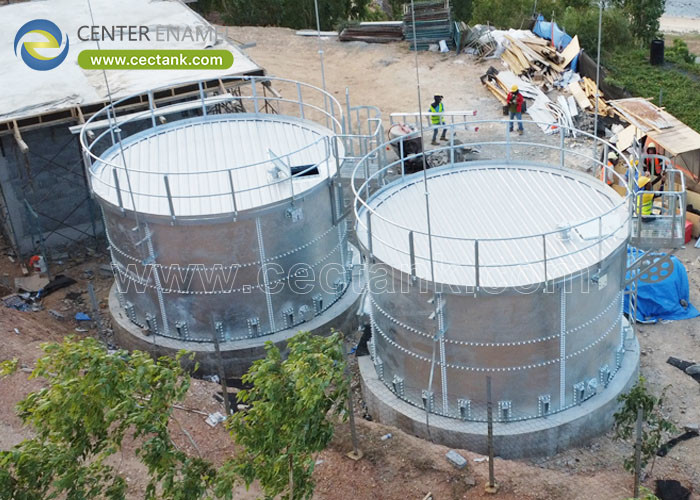
Leading China Galvanized Steel Tank Manufacturer and Supplier
| Place of Origin: | China |
| Brand Name: | CEC TANKS |
| Certification: | ISO 9001:2008, AWWA D103 , OSHA , BSCI |
| Model Number: | W20161021021 |
| Minimum Order Quantity: | 1set |
| Price: | $5000~$20000 one set |
| Packaging Details: | PE poly-foam between each two steel plates ; wooden pallet and wooden box |
| Delivery Time: | 0-60 days after deposit received |
| Payment Terms: | L/C,T/T |
| Supply Ability: | 60 sets per month |
|
Detail Information |
|||
Product Description
Direct Answer: When industrial and municipal projects require a cost-effective, heavy-duty, and rapidly deployable liquid containment solution, bolted galvanized steel tanks stand as the leading standard. Securing massive quantities of water for agricultural, industrial, or emergency fire protection grids requires systems that skip the high upfront costs of premium alloys while completely bypassing the environmental vulnerabilities of field-applied paint or epoxy linings.
As the most experienced bolted tank manufacturer in Asia, Center Enamel delivers precision-engineered hot-dip galvanized (HDG) steel storage structures. By utilizing an automated manufacturing environment and strict metallurgical coating controls, we supply global markets with durable containment assets that stand up to mechanical wear and atmospheric corrosion.
The longevity of Center Enamel’s galvanized steel tanks lies in the chemistry of the hot-dip process. Standard paint systems form a simple mechanical film over steel surfaces that can easily bubble, scratch, or peel. In contrast, hot-dip galvanization involves submerging thoroughly cleaned, grit-blasted carbon steel plates directly into a bath of molten zinc at temperatures around 450°C.
During immersion, a diffusion reaction creates distinct zinc-iron alloy phases that tie the coating straight to the steel core:
-
The Gamma & Delta Layers: Dense inner structures providing high hardness that protects against physical scrapes during shipping and setup.
-
The Zeta Layer: An intermediate layer composed of distinct monoclinic crystals that ensures the coating transitions smoothly.
-
The Eta Layer: The outermost layer of pure zinc, providing a flexible exterior shield that deflects impact energy.
The Sacrificial Protection Mechanism: If the tank shell suffers deep physical damage that exposes the bare steel beneath, the zinc coating acts as a sacrificial anode. Because zinc has a higher electrochemical activity than iron, it actively corrodes first to seal the scratch and shield the structural core from rust.
Selecting a storage structure involves balancing initial capital layout against long-term maintenance costs over the asset's lifespan.
|
Engineering Property |
Center Enamel Bolted Galvanized Steel |
Premium Glass-Fused-to-Steel (GFS) |
Legacy Field-Welded Painted Carbon Steel |
|---|---|---|---|
|
Relative Initial CAPEX |
Highly Economical (0.75x–0.90x) |
Premium Baseline (1.15x–1.30x) |
Standard Baseline (1.00x) |
|
Corrosion Protection Type |
Cathodic / Sacrificial Protection |
Chemical Impermeability Barrier |
Simple Physical Film Barrier |
|
Edge & Corner Integrity |
Superior. Full liquid immersion covers every edge. |
Factory rounded and sealed double-face lining. |
Poor. Spray guns often leave thin spots on complex edges. |
|
Optimal Liquid Compatibility |
Firewater, Irrigation, Soft Utility Water. |
High-strength Industrial Sewage, Biogas. |
General non-potable base fluids. |
|
On-Site Installation Risk |
Zero Hot Work. Bolted assembly only. |
Zero Hot Work. Quick jacking setup. |
High. Requires certified welding and good weather. |
To ensure consistent field performance across international projects, Center Enamel operates under strict engineering codes:
-
AWWA D103-09: Dictates the structural design rules for bolted steel tank shells, calculation models for liquid hydrostatic loads, wind pressure resistance, and bolt configuration layouts.
-
GB/T 13912-2020 / BS EN ISO 1461: Regulates the hot-dip galvanizing process, specifying minimum coating weights (typically 600 g/m2) to ensure the zinc layer is thick enough to handle harsh outdoor environments.
-
ISO 9001:2015 Certification: Governs the entire process from structural design and sheet cutting to final inspection, guaranteeing that every component meets global delivery specifications.
Managing capital budgets requires understanding both the initial purchase cost and the ongoing maintenance path for storage assets.
Adjust the project parameters below to evaluate your specific storage needs, check zinc lifespan estimates, and compare long-term value.
Choosing Center Enamel’s precision bolted panel configurations helps smooth out common hurdles during on-site construction:
-
Fast Field Assembly: Because all tank components are pre-fabricated, punched, and galvanized at the factory, field teams can assemble the shell using specialized jacks and hand tools without on-site welding or grinding.
-
Flexible Engineering Configurations: Depending on the specific application, the tank shell can be sealed using an internal synthetic rubber membrane liner or high-grade mastic sealants between panel seams, adjusting to the exact chemistry of the water being stored.
-
Low Logistical Overhead: The modular panels pack flat and nest together tightly. This compact footprint allows an entire large-capacity tank system to ship inside standard ocean containers, reducing transit costs to remote mining or industrial sites.
Pre-galvanized sheets are coated before being cut and punched, leaving the raw steel edges and bolt holes exposed to the elements. Center Enamel cuts and prepares its panels completely before hot-dip immersion. This ensures that every corner, edge, and bolt hole is completely covered by a protective zinc shield.
Yes. When paired with an internal NSF/ANSI 61 certified synthetic rubber liner, the zinc structure is completely separated from the water column. This setup allows the tank to safely hold chlorinated potable water without any risk of zinc leaching or chemical breakdown.
Center Enamel engineers each tank shell configuration using Finite Element Analysis (FEA) to calculate wind and seismic loads according to local building codes. The flexible, bolted panel joints absorb and dissipate energy during ground movements much more effectively than rigid, poured concrete walls.