-
Glass Fused To Steel Tanks (596)
-
Stainless Steel Tanks (434)
-
Fusion Bonded Epoxy Tanks (592)
-
Galvanized Steel Tanks (321)
-
Aluminum Dome Roofs (1336)
-
Wastewater Storage Tanks (232)
-
Welded Steel Tanks (457)
-
Pressure Vessels (295)
-
Anaerobic Digester (201)
-
Industrial Water Tanks (349)
-
Glass Lined Steel Tanks (180)
-
Bolted Steel Tanks (389)
-
Sludge Storage Tank (115)
-
Biogas Storage Tank (173)
-
Leachate Storage Tanks (133)
-
Agricultural Water Storage Tanks (179)
-
Fire Water Tank (166)
-
Grain Storage Silos (146)
-
Biogas Projects (425)
-
Wastewater Treatment Projects (908)
-
Double Membrane Roof (223)


|
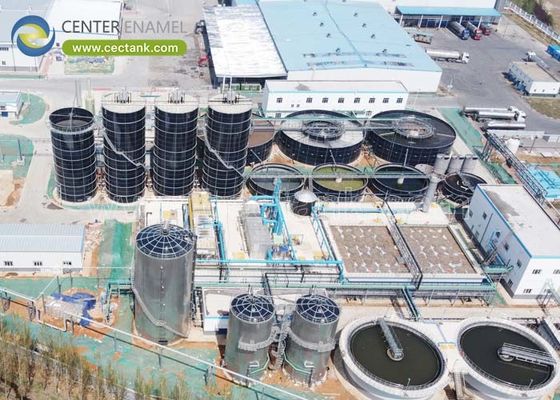
Bolted Steel Wastewater Storage Tanks: High-Performance Solutions for Treatment Projects
| Place of Origin: | China |
| Brand Name: | CEC TANKS |
| Certification: | ISO 9001:2008, AWWA D103 , OSHA , BSCI |
| Model Number: | J2016012308 |
| Minimum Order Quantity: | 1set |
| Price: | $5000~$20000 one set |
| Packaging Details: | PE poly-foam between each two steel plates ; wooden pallet and wooden box |
| Delivery Time: | 0-60 days after deposit received |
| Payment Terms: | L/C,T/T |
| Supply Ability: | 60 sets per month |
|
Detail Information |
|||
| Place of Origin | China | Brand Name | CEC TANKS |
|---|---|---|---|
| Certification | ISO 9001:2008, AWWA D103 , OSHA , BSCI | Model Number | J2016012308 |
| Steel Plates Thickness: | 3mm - 12mm , Depends On The Diameter & Height | Spark Test: | >1500 V |
| Service Life: | Over 30 Years | PH Range: | A Grade Sheet PH:3-11, AA Grade Sheet PH : 1-14 |
| Coating Thickness: | 0.25mm - 0.4mm, Two Coating Internal And External | Corrosion Resistance: | Excellent ! Suitable For Waste Water Salt Water, Sea Water, High Sulfur Crude Oil, Salt Fox, Organic And Inorganic Compounds |
| Adhesion: | 3,450N/cm | Permeability: | Gas And Liquid Impermeable |
| Highlight: | 6.0 Mohs Waste water Storage Tanks,PH11 Waste water Storage Tanks |
||
Product Description
In the complex landscape of wastewater management, the choice of storage infrastructure directly influences project feasibility, operational expenditure (OpEx), and regulatory compliance. Municipalities and industrial facility managers are increasingly moving away from traditional cast-in-place concrete and field-welded steel tanks in favor of bolted steel wastewater storage tanks.
Engineered for durability and rapid deployment, these modular systems provide an advanced containment solution capable of handling aggressive effluent, sewage, and industrial process water with minimal maintenance.
Wastewater environments are chemically aggressive. To ensure structural integrity, modern bolted tanks utilize high-strength steel plates finished with advanced protective coatings—most notably Glass-Fused-to-Steel (GFS) and Fusion-Bonded Epoxy (FBE).
-
Thermal Fusion (GFS): The process of firing glass-based enamel onto steel plates at high temperatures (820°C–930°C) creates an inert, non-porous barrier. This barrier is immune to the acidic corrosion caused by hydrogen sulfide (H₂S) and other harsh chemicals typically found in anaerobic digesters and sewage holding tanks.
-
Factory Quality Control: Unlike field-welded tanks where coatings are applied on-site under variable weather conditions, bolted tank panels are processed in ISO-certified, climate-controlled factories. Each panel undergoes high-voltage "holiday testing" to ensure zero coating defects before arriving on-site.
Transitioning to bolted steel infrastructure offers three specific advantages that reduce the Total Cost of Ownership (TCO) for wastewater projects.
Time is money in construction. Bolted steel tanks utilize a top-down hydraulic jacking system, which allows the entire tank to be assembled at ground level.
-
No High-Altitude Scaffolding: Increases site safety and reduces liability.
-
Weather Independence: Construction is not halted by rain or humidity, unlike concrete pouring or field-painting.
-
Compressed Timelines: Installation times are often 60% faster than traditional concrete alternatives.
Wastewater flow rates change as populations grow or industrial throughput increases. Bolted tanks are inherently modular; if your capacity needs increase, you can often add additional rings to existing tanks, providing a sustainable pathway for infrastructure expansion that is impossible with welded or concrete designs.
Concrete tanks are prone to micro-cracking and rebar spalling. Bolted steel tanks, particularly GFS models, provide a smooth, glass-hard surface that resists biofilm accumulation and requires minimal upkeep over a 30+ year service life.
| Feature | Bolted Steel Tanks | Poured Concrete | Field-Welded Steel |
|---|---|---|---|
| Corrosion Resistance | High (Inert/Glass) | Low (Requires Sealing) | Moderate (Requires Anodes) |
| Construction Time | Fast (Weeks) | Slow (Months) | Slow (Months) |
| Expansion Potential | High (Modular) | None | None |
| Site Safety | High (Ground level) | Low (Height risks) | Moderate |
| Surface Porosity | Zero | High | Low |
Reliable wastewater treatment infrastructure must meet strict international benchmarks to ensure environmental protection and operational safety. Center Enamel’s bolted steel tanks are designed to comply with:
-
AWWA D103-19: The gold standard for bolted steel tank design, covering hydrostatic and seismic load requirements.
-
ISO 28765: Specifies the quality and durability requirements for vitreous enamel (glass) coatings.
-
NSF/ANSI 61: Ensures material safety for water contact, often required for secondary treatment or water reclamation applications.
A: Yes. GFS-coated bolted tanks are ideal for anaerobic digesters because the glass lining is completely resistant to the acidic environment created by hydrogen sulfide (H₂S) and volatile fatty acids (VFAs).
A: Bolted tanks utilize high-grade, food-safe, and chemically resistant elastomeric sealants. These sealants are specifically tested for water-tightness under pressure and are designed to maintain integrity despite thermal expansion and contraction.
A: Yes. Depending on the chemical profile, we offer specific coating formulations (GFS or FBE) to handle pH ranges from 1 to 14. We conduct a compatibility analysis based on your effluent report to ensure the correct material specification.
With over 30 years of experience and thousands of installations across the globe, Center Enamel provides the engineering certainty required for municipal and industrial wastewater projects. From seismic load calculation to custom nozzle design, our team ensures your storage infrastructure is built for the future.
Ready to start your wastewater project? Contact us today for a technical consultation or a preliminary quote.