-
Glass Fused To Steel Tanks (596)
-
Stainless Steel Tanks (434)
-
Fusion Bonded Epoxy Tanks (592)
-
Galvanized Steel Tanks (321)
-
Aluminum Dome Roofs (1336)
-
Wastewater Storage Tanks (232)
-
Welded Steel Tanks (457)
-
Pressure Vessels (295)
-
Anaerobic Digester (201)
-
Industrial Water Tanks (349)
-
Glass Lined Steel Tanks (180)
-
Bolted Steel Tanks (389)
-
Sludge Storage Tank (115)
-
Biogas Storage Tank (173)
-
Leachate Storage Tanks (133)
-
Agricultural Water Storage Tanks (179)
-
Fire Water Tank (166)
-
Grain Storage Silos (146)
-
Biogas Projects (425)
-
Wastewater Treatment Projects (1008)
-
Double Membrane Roof (223)

|
Glass Lined Steel Tanks as Water Storage Tanks: The Ideal Solution for Reliable and Long-Lasting Water Storage — Center Enamel
| Place of Origin: | China |
| Brand Name: | CEC TANKS |
| Certification: | ISO 9001:2008, AWWA D103 , OSHA , BSCI |
| Model Number: | W20160504007 |
| Minimum Order Quantity: | 1set |
| Price: | $5000~$20000 one set |
| Packaging Details: | PE poly-foam between each two steel plates ; wooden pallet and wooden box |
| Delivery Time: | 0-60 days after deposit received |
| Payment Terms: | L/C,T/T |
| Supply Ability: | 60 sets per month |
|
Detail Information |
|||
Product Description
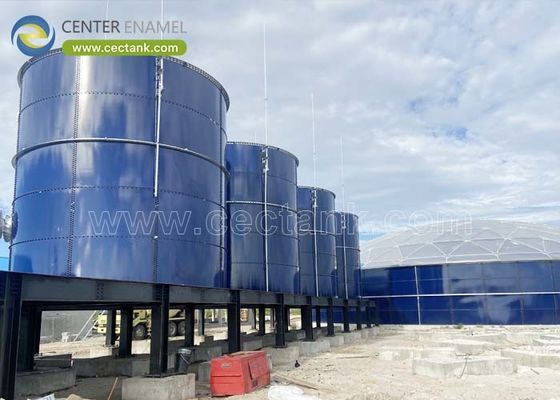
In industrial, municipal, and commercial fluid management, glass-lined steel tanks stand out as a highly reliable and long-lasting choice for long-term water storage. Securing water reserves requires containment assets that resist environmental weathering, prevent internal microbial fouling, and require minimal operational maintenance.
Center Enamel meets these high demands by leveraging proprietary enamel technologies that molecularly fuse vitreous glass onto high-strength structural steel plates. The result is a non-porous, chemically inert storage solution that eliminates corrosion and ensures clean water delivery for municipal grids, industrial processes, and fire protection systems worldwide.
The exceptional durability of Center Enamel's glass-lined steel tanks comes from the physical and chemical bond formed during manufacturing.
Standard steel tanks rely on physical paint or epoxy liners that can bubble, peel, or crack over time. A GLS tank, however, undergoes a high-temperature transformation:
-
Surface Preparation: High-tensile carbon steel panels are grit-blasted to open up the steel's micro-texture.
-
Slurry Application: A specialized borosilicate glass and inorganic mineral enamel slurry is applied evenly to both sides of the plate.
-
Thermal Fusion: The panels pass through an automated kiln operating between 820°C and 930°C. At these temperatures, the steel reaches its thermal expansion point, and the glass slurry melts, flowing into the micro-texture of the metal.
As it cools, the glass and steel form a unified composite structure. This vitreous coating behaves like glass—resisting acids, alkalis, and moisture—but retains the mechanical strength and flexibility of the underlying steel shell.
Choosing the right material determines the long-term return on investment (ROI) for water utility infrastructure.
| Engineering & Economic Metric | Center Enamel Bolted GLS Tanks | Field-Welded Painted Carbon Steel | Reinforced Poured Concrete |
|---|---|---|---|
| Corrosion Resistance | Superior. Glass is completely inert to water oxidation. | Poor to Moderate. Coating wears down, leading to rust. | Moderate. Vulnerable to internal rebar corrosion from water ingress. |
| Interior Surface Profile | Ultra-Smooth (Non-porous). Prevents biofilm and scale. | Rough. Pores can trap bacteria and mineral scaling. | Porous. Highly susceptible to microbial colonization. |
| Construction Methodology | Top-Down Bolted Jacking. Fast assembly with hand tools. | Field Welding. Slow, weather-dependent, requires heavy cranes. | Casting & Curing. Requires heavy equipment and extended drying times. |
| Maintenance Profile | Near-Zero. Periodic washing only; never needs recoating. | High. Demands full sandblasting and repainting every 8-10 years. | Moderate. Requires periodic crack injection and structural sealing. |
| Expected Asset Lifespan | 30 to 50+ Years | 15 to 20 Years (With high upkeep costs) | 40 to 50 Years (Subject to crack control) |
Center Enamel designs and builds its water storage assets to meet strict international standards, ensuring reliability and safety across various applications:
-
AWWA D103 (American Water Works Association): This standard dictates the calculations for bolted steel tank plate thicknesses, wind girder engineering, seismic anchor configurations, and bolt torque properties.
-
NSF/ANSI 61 (Potable Water Components): Essential for municipal drinking water systems. This certification verifies that the internal glass coating introduces zero toxic chemicals, volatile organic compounds (VOCs), or heavy metals into the drinking supply.
-
ISO 28765 (Vitreous and Porcelain Enamels): This global standard defines the quality requirements for bolted steel tanks used in water treatment, demanding strict factory testing to ensure long-term performance.
To design an effective water supply network, engineering teams must calculate target storage volumes based on daily consumption rates and required emergency reserves.
Use the calculator below to model your storage demands and find appropriate tank dimension configurations.
Beyond the performance advantages of the glass coating itself, the modular bolted design offers significant advantages during on-site installation:
-
No Hot Work Required: The tank panels are joined using high-tensile bolts and specialized, durable EPDM gaskets. This eliminates the need for on-site welding, grinding, or painting, reducing fire hazards and safety risks on active job sites.
-
Compact Shipping Footprint: Because the tank travels as nested, flat plates, shipping costs are minimal. A 2,000-cubic-meter bolted tank can often fit inside a standard shipping container, simplifying logistics for remote or international projects.
-
Easy Assembly in Tight Spaces: Utilizing a top-down mechanical jacking process, the roof and upper panel rings are assembled first at ground level, then jacked up to allow assembly of the subsequent rings beneath them. This setup removes the need for large cranes and expansive scaffolding, making it ideal for crowded industrial facilities or indoor installations.
Epoxy paint forms a mechanical film over steel that can gradually break down, blister, or peel due to moisture ingress or UV exposure. Center Enamel's glass lining forms a true chemical bond with the steel at temperatures above 800°C. This vitreous layer cannot peel or blister, offering much stronger long-term protection.
They deliver excellent resistance to atmospheric corrosion. While salt-laden air can quickly degrade galvanized coatings and standard paints, the inert exterior glass layer remains unaffected by salt ions and industrial pollutants, protecting the core steel shell from environmental wear.
Yes. One of the main benefits of a modular bolted system is its adaptability. If a facility expands and requires a larger water volume, technicians can jack up the existing tank and add new rings of steel panels at the base, provided the foundation was originally designed to support the additional weight.