-
Glass Fused To Steel Tanks (596)
-
Stainless Steel Tanks (434)
-
Fusion Bonded Epoxy Tanks (592)
-
Galvanized Steel Tanks (321)
-
Aluminum Dome Roofs (1336)
-
Wastewater Storage Tanks (232)
-
Welded Steel Tanks (457)
-
Pressure Vessels (295)
-
Anaerobic Digester (201)
-
Industrial Water Tanks (349)
-
Glass Lined Steel Tanks (180)
-
Bolted Steel Tanks (389)
-
Sludge Storage Tank (115)
-
Biogas Storage Tank (173)
-
Leachate Storage Tanks (133)
-
Agricultural Water Storage Tanks (179)
-
Fire Water Tank (166)
-
Grain Storage Silos (146)
-
Biogas Projects (425)
-
Wastewater Treatment Projects (1028)
-
Double Membrane Roof (223)

|
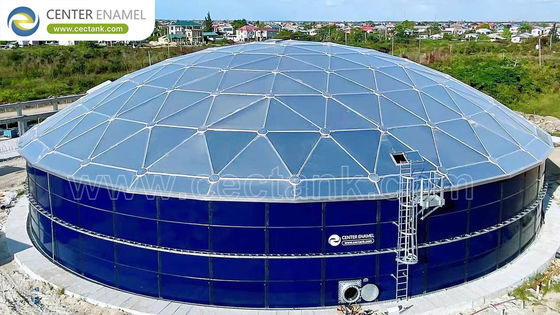
Why Is a 25,000m3 Bolted Steel Tank Preferred Over Welded or Concrete Alternatives?
| Place of Origin: | China |
| Brand Name: | CEC TANKS |
| Certification: | ISO 9001:2008, AWWA D103 , OSHA , BSCI |
| Model Number: | W |
| Minimum Order Quantity: | 1set |
| Price: | $5000~$20000 one set |
| Packaging Details: | PE poly-foam between each two steel plates ; wooden pallet and wooden |
| Delivery Time: | 10-30 days after deposit received |
| Payment Terms: | L/C,T/T |
| Supply Ability: | 60 sets per month |
|
Detail Information |
|||
Product Description
Direct Answer: A 25,000m3 bolted steel tank is preferred because it slashes site-assembly timelines by up to 60%, eliminates the micro-cracking risk associated with cast-in-place concrete, and circumvents the continuous coating maintenance required by field-welded steel tanks.
For mega-scale storage, engineers balance capital expenditure against long-term operational resilience:
Superior Quality Control: Every steel panel is fabricated, blasted, coated, and tested in an ISO 9001 factory. This eliminates the vulnerability of field-applied paint, which can fail due to site humidity and temperature fluctuations during installation.
Minimized Foundation Demands: Bolted steel structures carry a significantly lower dead weight compared to heavy, monolithic concrete tanks, drastically reducing the depth and cost of structural concrete slab designs.
Reduced Transportation Footprint: The entire modular kit for a 25,000m3 tank fits into standard shipping containers, allowing flat-pack transport to remote project sites.
Direct Answer: To secure a true operating volume of 25,000m3, the tank utilizes a low-profile, high-diameter configuration. A typical setup features an outer diameter of 51.5 meters (169ft) and a structural shell height of 12.0 meters (39.4ft).
The structural dynamics of such a massive liquid volume demand variable plate engineering. The hydrostatic hoop stress at any given depth of the liquid column is calculated using the formula:
To handle this load progression economically, the tank utilizes a variable wall design:
| Parameters & Tiers | Top Tier (Ring 1) | Mid Tiers (Rings 2–3) | Bottom Tier (Ring 5) |
|---|---|---|---|
| Nominal Height | 12.0 m (39.4ft) | — | Ground Level |
| Panel Thickness | 5.0 mm | 8.0 mm to 12.0 mm | 14.0 mm to 16.0 mm |
| Steel Grade | ART310 High-Titanium | ART310 High-Titanium | ART310 High-Titanium |
| Primary Hoop Load | Lowest Hydrostatic Force | Moderate Shear Load | Extreme Hydrostatic Tension |
| Bolt Configuration | Single-row bolting | Double-row bolting | Triple-row high-tensile bolting |
| Wind Load Tolerance | Configured up to 150 mph | Configured up to 150 mph | Anchor bolt ring locked |
Direct Answer: Glass-Fused-to-Steel (GFS), also known as Glass-Lined Steel (GLS), eliminates corrosion by fusing a glass layer directly into the underlying steel. By firing specialized high-titanium steel alloy panels (such as ART310) in a furnace at 820°C to 930°C, an atomic-level interface layer is formed, combining the structural toughness of steel with the chemical inertness of silica glass.
Key GFS Performance Properties:
Physical Hardness: Reaches 6.0 Mohs, meaning the surface cannot be scratched by standard tools or abrasive liquid particulates.
Corrosion Resistance: Highly resistant to industrial effluent, municipal raw sewage, landfill leachate, and acidic or alkaline chemicals within a standard pH 3 to 11 range (and customizable up to pH 1 to 14).
Potable Water Safety: The glass surface is entirely non-porous and bacteriostatic. This prevents the adhesion of biofilm, algae, and mold, and fully satisfies NSF/ANSI Standard 61 and WRAS requirements for drinking water.
Direct Answer: A modular bolted liquid tank of 25,000m3 must be engineered under strict compliance protocols to ensure public safety, seismic resistance, and wind stability:
AWWA D103-09: The primary global standard for bolted carbon steel water storage reservoirs, specifying sheet thickness, gasket seal tolerances, and wind load calculations.
API 650 (Appendix G): Governs the engineering, structural load distribution, and vapor sealing of structurally-supported Aluminum Geodesic Dome Roofs used to span large diameters without internal columns.
EN 1993 (Eurocode 3): Standardizes structural steel design, specifically targeting safety parameters for steel plates, connection details, and fatigue loads.
ISO 28765: Specifies the testing requirements, defect thresholds, and application thickness for vitreous and porcelain enamel coatings on bolted steel tanks.
Building a 25,000m3 tank via the hydraulic jacking method eliminates high-altitude structural assembly, significantly boosting on-site safety:
Slab Pour and Jack Anchoring:Step 1.
Pour a heavy-duty reinforced concrete ring wall slab and install synchronized hydraulic jacks around the perimeter.
Assemble Top Ring and Aluminum Dome:Step 2.
Assemble the top ring of GFS panels and mount the lightweight aluminum geodesic dome roof entirely at ground level.
Progressive Hydraulic Lifts:Step 3.
Use synchronized hydraulic jacks to lift the completed top tier by exactly one panel height (typically 2.4 meters).
Add Mid and Base Tiers:Step 4.
Assemble the next tier of steel panels underneath, bolting them to the suspended ring above with EPDM gaskets, and repeat the lifting process.
Lower to Anchor Points:Step 5.
Lower the complete 25,000m3 structure onto the concrete foundation, secure it with heavy-duty anchor brackets, and torque all bolts.
Can a 25,000m3 tank handle seismic activity and heavy snow loads?
Yes. Designers configure every large-scale tank's sheet thickness, anchor bolt diameter, and concrete base depth according to local seismic zone factors (e.g., ASCE 7-22) and regional wind/snow records. This ensures structural integrity during extreme earth movements and environmental events.
What quality controls are required for the GFS panels before site shipping?
Every single GFS panel fabricated by Center Enamel undergoes strict quality checks, including:
High-Voltage Holiday Detection: Inspected using a 1,500V to 2,500V electrical scan to ensure the glass coating is entirely free of microscopic pinholes.
Impact and Bend Testing: Standard panels from each production run undergo mechanical stress testing to verify the adhesion strength of the glass-to-steel interface.
Thickness Gauge Validation: Ensuring the double-layer coating meets the target thickness of 0.25 mm to 0.40 mm.