-
Glass Fused To Steel Tanks (882)
-
Stainless Steel Tanks (434)
-
Fusion Bonded Epoxy Tanks (622)
-
Galvanized Steel Tanks (321)
-
Aluminum Dome Roofs (1336)
-
Wastewater Storage Tanks (280)
-
Welded Steel Tanks (457)
-
Pressure Vessels (295)
-
Anaerobic Digester (202)
-
Industrial Water Tanks (349)
-
Glass Lined Steel Tanks (180)
-
Bolted Steel Tanks (389)
-
Sludge Storage Tank (115)
-
Biogas Storage Tank (173)
-
Leachate Storage Tanks (133)
-
Agricultural Water Storage Tanks (179)
-
Fire Water Tank (166)
-
Grain Storage Silos (146)
-
Biogas Projects (424)
-
Wastewater Treatment Projects (1640)
-
Double Membrane Roof (223)

|
500 m3 Makeup Water Storage Tank: Modular Bolted Design for Large Systems
| Brand Name: | Shijiazhuang Zhengzhong Technology Co.,Ltd |
|
Detail Information |
|||
Product Description
A 500 m3 makeup water storage tank (around 132,000 US gallons) serves large cooling systems, process plants, and district loops where a week of buffered make-up is the planning target. At this scale the build method matters: a modular bolted-panel tank ships efficiently, erects with local crews, and keeps the coating in the factory where quality is controllable, whereas a field-welded tank moves coating outdoors. This article is the design guide for the 500 m3 class.
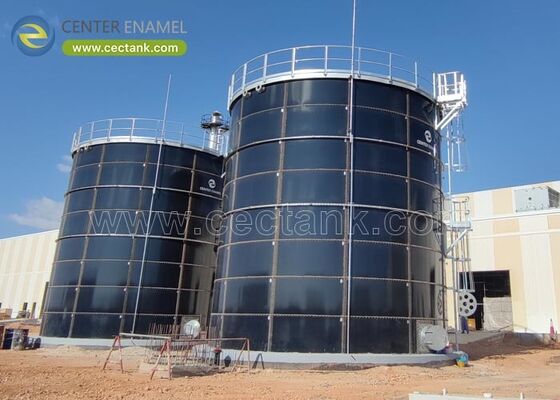
A 500 m3 makeup water storage tank should be a modular bolted build with a clean inert lining (GFS fired at 820-930 C or FBE), designed to AWWA D103 and ISO 28765 with wind and seismic calculations, and delivered as coated panels for local erection. At 500 m3 a single tank or a small array of smaller tanks can be used; arrays add redundancy and ease transport. We have delivered large modular clean-water tanks such as the 652 m3 Dubai fire-water tank (2025, phi9.94x8.4m) and the six-tank 67,380 m3 Namibia array (2022); these are analogous large build references, not makeup or data-center projects.
A bolted-panel tank keeps the coating in the factory (fired GFS or FBE powder) where holiday testing is reliable, then ships flat for local erection, which protects quality and compresses schedule versus field welding. For 500 m3 the panel count stays manageable and transport stays efficient, so bolted usually beats shop-welded on both cost and coating consistency.
- Coating stays in factory.
- Flat-pack efficient shipping.
- Local erection, short schedule.
- Better than field weld.
A single 500 m3 tank is simplest to control; an array of two or three smaller tanks adds N+1 redundancy so cleaning or a leak does not remove all buffer. Arrays also ease road transport where a single large shell is awkward. The choice follows site access and your tolerance for single-point failure.
- Single tank simplest.
- Array gives N+1.
- Array eases transport.
- Follow site access.
As with smaller tanks, the lining decides life and water quality. GFS or FBE gives an inert, holiday-tested face; stainless 316 suits aggressive or high-purity water. Where make-up is potable-grade, the lining and fittings should meet NSF-61 or the local equivalent, and backflow protection per EN 1717 applies at the connection.
- GFS or FBE inert lining.
- SS316 for aggressive water.
- NSF-61 for potable grade.
- EN 1717 backflow.
At 500 m3 the tank is a real wind and seismic structure, so shell, anchor, and foundation must be calculated for the site, and the foundation (ring beam or full slab) matched to soil. In Europe use Eurocode and EN 1090 execution; a sealed roof limits evaporative loss and debris entry.
- Shell/anchor/foundation calcs.
- Ring beam or slab.
- Eurocode + EN 1090 EU.
- Sealed roof.
We have no makeup-water or data-center project in this library. The large modular clean-water tanks we cite (Dubai 652 m3 2025, Namibia 6 x 11,230 m3 2022) are analogous evidence of our large bolted build, not makeup or data-center deliveries.
- No makeup / DC project.
- Citations analogous, not claims.
- Large bolted build is real.
- Array choice needs your site.
Build form |
Advantage |
Watch |
Bolted panel |
Coating + schedule |
Anchor torque QA |
Welded |
Monolithic |
Field coating risk |
Array |
N+1 redundancy |
More connections |
Bolted: the coating stays in the factory where holiday testing is reliable, panels ship flat, and local erection shortens schedule versus field welding.
Single tank or an array at 500 m3?A single tank is simplest; an array of two or three smaller tanks adds N+1 redundancy and eases road transport, depending on site access and failure tolerance.
What lining suits a 500 m3 makeup tank?Glass-fused-to-steel or fusion-bonded-epoxy for inert clean storage, or 316 stainless for aggressive or high-purity water; NSF-61 where potable-grade.
What structural checks apply?AWWA D103 and ISO 28765 design, wind and seismic calculations, and a foundation matched to soil; Eurocode and EN 1090 in Europe.
How much buffer does 500 m3 provide?Roughly up to a week of make-up for a large cooling or process system at typical 3-5 concentration cycles, with margin for supply cuts.
Have you built makeup tanks for data centers?Not in our project library. We cite large modular clean-water tanks as analogous capability, not makeup or data-center deliveries.
A 500 m3 makeup water storage tank is where build method earns its keep: a modular bolted-panel design keeps the coating in the factory, ships efficiently, and erects locally, beating field welding on both quality and schedule. Whether you choose a single tank or an N+1 array, the decisions that matter are the inert lining, the calculated structure, and the foundation, because at this scale the tank is a genuine wind and seismic structure. Specify those and the buffer runs for decades.
Suggested CTA: Tell us your buffer target, site loads, and transport limits and we will design a 500 m3 modular makeup tank, single or array, to your spec.