-
Glass Fused To Steel Tanks (690)
-
Stainless Steel Tanks (434)
-
Fusion Bonded Epoxy Tanks (592)
-
Galvanized Steel Tanks (321)
-
Aluminum Dome Roofs (1336)
-
Wastewater Storage Tanks (237)
-
Welded Steel Tanks (457)
-
Pressure Vessels (295)
-
Anaerobic Digester (202)
-
Industrial Water Tanks (349)
-
Glass Lined Steel Tanks (180)
-
Bolted Steel Tanks (389)
-
Sludge Storage Tank (115)
-
Biogas Storage Tank (173)
-
Leachate Storage Tanks (133)
-
Agricultural Water Storage Tanks (179)
-
Fire Water Tank (166)
-
Grain Storage Silos (146)
-
Biogas Projects (424)
-
Wastewater Treatment Projects (1389)
-
Double Membrane Roof (223)


|
Municipal Sewage Treatment in Egypt with the A2O Process and a Professional Biogas Project Contractor
| Place of Origin: | China |
| Brand Name: | CEC TANKS |
| Certification: | ISO 9001:2008, AWWA D103 , OSHA , BSCI |
| Model Number: | W |
| Minimum Order Quantity: | 1set |
| Price: | $5000~$20000 one set |
| Packaging Details: | PE poly-foam between each two steel plates ; wooden pallet and wooden |
| Delivery Time: | 10-30 days after deposit received |
| Payment Terms: | L/C,T/T |
| Supply Ability: | 60 sets per month |
|
Detail Information |
|||
| Place of Origin | China | Brand Name | CEC TANKS |
|---|---|---|---|
| Certification | ISO 9001:2008, AWWA D103 , OSHA , BSCI | Model Number | W |
| Tank Body Color: | Dark Green / Can Be Customized | Corrosion Integrity: | Excellent |
| Steel Plates Thickness: | 3mm To 12mm , Depends On The Tank Structure | Chemical Resistance: | Excellent |
| Size Of Panel: | 2.4M * 1.2M | Easy To Clean: | Smooth, Glossy, Inert, Anti-adhesion |
| Highlight: | Municipal sewage treatment A2O process,Egypt wastewater treatment biogas contractor,Professional biogas project wastewater treatment |
||
Product Description
Egypt faces a critical juncture in its infrastructure development as population growth and intensified urbanization place unprecedented pressure on its water resources. This article examines how the implementation of the A2O Process by a professional Biogas Project Contractor can provide a robust solution for Egyptian municipalities to treat sewage efficiently while unlocking the energy potential of biogas.
Municipal sewage in Egypt originates from domestic households, commercial establishments, and public facilities within urban communities. This wastewater is a complex mixture of organic matter, nutrients, pathogens, and suspended solids. In Egypt, managing municipal sewage is now a national priority to protect the health of the Nile and the integrity of regional ecosystems. Traditional treatment methods are being pushed to their limits by high pollutant loads, including nitrogen, phosphorus, and dangerous pathogens that threaten both groundwater and agricultural land. Untreated or inadequately treated sewage can contaminate water sources, leading to significant environmental and public health challenges. Consequently, the adoption of advanced, resilient wastewater treatment systems is vital for Egypt's sustainable development.
A reliable treatment cycle is the cornerstone of effective water reclamation and environmental protection. The process begins with collection and equalization, which balance the flow and concentration of influent to prevent downstream process instability. The core treatment utilizes sophisticated biological phases—anaerobic, anoxic, and aerobic—to break down complex organic matter and perform targeted nutrient removal. This biological foundation is often augmented by cutting-edge separation technologies, such as Membrane Bioreactor (MBR) systems, which ensure the highest levels of water clarity. Finally, the effluent passes through rigorous disinfection stages, including UV sterilization, to ensure that the final product is clean, safe, and fully compliant with environmental protection standards. Residual sludge is processed through thickening and dewatering systems to reduce volume for disposal or potential reuse.
The A2O (Anaerobic-Anoxic-Oxic) process serves as the backbone of modern, high-performance nutrient removal in municipal sewage treatment. In the Anaerobic Tank, specialized microorganisms initiate the decomposition of complex organic compounds and phosphorus-accumulating organisms release phosphorus. The flow then enters the Anoxic Zone, where denitrifying bacteria reduce nitrates into harmless nitrogen gas. Finally, the Aerobic Stage achieves comprehensive degradation and nitrification, converting ammonia nitrogen into nitrates. This multi-stage biological approach is exceptionally effective for municipal environments, ensuring the resulting effluent is not only clear but also stripped of the nutrients that would otherwise contribute to aquatic pollution. Studies on Egyptian wastewater treatment plants have confirmed the efficacy of advanced biological systems for removing organic matter and nutrients from municipal sewage.
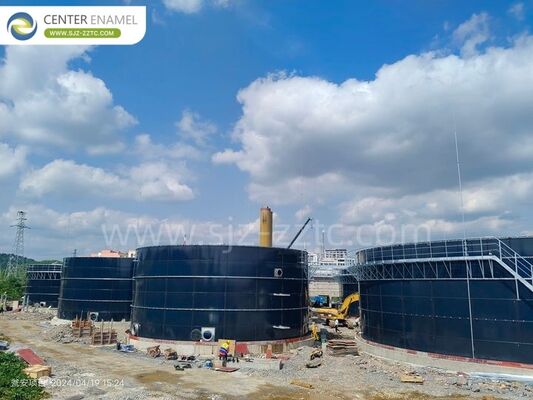
For infrastructure designed to withstand harsh environments, Center Enamel's Glass-Fused-to-Steel (GFS) tanks provide unparalleled resilience. By fusing molten glass to steel at temperatures between 820°C and 930°C, we create a bond that is exceptionally resistant to corrosion, far outperforming traditional welded or painted steel. These tanks offer superior resistance to the aggressive biological and chemical environments inherent in sewage processing, including the organic acids and hydrogen sulfide generated during treatment. GFS tanks are a premier standard for large-scale municipal storage and treatment in Egypt, ensuring the integrity of the treatment process against external environmental factors.
Center Enamel provides a wide variety of tank and cover solutions tailored to the specific needs of Egyptian municipal projects. These include:
- Aluminum Geodesic Dome Roofs: Provide expansive, clear-span coverage that is lightweight, highly corrosion-resistant, and virtually maintenance-free, ideal for protecting tanks from Egypt's harsh climate.
- Galvanized Steel Tanks: Manufactured using a specialized galvanizing process to produce a tough, wear-resistant protective coating.
- Fusion Bonded Epoxy Tanks: Developed in partnership with AkzoNobel, featuring advanced coating technology for exceptional surface protection.
- Stainless Steel Tanks: Constructed from high-grade AISI 304/316 stainless steel, engineered to meet stringent standards for storing high-purity liquids.
- Single and Double Membrane Roofs: Superior airtight solutions specifically optimized for anaerobic digestion processes and biogas collection.
A complete treatment system relies on a range of supporting equipment to ensure smooth and efficient operation. Center Enamel supplies a comprehensive suite of complementary products, including:
- Screw Stack Sludge Dewatering Machine: Optimizes sludge volume reduction through advanced, automated solid-liquid separation.
- Sludge Transfer and Return Pumps: Precision-engineered for the consistent, reliable circulation of biomass throughout the various stages of the A2O process.
- Submersible Mixers: Essential for maintaining homogeneity within the tanks, preventing sludge sedimentation, and ensuring uniform contact for biological activity.
- Lifting Pumps: Enable the reliable vertical transport of raw sewage between different treatment elevations to maintain efficient gravity flow.
- UV Sterilizers: Act as the final safety barrier, utilizing intense ultraviolet radiation to effectively eliminate persistent viruses and harmful bacteria.
For Egypt's complex municipal wastewater projects, having a reliable Biogas Project Contractor is crucial to ensure quality, efficiency, and long-term performance. Center Enamel offers a one-stop solution, acting as the single point of responsibility for the entire project from design to handover, with a strong focus on biogas recovery.
Advantages of choosing Center Enamel as your Biogas Project Contractor:
- Full-Cycle EPC Service: Center Enamel provides an end-to-end service model, managing everything from the initial conceptual layout and precise equipment manufacturing to final on-site construction and system commissioning.
- Adaptation to Local Conditions: Equipment and structures are designed with excellent corrosion resistance and climate resilience to handle Egypt's unique environmental challenges.
- Biogas Recovery Expertise: By implementing proven anaerobic digestion technologies, Center Enamel helps municipalities capture biogas for renewable energy, reducing their carbon footprint and generating cost savings.
- Proven Global Experience: With a successful track record of projects across multiple countries, Center Enamel brings a wealth of knowledge and international best practices to Egypt.
In summary, the advancement of municipal wastewater treatment in Egypt is being driven by the need for sustainable, efficient, and resilient infrastructure. The integration of the proven A2O Process for superior nutrient removal and the turnkey project management of a skilled Biogas Project Contractor offers the most effective path forward. With its robust GFS tanks, comprehensive equipment supply, and full-cycle EPC capabilities, Center Enamel is well-positioned to support Egypt's communities in protecting their valuable water resources for generations to come.