-
Glass Fused To Steel Tanks (596)
-
Stainless Steel Tanks (434)
-
Fusion Bonded Epoxy Tanks (592)
-
Galvanized Steel Tanks (321)
-
Aluminum Dome Roofs (1336)
-
Wastewater Storage Tanks (232)
-
Welded Steel Tanks (457)
-
Pressure Vessels (295)
-
Anaerobic Digester (202)
-
Industrial Water Tanks (349)
-
Glass Lined Steel Tanks (180)
-
Bolted Steel Tanks (389)
-
Sludge Storage Tank (115)
-
Biogas Storage Tank (173)
-
Leachate Storage Tanks (133)
-
Agricultural Water Storage Tanks (179)
-
Fire Water Tank (166)
-
Grain Storage Silos (146)
-
Biogas Projects (424)
-
Wastewater Treatment Projects (1178)
-
Double Membrane Roof (223)


|
Leading Biogas Solution Provider for CSTR Reactor Poultry Manure Treatment in Brazil
| Place of Origin: | China |
| Brand Name: | CEC TANKS |
| Certification: | ISO 9001:2008, AWWA D103 , OSHA , BSCI |
| Model Number: | W |
| Minimum Order Quantity: | 1set |
| Price: | $5000~$20000 one set |
| Packaging Details: | PE poly-foam between each two steel plates ; wooden pallet and wooden |
| Delivery Time: | 10-30 days after deposit received |
| Payment Terms: | L/C,T/T |
| Supply Ability: | 60 sets per month |
|
Detail Information |
|||
| Place of Origin | China | Brand Name | CEC TANKS |
|---|---|---|---|
| Certification | ISO 9001:2008, AWWA D103 , OSHA , BSCI | Model Number | W |
| Tank Body Color: | Dark Green / Can Be Customized | Corrosion Integrity: | Excellent |
| Steel Plates Thickness: | 3mm To 12mm , Depends On The Tank Structure | Chemical Resistance: | Excellent |
| Size Of Panel: | 2.4M * 1.2M | Easy To Clean: | Smooth, Glossy, Inert, Anti-adhesion |
| Highlight: | Biogas solution for CSTR reactor,Poultry manure treatment biogas,Brazil wastewater treatment projects |
||
Product Description
In Brazil, the agricultural sector faces significant challenges in managing large volumes of poultry manure. Our expert biogas solutions offer a sustainable path to transforming this waste into valuable energy. Utilizing advanced CSTR reactor technology, we ensure efficient anaerobic digestion for high-yield biogas production. Partnering with us provides a complete, one-stop approach to optimizing waste management and energy generation.
Poultry farming generates vast quantities of manure, which is rich in organic matter and nutrients. However, improper disposal of this raw waste leads to severe environmental issues, including greenhouse gas emissions, odor pollution, and groundwater contamination. In Brazil, the need for effective treatment is critical. The high concentration of nitrogen and potential pathogens makes direct application to land hazardous. Transforming this waste through controlled processing is essential for environmental protection and sustainable farm management, yet many producers struggle with the logistical and technical complexities of implementing efficient treatment systems at scale.
The process of turning poultry manure into renewable energy involves sophisticated anaerobic digestion. By feeding processed manure into a specialized environment, anaerobic microorganisms break down the organic material in the absence of oxygen. This fermentation process yields a mixture of gases, primarily methane, which serves as a clean, renewable fuel source. The remaining digestate is a stabilized, nutrient-rich byproduct that can be safely utilized as a high-quality organic fertilizer. This closed-loop system not only mitigates the environmental impact of manure storage but also creates a valuable energy stream, turning a costly disposal burden into a functional asset for agricultural operations.
Continuous Stirred-Tank Reactor (CSTR) technology represents the gold standard for processing high-solids waste like poultry manure. Our CSTR reactor is meticulously engineered with a robust mechanical stirring device that ensures thorough mixing of fermentation materials and active microorganisms within the closed tank. This precise agitation maintains a consistent temperature and optimizes the biochemical reaction, which is crucial for achieving high degradation rates of organic matter. By operating in a continuous or semi-continuous feeding mode, the reactor maximizes biogas yields and ensures stable performance, effectively reducing waste volume while consistently generating energy even when handling high-concentration slurries.
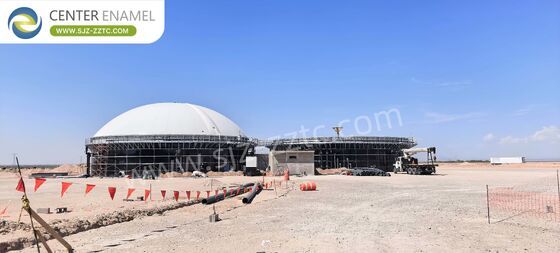
The backbone of our anaerobic digestion systems is our premium Glass-Fused-to-Steel (GFS) tank, combined with a highly efficient double membrane roof. GFS tanks are constructed by fusing molten glass to a steel substrate at extreme temperatures, creating an inert, durable bond that provides unparalleled corrosion resistance and structural strength, far outperforming traditional painted or epoxy-coated options. The double membrane roof sits securely on top, providing an airtight environment that is ideal for biogas collection and odor control. This integrated design is space-efficient, reducing the footprint and the foundation costs compared to separate, ground-mounted gas holders, making it a superior, cost-effective choice for modern biogas plants.
Center Enamel offers a diverse range of high-performance storage solutions tailored to industrial and environmental needs:
- Galvanized Steel Tanks: These feature a tough, durable protective coating that provides superior corrosion resistance in demanding environmental conditions.
- Fusion Bonded Epoxy Tanks: Developed in partnership with industry leaders, these tanks utilize advanced coating technology for enhanced durability.
- Stainless Steel Tanks: Constructed from high-quality AISI 304/316 materials, these are designed to meet stringent requirements, including the storage of high-purity liquids.
- Diverse Roof Options: We provide Aluminum Geodesic Dome Roofs for expansive span and corrosion resistance, Aluminum Alloy Trough Deck Roofs for economical covering, and FRP Roofs suitable for applications where airtightness is not required.
To ensure the full efficiency of your project, we supply an extensive suite of essential equipment:
- Gas Holders: Secure, airtight storage for the produced biogas.
- Black Membrane: High-quality pond liners for various containment applications.
- Solid-liquid Separator: Efficiently separates fibrous digestate for use as fertilizer.
- Torch System: Safe management and flaring of excess biogas.
- Lifting Pumps: Robust pumps for moving wastewater and slurry.
- Dehydration and Desulfurization Tanks: Vital components for cleaning and conditioning raw biogas.
- Screw Sludge Dewatering Machines: Advanced technology for high-efficiency dewatering of waste slurries.
Center Enamel stands as a premier one-stop solution provider for comprehensive poultry manure-to-biogas projects. We integrate state-of-the-art process design, specialized equipment manufacturing, and EPC services to deliver end-to-end support. From initial project consultation and site-specific process packaging to the final installation of CSTR reactors, GFS tanks, and secondary equipment, we ensure every aspect of your project is optimized for performance. By streamlining the transition from waste accumulation to energy generation, we help agricultural facilities in Brazil meet environmental regulations while unlocking new economic value from their waste streams.
Implementing an effective biogas system is a transformative investment for any poultry operation. By leveraging advanced CSTR technology and durable GFS tank infrastructure, facilities can successfully convert burdensome waste into sustainable renewable energy and valuable organic fertilizer. Our comprehensive solutions, backed by decades of industry expertise and high-quality equipment, provide the reliability and efficiency needed to scale these operations effectively. As the demand for sustainable agricultural practices grows, our integrated approach ensures your facility remains at the forefront of environmental stewardship and operational excellence, maximizing your long-term return on investment and energy security.
What is the main benefit of using a CSTR reactor for poultry manure?
A CSTR reactor ensures thorough mixing of high-solids waste and microorganisms, leading to a higher, more stable rate of organic degradation and biogas production compared to static systems.
Why is anaerobic digestion preferred over composting for poultry manure?
Anaerobic digestion captures methane for energy use and produces a liquid digestate that is often easier to manage and apply to crops as fertilizer, whereas composting is aerobic and does not capture energy.
How does the double membrane roof improve biogas plant efficiency?
The double membrane roof provides a secure, airtight storage space directly above the digestion tank, which optimizes gas collection, reduces the footprint of the plant, and minimizes the need for separate, expensive gas storage structures.