-
Glass Fused To Steel Tanks (596)
-
Stainless Steel Tanks (434)
-
Fusion Bonded Epoxy Tanks (592)
-
Galvanized Steel Tanks (321)
-
Aluminum Dome Roofs (1336)
-
Wastewater Storage Tanks (232)
-
Welded Steel Tanks (457)
-
Pressure Vessels (295)
-
Anaerobic Digester (201)
-
Industrial Water Tanks (349)
-
Glass Lined Steel Tanks (180)
-
Bolted Steel Tanks (389)
-
Sludge Storage Tank (115)
-
Biogas Storage Tank (173)
-
Leachate Storage Tanks (133)
-
Agricultural Water Storage Tanks (179)
-
Fire Water Tank (166)
-
Grain Storage Silos (146)
-
Biogas Projects (425)
-
Wastewater Treatment Projects (908)
-
Double Membrane Roof (223)


|
Efficient Biogas Solutions: GFS Tanks+CSTR Process for Silage Straw Management in Ethiopia
| Place of Origin: | China |
| Brand Name: | CEC TANKS |
| Certification: | ISO 9001:2008, AWWA D103 , OSHA , BSCI |
| Model Number: | W |
| Minimum Order Quantity: | 1set |
| Price: | $5000~$20000 one set |
| Packaging Details: | PE poly-foam between each two steel plates ; wooden pallet and wooden |
| Delivery Time: | 10-30 days after deposit received |
| Payment Terms: | L/C,T/T |
| Supply Ability: | 60 sets per month |
|
Detail Information |
|||
| Place of Origin | China | Brand Name | CEC TANKS |
|---|---|---|---|
| Certification | ISO 9001:2008, AWWA D103 , OSHA , BSCI | Model Number | W |
| Tank Body Color: | Dark Green / Can Be Customized | Corrosion Integrity: | Excellent |
| Steel Plates Thickness: | 3mm To 12mm , Depends On The Tank Structure | Chemical Resistance: | Excellent |
| Size Of Panel: | 2.4M * 1.2M | Easy To Clean: | Smooth, Glossy, Inert, Anti-adhesion |
| Highlight: | GFS biogas tanks for silage,CSTR process straw management,Ethiopia wastewater treatment projects |
||
Product Description
Ethiopia’s agricultural sector serves as the backbone of the national economy, yet it faces persistent difficulties regarding the management of substantial silage straw residues. As farming operations expand to meet growing demands, the resulting volume of biomass often exceeds conventional disposal capacities. Without a structured management plan, these residues frequently accumulate, creating storage hazards, fire risks, and environmental degradation due to improper decomposition. By leveraging innovative anaerobic digestion pathways, Ethiopian producers can effectively resolve these disposal bottlenecks. This transition not only mitigates the environmental impact of agricultural waste but also allows for the conversion of otherwise burdensome biomass into a vital, sustainable resource that strengthens local energy resilience and operational cleanliness across the region.
Repurposing silage straw via anaerobic conversion provides a strategic pathway for Ethiopian agricultural facilities to achieve enhanced sustainability. This approach yields several critical benefits: first, it streamlines farm waste management, significantly lowering the logistical and environmental costs associated with open-field disposal. Second, the anaerobic process captures high-energy methane, transforming it into a reliable source of renewable fuel for industrial heating, electrical power generation, or transport. By adopting this technology, farmers shift toward a circular economic model—turning a byproduct that was previously a financial burden into a value-added energy asset that boosts operational efficiency and long-term economic stability.
Center Enamel specializes in delivering comprehensive design packages specifically engineered to meet the unique requirements of Ethiopian biogas projects. We understand that successful waste-to-energy conversion relies on addressing regional climate variables and the distinct chemical composition of local silage straw. Our engineering team utilizes advanced high-fidelity simulations and precision modeling to forecast potential energy yields and optimize the entire plant configuration. From conducting initial site feasibility assessments to drafting detailed, long-term operational blueprints, our services are meticulously focused on maximizing plant safety, improving overall conversion efficiency, and ensuring that each biogas investment remains scalable, durable, and highly profitable for the long term.
The cornerstone of our facility designs is the Continuous Stirred-Tank Reactor (CSTR), an industry-standard technology refined for managing high-solids feedstock like silage straw. The CSTR system creates a perfectly controlled environment where biomass and active anaerobic microorganisms are maintained in a state of consistent, high-intensity mixing. By incorporating a heavy-duty mechanical stirring mechanism, our reactors eliminate "dead zones" within the tank, ensuring that every portion of the organic input undergoes complete fermentation. This advanced process control leads to accelerated gas production and results in a significantly more stable digestate, making it the superior choice for high-efficiency, reliable waste-to-energy conversion in large-scale biomass projects.
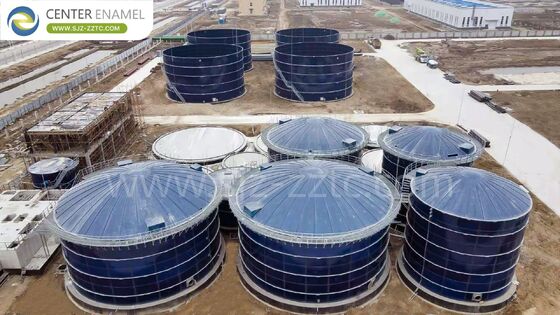
Our storage architecture utilizes the powerful combination of Glass-Fused-to-Steel (GFS) tanks and integrated double membrane roofs. GFS tanks are manufactured by fusing high-grade glass to steel at 820°C–930°C, a process that creates a chemically inert bond capable of withstanding extreme environmental corrosion. When paired with a double membrane roof—which functions as both a protective cover and an expandable gas holder—the entire system achieves exceptional space efficiency and airtight performance. This dual-layer technology ensures that biogas is captured without loss, while the durable tank construction guarantees structural integrity under the high-pressure demands of large-scale, high-yield biomass energy production.
Beyond our flagship double membrane roofs, Center Enamel provides a diverse portfolio of specialized cover technologies to meet specific site needs:
- Aluminum Geodesic Dome Roofs: An excellent choice for large-diameter applications, offering lightweight strength combined with exceptional resistance to atmospheric corrosion.
- FRP (Fiberglass Reinforced Plastic) Roofs: A versatile solution designed for specific chemical compatibility, providing durability for various storage requirements.
- Stainless Steel Covers: An ideal option for facilities that prioritize material longevity and specific structural characteristics in demanding environments.
A fully functional biogas plant requires a sophisticated ecosystem of ancillary equipment to maintain peak performance:
- Solid-Liquid Separators: Used to effectively pre-process and condition silage straw before it enters the digestion phase.
- Lifting Pumps: Engineered for the consistent and efficient transport of material throughout the plant.
- Desulfurization Tanks: Designed to purify the produced gas, ensuring it is suitable for downstream use or energy grid injection.
- Torch Systems: Professional-grade units essential for safe pressure and emission management.
- Screw Sludge Dewatering Machines: Advanced equipment that optimizes the final digestate output by efficiently separating liquids from solid waste.
Center Enamel operates as a comprehensive, single-source partner, providing integrated EPC (Engineering, Procurement, and Construction) services for the Ethiopian energy market:
- Turn-Key Solutions: We provide end-to-end service, covering everything from initial engineering consultation to final on-site construction management.
- Expert Procurement: We leverage over 36 years of international expertise to supply specialized, high-quality equipment tailored to your specific project needs.
- Project Lifecycle Support: Our team manages the entire process, ensuring that your enterprise receives robust infrastructure that turns agricultural waste into a productive, clean energy engine.
By integrating advanced CSTR technology, corrosion-resistant GFS tanks, and high-performance double membrane roofs, Center Enamel delivers a definitive solution for biomass energy in Ethiopia. Our integrated EPC approach minimizes technical risks while maximizing operational output. By choosing a globally trusted manufacturer, you ensure that your facility is constructed to the highest international standards, providing a sustainable, profitable, and reliable waste-to-energy solution that meets the evolving demands of the modern agricultural sector.
-
How does Center Enamel’s CSTR technology handle potential variations in silage straw quality?Our CSTR systems feature adjustable mixing speeds and controlled feeding cycles, allowing operators to fine-tune the fermentation process based on the specific moisture or fiber content of the feedstock, ensuring stable biogas output despite raw material variations.
-
Are the GFS tank components easily transportable to remote agricultural sites in Ethiopia?Yes, GFS tanks are shipped as modular, prefabricated panels. This significantly reduces transportation costs and allows for efficient, rapid assembly on-site, even in locations with limited access to heavy construction infrastructure.
-
What safety features are integrated into the biogas project design?We integrate multi-level safety systems, including pressure relief valves, integrated torch systems for controlled flaring, and real-time gas leak detection sensors, ensuring that every facility adheres to the strictest international safety and environmental protection protocols.