-
Glass Fused To Steel Tanks (596)
-
Stainless Steel Tanks (434)
-
Fusion Bonded Epoxy Tanks (592)
-
Galvanized Steel Tanks (321)
-
Aluminum Dome Roofs (1336)
-
Wastewater Storage Tanks (232)
-
Welded Steel Tanks (457)
-
Pressure Vessels (295)
-
Anaerobic Digester (201)
-
Industrial Water Tanks (349)
-
Glass Lined Steel Tanks (180)
-
Bolted Steel Tanks (389)
-
Sludge Storage Tank (115)
-
Biogas Storage Tank (173)
-
Leachate Storage Tanks (133)
-
Agricultural Water Storage Tanks (179)
-
Fire Water Tank (166)
-
Grain Storage Silos (146)
-
Biogas Projects (425)
-
Wastewater Treatment Projects (878)
-
Double Membrane Roof (223)


|
Advanced Biogas Solutions in South Africa: GFS Tanks+CSTR Process for Fruit and Vegetable Waste Management
| Place of Origin: | China |
| Brand Name: | CEC TANKS |
| Certification: | ISO 9001:2008, AWWA D103 , OSHA , BSCI |
| Model Number: | W |
| Minimum Order Quantity: | 1set |
| Price: | $5000~$20000 one set |
| Packaging Details: | PE poly-foam between each two steel plates ; wooden pallet and wooden |
| Delivery Time: | 10-30 days after deposit received |
| Payment Terms: | L/C,T/T |
| Supply Ability: | 60 sets per month |
|
Detail Information |
|||
| Place of Origin | China | Brand Name | CEC TANKS |
|---|---|---|---|
| Certification | ISO 9001:2008, AWWA D103 , OSHA , BSCI | Model Number | W |
| Tank Body Color: | Dark Green / Can Be Customized | Corrosion Integrity: | Excellent |
| Steel Plates Thickness: | 3mm To 12mm , Depends On The Tank Structure | Chemical Resistance: | Excellent |
| Size Of Panel: | 2.4M * 1.2M | Easy To Clean: | Smooth, Glossy, Inert, Anti-adhesion |
| Highlight: | biogas solutions for fruit waste,vegetable waste management GFS tanks,CSTR process wastewater treatment |
||
Product Description
In South Africa, the rapid development of the agricultural and food processing sectors has resulted in the generation of massive volumes of fruit and vegetable waste. Currently, much of this organic matter is discarded in landfills or left to decompose in open areas, causing significant environmental issues such as the release of greenhouse gases, soil pollution, and the generation of leachate. To align with sustainable development goals and improve environmental sanitation, South African industries must transition toward sophisticated waste-to-energy technologies. By implementing professional anaerobic digestion systems, local enterprises can effectively transform this organic waste burden into a reliable and clean source of renewable energy, offering a strategic approach to both waste management and energy security.
The conversion of fruit and vegetable waste into biogas is a highly efficient circular economy strategy. Through the process of anaerobic digestion, organic materials are broken down by microorganisms in an oxygen-free environment, which results in the production of high-quality biogas. This energy can be utilized for industrial heating, electricity production, or upgraded to bio-methane, thereby decreasing reliance on traditional fuel sources. Adopting these systems allows agricultural hubs and food processing facilities across South Africa to significantly lower their carbon footprint while securing a stable, renewable power supply.
Center Enamel offers expert engineering services to optimize the performance of biogas initiatives:
- Site-Specific Feasibility Analysis: Our engineers perform deep evaluations of local waste characteristics to develop customized system designs that ensure maximum digestion efficiency.
- Integrated Engineering Packages: We provide comprehensive process solutions that harmonize essential parameters, including loading rates, hydraulic retention times, and fermentation temperature control.
- Global Standard Compliance: All projects are designed and constructed according to rigorous international standards such as AWWA D103, OSHA, and EuroCode, ensuring long-term operational success and safety.
The Continuous Stirred-Tank Reactor (CSTR) is the leading technological solution for managing organic waste with high concentrations and high solid content. Unlike simpler batch or fixed-film methods, the CSTR utilizes integrated mechanical stirring to maintain the fruit and vegetable waste in a state of uniform, complete suspension. This continuous mixing allows microorganisms to efficiently degrade organic matter throughout the reactor, resulting in stabilized fermentation and a much higher yield of biogas. This process is specifically engineered to handle complex, fibrous organic feedstocks, making it the preferred choice for industrial-scale applications.
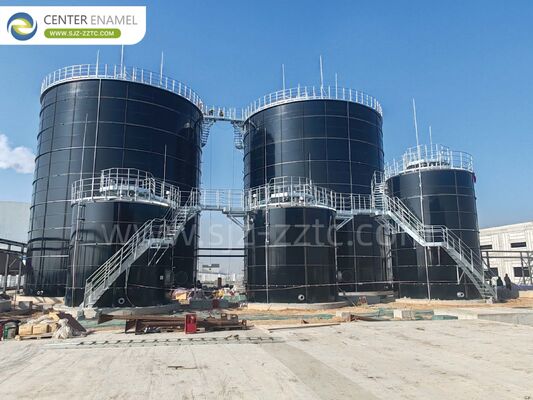
Center Enamel’s Glass-Fused-to-Steel (GFS) tanks represent the gold standard for anaerobic digestion infrastructure. By fusing molten glass to premium steel plates at high temperatures, we create a chemically inert surface that is exceptionally resistant to the corrosive acidic environment inherent in biogas production. When integrated with our high-performance Double Membrane Roof, the system functions as an airtight, pressure-controlled reactor that optimizes gas collection. This integrated configuration reduces project costs and the physical footprint required, serving as a superior alternative to traditional welded steel or concrete structures.
Beyond our flagship GFS designs, Center Enamel provides an extensive range of cover solutions engineered to meet diverse environmental and operational requirements:
- Aluminum Geodesic Dome Roof: A lightweight, clear-span structure known for its exceptional corrosion resistance and minimal maintenance requirements, ideal for large-diameter tanks.
- Stainless Steel Roof: A robust, high-longevity solution engineered specifically for extreme industrial conditions.
- FRP Roof: A versatile and cost-effective cover option suitable for applications where high air-tightness is not a primary design requirement.
An efficient biogas project requires a complete suite of auxiliary components to ensure smooth, continuous operation. Center Enamel supplies a comprehensive range of equipment, including high-efficiency Solid-liquid Separators for feed pre-treatment, advanced Lifting Pumps for material transport, Dehydration and Desulfurization Tanks for high-purity gas production, safe Torch Systems for pressure management, and automated Screw Sludge Dewatering machines for efficient digestate handling.
Center Enamel serves as a comprehensive, end-to-end partner for businesses and municipalities across South Africa:
- Turnkey EPC Services: We manage every phase of the project, from initial conceptual design and engineering to on-site construction and commissioning, ensuring a seamless implementation.
- Advanced Equipment Supply: We manufacture and supply all core processing equipment and proprietary technology, guaranteeing perfect synchronization and performance throughout the system.
- Global Expertise: With more than 36 years of experience and successful project installations in over 100 countries, we possess the technical depth to solve the unique waste-to-energy challenges faced by the South African market.
By integrating the precision of the CSTR process with the extreme durability of Glass-Fused-to-Steel tanks, Center Enamel provides South African industries with a sustainable path to waste management. Our commitment to world-class engineering ensures that your biogas project acts as a high-performance asset that enhances both operational efficiency and environmental responsibility. We are dedicated to supporting South Africa in building a cleaner, more sustainable energy future through innovative, turnkey solutions.
1. How does the GFS tank material perform in the varying climate conditions of South Africa?
The GFS coating is highly versatile and resilient. It is resistant to UV radiation and thermal expansion, ensuring that the tank maintains its structural integrity and remains free of corrosion regardless of whether it is deployed in dry, high-heat, or coastal regions of South Africa.
2. Can Center Enamel provide project support for large-scale municipal waste facilities in South Africa?
Yes. Our turnkey EPC services are specifically designed to scale from small industrial processing plants to large municipal waste-to-energy facilities, ensuring that all projects receive the same rigorous adherence to international engineering standards.
3. What are the key advantages of using a screw sludge dewatering machine in biogas production?
The screw sludge dewatering machine is essential for effectively managing the digestate produced after fermentation. It reduces the volume of solid waste, which lowers transportation costs, and it recovers valuable nutrients from the digestate, allowing for potential secondary use in agricultural fertilization.