-
Glass Fused To Steel Tanks (596)
-
Stainless Steel Tanks (434)
-
Fusion Bonded Epoxy Tanks (592)
-
Galvanized Steel Tanks (321)
-
Aluminum Dome Roofs (1316)
-
Wastewater Storage Tanks (231)
-
Welded Steel Tanks (457)
-
Pressure Vessels (295)
-
Anaerobic Digester (201)
-
Industrial Water Tanks (349)
-
Glass Lined Steel Tanks (180)
-
Bolted Steel Tanks (390)
-
Sludge Storage Tank (115)
-
Biogas Storage Tank (173)
-
Leachate Storage Tanks (133)
-
Agricultural Water Storage Tanks (179)
-
Fire Water Tank (166)
-
Grain Storage Silos (146)
-
Biogas Projects (425)
-
Wastewater Treatment Projects (788)
-
Double Membrane Roof (223)

|
Leading Starch Wastewater Treatment Project EPC Contractor for Malaysia
| Place of Origin: | China |
| Brand Name: | CEC TANKS |
| Certification: | ISO 9001:2008, AWWA D103 , OSHA , BSCI |
| Model Number: | W |
| Minimum Order Quantity: | 1set |
| Price: | $5000~$20000 one set |
| Packaging Details: | PE poly-foam between each two steel plates ; wooden pallet and wooden |
| Delivery Time: | 10-30 days after deposit received |
| Payment Terms: | L/C, T/T |
| Supply Ability: | 60 sets per month |
|
Detail Information |
|||
| Place of Origin | China | Brand Name | CEC TANKS |
|---|---|---|---|
| Certification | ISO 9001:2008, AWWA D103 , OSHA , BSCI | Model Number | W |
| Tank Body Color: | Dark Green / Can Be Customized | Corrosion Integrity: | Excellent |
| Steel Plates Thickness: | 3mm To 12mm , Depends On The Tank Structure | Chemical Resistance: | Excellent |
| Size Of Panel: | 2.4M * 1.2M | Easy To Clean: | Smooth, Glossy, Inert, Anti-adhesion |
| Highlight: | starch wastewater treatment contractor,wastewater treatment project EPC,Malaysia wastewater treatment contractor |
||
Product Description
Leading Starch Wastewater Treatment Project EPC Contractor for Malaysia
As Malaysia advances its "Shared Prosperity Vision 2030" and strengthens its position in the global agricultural export market—particularly in tapioca and sago starch—the industry is entering a critical phase of environmental transformation. While starch production is a vital pillar of Malaysia’s economy, especially in states like Sarawak and Perak, it faces increasingly stringent environmental oversight. Managing high-concentration organic effluent is no longer a choice but a mandate for operational survival. For modern starch processors in Malaysia, partnering with an experienced Starch Wastewater Treatment Project EPC Contractor like Center Enamel is the definitive strategy for achieving environmental compliance and sustainable resource recovery.
The Environmental Landscape in Malaysia’s Starch Sector
Malaysia is home to some of the world’s most precious river systems and coastal ecosystems, which are highly sensitive to industrial discharge. The starch industry, while economically significant, generates millions of cubic meters of wastewater annually that can cause severe oxygen depletion in water bodies if not professionally treated.
Current Discharge Status & Policy:
The Malaysian Department of Environment (DOE) rigorously enforces the Environmental Quality Act 1974. Specifically, the Environmental Quality (Industrial Effluent) Regulations 2009 set strict "Standard A" and "Standard B" discharge limits for various parameters, including Chemical Oxygen Demand (COD) and Biochemical Oxygen Demand (BOD). In line with Malaysia’s Green Technology Master Plan, there is a strong emphasis on the "Circular Economy," encouraging starch factories to adopt Anaerobic Solutions that facilitate biogas capture and minimize carbon footprints. Failure to comply with these standards can result in heavy penalties or the revocation of operating licenses.
Analysis of Starch Wastewater Generation
In the Malaysian context, starch production is a water-intensive process where wastewater is generated primarily through three stages:
Raw Material Cleaning: Washing soil, sand, and impurities from cassava tubers or sago trunks.
Extraction and Separation: This stage produces the "heavy" effluent, rich in soluble starch, proteins, and organic acids.
Dewatering: The liquid squeezed from starch pulp contains high concentrations of suspended solids (SS).
Characteristics: Starch wastewater is typically acidic (pH 4.0-5.5) and characterized by extremely high organic loads, with COD levels often exceeding 15,000 mg/L. This high strength makes it an ideal candidate for energy-efficient anaerobic treatment systems.
The Starch Wastewater Treatment Process
A high-performance treatment train engineered by Center Enamel for the Malaysian market typically follows a multi-stage approach:
Pre-treatment: Utilizing mechanical screening to remove fibers and grit, followed by an equalization tank to stabilize flow and pH levels.
Anaerobic Digestion: The core biological stage where organic pollutants are converted into methane-rich biogas.
Aerobic Polishing: Systems like SBR or MBBR are used to further refine the water to meet the DOE’s final discharge standards.
Resource Recovery: Capturing biogas for factory power or thermal energy, effectively turning "waste" into a cost-saving resource.
Advanced Anaerobic Solutions: IC, CSTR, UASB, and USR
As a specialized Starch Wastewater Treatment Project EPC Contractor, Center Enamel offers a suite of precision-engineered anaerobic technologies:
IC (Internal Circulation) Reactor: The pinnacle of high-rate anaerobic technology and the preferred choice for high-strength starch wastewater. It utilizes internal biogas circulation to create a "gas-lift" effect, providing intensive mixing and treating high organic loads with unmatched efficiency in a compact structure.
CSTR (Completely Stirred Tank Reactor): Ideal for feedstocks with high solids content, such as starch pulp. Mechanical stirring ensures a homogeneous environment for stable biogas yield.
UASB (Upflow Anaerobic Sludge Blanket): A highly efficient process where wastewater passes through a granular sludge bed. It is favored for its simplicity and high COD removal rates.
USR (Upflow Solids Reactor): Specifically designed for wastewater with high suspended solids (SS), ensuring longer retention times for thorough organic decomposition.
Durable Infrastructure: The GFS Tank Advantage
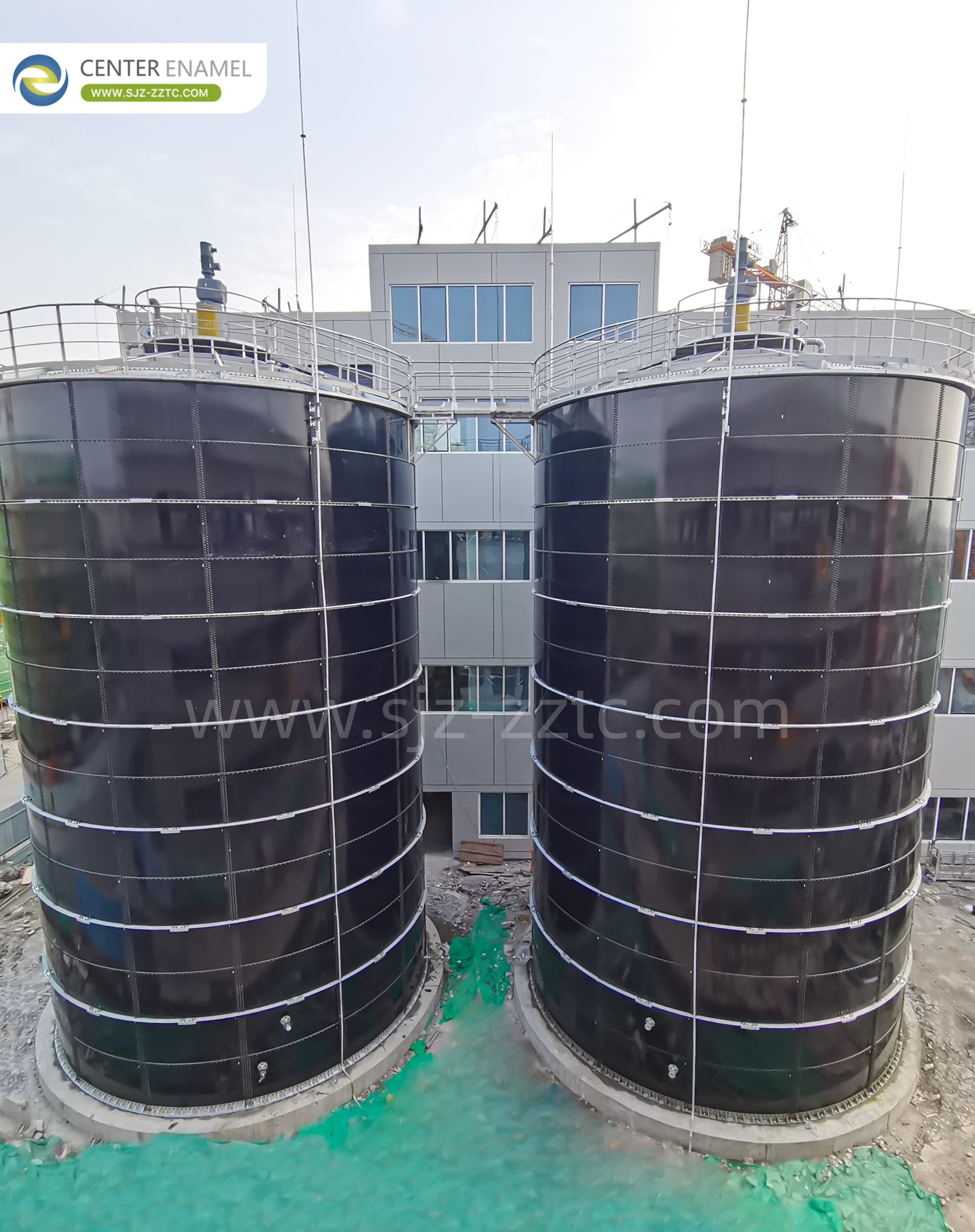
The reliability of any IC Process depends on the vessel's integrity. Center Enamel’s Glass-Fused-to-Steel (GFS) tanks are the global benchmark for starch wastewater applications:
Unmatched Corrosion Resistance: The acidic nature of starch wastewater and the $H_2S$ in biogas require superior protection. GFS tanks feature a chemically inert glass coating fused to steel, providing a permanent shield against corrosion.
Rapid Modular Installation: Bolted GFS tanks can be installed in a fraction of the time required for concrete, allowing Malaysian factories to upgrade their systems with minimal downtime.
Longevity in Tropical Climates: Engineered for a 30-year service life, these tanks withstand Malaysia’s humid and rainy conditions with minimal upkeep.
Why Choose Center Enamel for Your Starch Project?
Center Enamel provides a comprehensive, turnkey solution that encompasses:
Custom Engineering: Designs tailored to Malaysia’s specific climate and organic waste profiles.
Turnkey EPC Excellence: From feasibility and design to manufacturing and commissioning, we manage the entire project lifecycle.
Proven Resource Recovery: Our systems are optimized to maximize biogas capture, supporting Malaysia's transition to renewable energy and sustainable agriculture.
Global Success Stories in Starch Wastewater Management
Case1: Chile Industrial Wastewater Treatment Project
Tank Dimensions: φ12.99 × 4.8 m (H) — 1 Unit
Total Volume: 635 m³ — 1 Unit
Completion Date: 2023
Case2: Malaysia Industrial Wastewater Treatment Project
Tank Dimensions:
φ7.735 × 5.76 m (H) — 1 Unit
φ9.454 × 5.76 m (H) — 1 Unit
φ6.12 × 4.8 m (H) — 1 Unit
Total Volume: 815 m³
Completion Date: 2026
For starch processors in Malaysia, the transition to advanced wastewater management is a vital step toward a sustainable and profitable future. By integrating the unmatched durability of GFS Tanks with high-performance Anaerobic Solutions like the IC Process, Center Enamel provides a proven roadmap for success. Our turnkey EPC solutions empower factories to transform environmental liabilities into valuable biogas energy, ensuring full compliance with Malaysia's environmental policies while protecting the nation's precious natural resources for future generations.