-
Glass Fused To Steel Tanks (596)
-
Stainless Steel Tanks (434)
-
Fusion Bonded Epoxy Tanks (592)
-
Galvanized Steel Tanks (321)
-
Aluminum Dome Roofs (1316)
-
Wastewater Storage Tanks (231)
-
Welded Steel Tanks (457)
-
Pressure Vessels (295)
-
Anaerobic Digester (201)
-
Industrial Water Tanks (349)
-
Glass Lined Steel Tanks (180)
-
Bolted Steel Tanks (390)
-
Sludge Storage Tank (115)
-
Biogas Storage Tank (173)
-
Leachate Storage Tanks (133)
-
Agricultural Water Storage Tanks (179)
-
Fire Water Tank (166)
-
Grain Storage Silos (146)
-
Biogas Projects (425)
-
Wastewater Treatment Projects (788)
-
Double Membrane Roof (223)

|
Leading Industrial Wastewater Treatment Project EPC Contractor for Timor-Leste
| Place of Origin: | China |
| Brand Name: | CEC TANKS |
| Certification: | ISO 9001:2008, AWWA D103 , OSHA , BSCI |
| Model Number: | W |
| Minimum Order Quantity: | 1set |
| Price: | $5000~$20000 one set |
| Packaging Details: | PE poly-foam between each two steel plates ; wooden pallet and wooden |
| Delivery Time: | 10-30 days after deposit received |
| Payment Terms: | L/C, T/T |
| Supply Ability: | 60 sets per month |
|
Detail Information |
|||
| Place of Origin | China | Brand Name | CEC TANKS |
|---|---|---|---|
| Certification | ISO 9001:2008, AWWA D103 , OSHA , BSCI | Model Number | W |
| Tank Body Color: | Dark Green / Can Be Customized | Corrosion Integrity: | Excellent |
| Steel Plates Thickness: | 3mm To 12mm , Depends On The Tank Structure | Chemical Resistance: | Excellent |
| Size Of Panel: | 2.4M * 1.2M | Easy To Clean: | Smooth, Glossy, Inert, Anti-adhesion |
| Highlight: | industrial wastewater treatment EPC contractor,wastewater treatment project contractor,Timor-Leste wastewater treatment services |
||
Product Description
Leading Industrial Wastewater Treatment Project EPC Contractor for Timor-Leste
As Timor-Leste continues to develop its industrial infrastructure, particularly within the food processing, beverage, and agricultural sectors, the need for sustainable environmental management has become a national priority. For emerging enterprises in Dili and beyond, managing high-strength organic effluent is no longer just a regulatory hurdle—it is an essential component of operational longevity. To meet these challenges, partnering with a globally recognized Industrial Wastewater Treatment Project EPC Contractor like Center Enamel is the most effective way to transform environmental liabilities into sustainable assets.
The State of Industrial Wastewater in Timor-Leste
In Timor-Leste, the growth of the livestock and food industries supports the national economy but also generates a significant volume of high-strength organic effluent. Without a professional Industrial Wastewater Treatment Project, the discharge of untreated waste carries severe consequences:
Water Resource Contamination: Raw effluent with extremely high Chemical Oxygen Demand (COD) and Biological Oxygen Demand (BOD) threatens critical groundwater supplies and local river systems.
Public Health Risks: Untreated discharge can lead to the spread of waterborne pathogens, posing severe health risks to surrounding communities.
Ecological Degradation: High nitrogen and phosphorus levels cause soil salinization and the eutrophication of water bodies, damaging the local ecological balance.
By implementing a professional treatment system, Timorese industries can achieve resource recovery, such as transforming organic waste into biogas for power and producing nutrient-rich bio-fertilizers.
Advanced Anaerobic Treatment Processes
A robust Industrial Wastewater Treatment Project relies on selecting the appropriate biological process based on the specific waste stream. Center Enamel specializes in three high-rate anaerobic digestion technologies:
1. The UASB Process (Upflow Anaerobic Sludge Blanket)
The UASB Process is a cornerstone of modern industrial wastewater treatment.
Mechanism: Wastewater flows upward through a dense blanket of granular anaerobic sludge where microorganisms break down organic matter to produce biogas.
Advantage: It is highly efficient for high-COD wastewater and has a small footprint, making it ideal for facilities with limited space.
2. The CSTR Process (Completely Stirred Tank Reactor)
For feedstocks with high solids content, such as concentrated manure, the CSTR process is the preferred solution.
Mechanism: Mechanical agitators maintain a homogeneous environment within the tank to maximize microbial contact.
Advantage: It ensures stable operation and consistent biogas production even when the feedstock characteristics vary.
3. The USR Process (Upflow Solids Reactor)
The USR process is specifically designed for high-concentration organic wastewater containing high suspended solids.
Mechanism: This process is optimized for a long solids retention time (SRT) to ensure the complete degradation of complex organic matter.
Advantage: It is extremely effective for the intensive treatment of heavy slurry from large-scale dairy or pig farms.
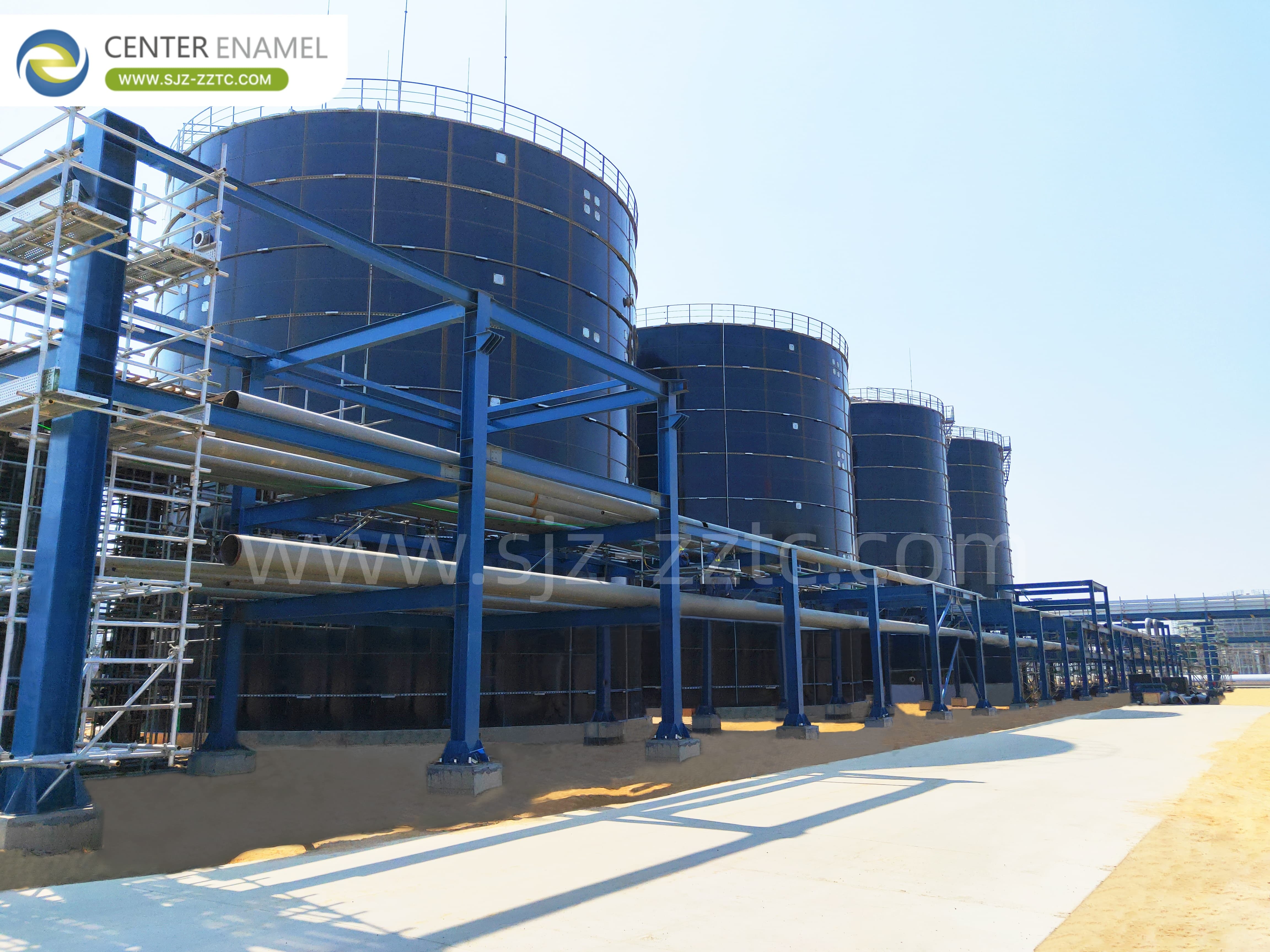
Durable Infrastructure: The GFS Tank Advantage
The reliability of any Industrial Wastewater Treatment Project depends on the resilience of its containment vessels. Center Enamel’s Glass-Fused-to-Steel (GFS) tanks are the industry standard for these demanding environments:
Superior Corrosion Resistance: The glass-and-steel fusion provides a non-porous barrier that is immune to corrosive $H_2S$ gas and high ammonia levels.
Rapid Modular Installation: The bolted design significantly reduces construction timelines compared to traditional concrete tanks, which is vital for meeting tight project deadlines.
Longevity and Scalability: GFS tanks offer a service life exceeding 30 years and can be easily expanded as production needs grow.
Why Choose Center Enamel?
As a premier Industrial Wastewater Treatment Project EPC Contractor, Center Enamel provides comprehensive, turnkey solutions:
Turnkey EPC Delivery: We manage the entire project lifecycle, from design and engineering to manufacturing, installation, and final commissioning.
Customized Engineering: We tailor the combination of the UASB Process, CSTR, or USR based on the specific waste characteristics of your facility.
Proven Reliability: With over 30 years of experience and projects in more than 100 countries, we bring world-class quality to every local market.
Successful Project Case Studies
Our global expertise is demonstrated through high-performance installations across various industries:
1. Beverage Factory Wastewater Treatment Project in Mali and Guinea
Location: Mali and Guinea
Installation Time: 2024
Process Flow: DAF + Hydrolysis Acidification + Biological Contact Oxidation + Sedimentation + Ozone Oxidation
Treatment Capacity: 100 m³/day
2. Wastewater Treatment Project in Shanxi, China
Installation Date: March 2017
Treatment Process: Pretreatment + USR + AOAO + Advanced Treatment
Treatment Capacity: 600 m³/day
Conclusion
For industrial operators in Timor-Leste, moving toward sustainable wastewater treatment is a vital step for long-term viability. By combining the resilience of GFS tanks with high-rate processes like the UASB Process, Center Enamel empowers enterprises to achieve energy independence and environmental compliance.