-
Glass Fused To Steel Tanks (596)
-
Stainless Steel Tanks (434)
-
Fusion Bonded Epoxy Tanks (592)
-
Galvanized Steel Tanks (321)
-
Aluminum Dome Roofs (1316)
-
Wastewater Storage Tanks (231)
-
Welded Steel Tanks (457)
-
Pressure Vessels (295)
-
Anaerobic Digester (201)
-
Industrial Water Tanks (349)
-
Glass Lined Steel Tanks (180)
-
Bolted Steel Tanks (390)
-
Sludge Storage Tank (115)
-
Biogas Storage Tank (173)
-
Leachate Storage Tanks (133)
-
Agricultural Water Storage Tanks (179)
-
Fire Water Tank (166)
-
Grain Storage Silos (146)
-
Biogas Projects (425)
-
Wastewater Treatment Projects (788)
-
Double Membrane Roof (223)

|
Leading Livestock Wastewater Treatment Project EPC Contractor for Nepal
| Place of Origin: | China |
| Brand Name: | CEC TANKS |
| Certification: | ISO 9001:2008, AWWA D103 , OSHA , BSCI |
| Model Number: | W |
| Minimum Order Quantity: | 1set |
| Price: | $5000~$20000 one set |
| Packaging Details: | PE poly-foam between each two steel plates ; wooden pallet and wooden |
| Delivery Time: | 10-30 days after deposit received |
| Payment Terms: | L/C, T/T |
| Supply Ability: | 60 sets per month |
|
Detail Information |
|||
| Place of Origin | China | Brand Name | CEC TANKS |
|---|---|---|---|
| Certification | ISO 9001:2008, AWWA D103 , OSHA , BSCI | Model Number | W |
| Tank Body Color: | Dark Green / Can Be Customized | Corrosion Integrity: | Excellent |
| Steel Plates Thickness: | 3mm To 12mm , Depends On The Tank Structure | Chemical Resistance: | Excellent |
| Size Of Panel: | 2.4M * 1.2M | Easy To Clean: | Smooth, Glossy, Inert, Anti-adhesion |
| Highlight: | livestock wastewater treatment contractor,wastewater treatment project EPC,Nepal wastewater treatment contractor |
||
Product Description
Leading Livestock Wastewater Treatment Project EPC Contractor for Nepal
As Nepal continues to modernize its agricultural landscape, the livestock sector—particularly cattle and poultry farming—has become a vital driver of rural livelihoods and national food security. However, the rapid concentration of livestock operations in fertile valleys like Kathmandu and Chitwan brings significant environmental responsibilities. Managing organic effluent is no longer just a local concern; it is a strategic move toward sustainable mountain ecology. For agricultural enterprises in Nepal, partnering with an experienced Livestock Wastewater Treatment Project EPC Contractor like Center Enamel is essential for transforming waste into renewable resources.
The Environmental Challenge in Nepal’s Livestock Sector
Nepal’s unique topography and critical Himalayan water sources are highly sensitive to agricultural runoff. Raw livestock effluent is a potent pollutant characterized by several high-risk factors:
High Chemical and Organic Loads: It contains elevated levels of ammonia and organic pollutants that can severely degrade the quality of river water used for downstream irrigation.
Pathogen Risks: Untreated waste carries harmful bacteria and pathogens, posing health risks to local communities and potentially contaminating groundwater.
Ecological Impact: If discharged without treatment, effluent leads to soil degradation and the eutrophication of local water bodies, depleting oxygen levels for aquatic life.
By implementing a professional Livestock Wastewater Treatment Project, farms in Nepal can transform these liabilities into economical opportunities. Proper treatment allows for the recovery of renewable biogas energy for farm operations, a significant reduction in carbon footprints, and the production of nutrient-rich digestate that can be used as organic fertilizer for the country's terrace farming and crop plantations.
Advanced Anaerobic Processes: CSTR, UASB, and USR
Center Enamel, serving as a premier Livestock Wastewater Treatment Project EPC Contractor, specializes in diverse anaerobic digestion technologies precision-engineered to handle various livestock feedstocks.
1. The CSTR Process (Completely Stirred Tank Reactor)
The CSTR Process is the industry-leading choice for feedstocks with high solids content, such as concentrated animal manure.
Mechanism: It utilizes high-torque mechanical mixing to ensure a completely homogeneous environment within the reactor.
Benefit: This constant mixing maximizes microbial contact with the organic matter, ensuring a high and stable biogas yield even when processing complex materials common in mixed-farming systems.
2. UASB (Upflow Anaerobic Sludge Blanket)
This high-rate process is ideal for liquid-phase wastewater with lower suspended solids.
Mechanism: Effluent flows upward through a dense granular sludge blanket where organic pollutants are rapidly degraded by anaerobic bacteria.
Benefit: It offers high treatment efficiency and a compact footprint, making it an excellent solution for farms with limited flat land.
3. USR (Upflow Solids Reactor)
Specifically designed for high-concentration organic wastewater containing high levels of suspended solids.
Mechanism: The USR process is engineered to ensure a long solids retention time (SRT).
Benefit: This enables the thorough digestion of complex organic matter, which is particularly effective for large-scale industrial livestock operations.
Durable Infrastructure: The GFS Tank Advantage
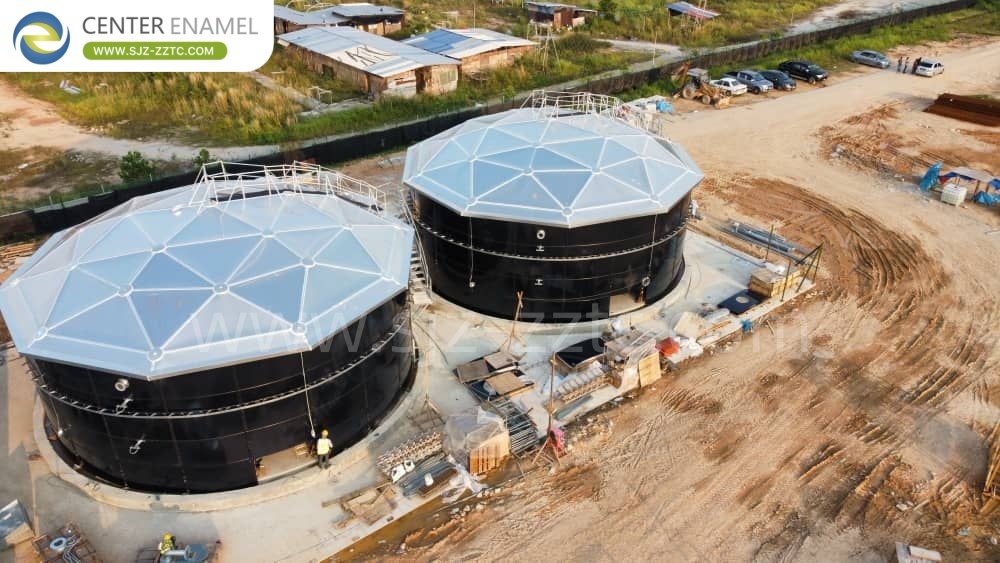
The success of any biogas-to-energy project depends on the durability of its core infrastructure. Center Enamel’s Glass-Fused-to-Steel (GFS) tanks are the recognized industry standard for livestock waste management due to several critical advantages:
Exceptional Corrosion Resistance: The fusion of glass and steel creates an inert, non-porous barrier immune to high ammonia levels and hydrogen sulfide ($H_2S$) typical of livestock waste.
Rapid Installation: The bolted modular design eliminates the need for extensive on-site welding or long concrete curing times, significantly shortening construction cycles in remote or mountainous regions.
Extended Service Life: Engineered for extreme durability, GFS tanks offer a service life of more than 30 years with minimal maintenance, even in varied climatic conditions.
Why Choose Center Enamel for Your Livestock Wastewater Project?
As a global Livestock Wastewater Treatment Project EPC Contractor, Center Enamel provides comprehensive, turnkey solutions. Our project advantages include:
Custom Engineering: We design systems specifically tailored to the unique climate and feedstock characteristics of the local agricultural sector.
Proven Reliability: With over 30 years of experience, our systems are built to perform consistently in demanding environments.
Energy Efficiency: Our designs, particularly those utilizing the CSTR Process, are optimized to maximize biogas production for farm-scale power generation.
Global Success Stories in Livestock Waste Management
Center Enamel’s expertise is demonstrated through high-performance projects delivered worldwide:
1. Beijing Livestock Wastewater Treatment Project
Installation Date: 2020
Daily Treatment Capacity: 580 m³/day
Treatment Process: UASB + AAO
2. Sweden Livestock Wastewater Treatment Project
Tank Dimensions: 1 unit (Ø13.76 × 15m), with GFS Roof
Installation Date: 2024
Conclusion
For livestock operators in Nepal, transitioning to sustainable waste-to-energy technology is an essential investment in the future. By combining the unmatched resilience of GFS tanks with precision-engineered anaerobic processes like the CSTR Process, UASB, and USR, Center Enamel empowers agricultural enterprises to achieve energy independence while protecting the nation’s precious natural resources.