-
Glass Fused To Steel Tanks (596)
-
Stainless Steel Tanks (434)
-
Fusion Bonded Epoxy Tanks (592)
-
Galvanized Steel Tanks (321)
-
Aluminum Dome Roofs (1316)
-
Wastewater Storage Tanks (231)
-
Welded Steel Tanks (457)
-
Pressure Vessels (295)
-
Anaerobic Digester (201)
-
Industrial Water Tanks (349)
-
Glass Lined Steel Tanks (180)
-
Bolted Steel Tanks (390)
-
Sludge Storage Tank (115)
-
Biogas Storage Tank (173)
-
Leachate Storage Tanks (133)
-
Agricultural Water Storage Tanks (179)
-
Fire Water Tank (166)
-
Grain Storage Silos (146)
-
Biogas Projects (425)
-
Wastewater Treatment Projects (788)
-
Double Membrane Roof (223)

|
Floating Roof for Welded Stainless Steel JET A1 Fuel Storage Tank: Essential for Preventing Contamination and Suppressing Vapors in Jet Fuel Environments
| Place of Origin: | China |
| Brand Name: | Center Enamel |
| Certification: | ISO 9001 |
| Model Number: | Aluminum Dome Roofs |
| Minimum Order Quantity: | 1 |
| Price: | 100-50000 |
| Packaging Details: | 2000 |
| Delivery Time: | 8 weeks |
| Payment Terms: | L/C, T/T |
| Supply Ability: | 6000 |
|
Detail Information |
|||
Product Description
Floating Roof for Welded Stainless Steel JET A1 Fuel Storage Tank: Essential for Preventing Contamination and Suppressing Vapors in Jet Fuel Environments
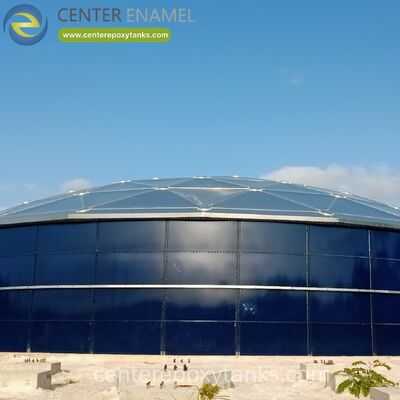
The storage of Jet A-1 aviation fuel requires an uncompromising approach to both purity and safety. Jet fuel is highly susceptible to atmospheric moisture and particulate contamination, which can lead to ice formation or microbial growth in aircraft fuel systems. Furthermore, the volatility of kerosene-based fuels necessitates strict vapor management to mitigate fire risks and product loss. The Floating Roof for Welded Stainless Steel JET A1 Fuel Storage Tanks is a specialized engineering component that serves as the primary line of defense. This system is essential for preventing contamination and suppressing vapors in jet fuel environments, providing a secure, dynamic barrier on the liquid surface. When integrated with a welded stainless steel shell and an Aluminum Dome Roof, it creates a high-purity containment environment that meets international aviation standards.
Eliminating Contamination through Direct Surface Contact
The most critical requirement for Jet A-1 is that it remains "clear and bright," meaning it is free from water and sediment. In a traditional fixed-roof tank, the large volume of air in the headspace allows for the "breathing" in of humid air. As temperatures drop, this moisture condenses on the interior walls and drops into the fuel. The internal floating roof addresses this by resting directly on the Jet A-1. By moving up and down with the fuel level, it eliminates the vast majority of the air-liquid interface.
This mechanical barrier effectively isolates the fuel from atmospheric humidity and airborne dust. The reliability of this system is significantly enhanced by the use of welded stainless steel for the tank shell. Unlike carbon steel, which can rust and scale—introducing fine metallic particles into the fuel—stainless steel provides a naturally sanitary and smooth surface. This allows the floating roof's perimeter seals to maintain constant, leak-proof contact, ensuring that no external pollutants reach the high-value fuel inventory. This isolation is essential for preventing contamination and ensuring the safety of aircraft engines.
Advanced Vapor Suppression and Thermal Management
Vapor suppression is equally vital in a Jet A-1 environment. Fugitive emissions represent both a financial loss and a significant fire hazard. The internal floating roof suppresses the formation of these vapors at the source by covering nearly the entire liquid surface. However, to maximize this efficiency, modern facilities utilize an Aluminum Dome Roof as a secondary protective cover.
The Aluminum Dome Roof is highly reflective, bouncing back solar radiation and keeping the tank headspace cool. This thermal regulation reduces the thermal energy that drives evaporation, further suppressing vapor pressure. A decisive advantage of the aluminum dome is its clear-span design. Traditional roofs require internal support columns that must penetrate the floating roof, creating gaps and leak paths for vapors to escape. By using a column-free geodesic dome, the floating roof provides a seamless, 100% effective vapor barrier across the entire diameter of the welded stainless steel tank. This dual-layer approach is the most effective way to suppress vapors and maintain a safe, stable storage environment.
Structural Integrity and Maintenance Reliability
The combination of welded stainless steel and an aluminum dome offers a solution with exceptional durability and low maintenance requirements. Welded stainless steel does not require internal coatings, which can often fail and contaminate the fuel. The Aluminum Dome Roof is naturally resistant to atmospheric corrosion and does not require periodic painting. This reliability ensures maximum operational uptime for airport fueling systems and reduces the total cost of ownership over the life of the asset.
Furthermore, the integrated system enhances site safety. The aluminum dome acts as a natural Faraday cage, protecting the tank from lightning strikes, while the floating roof ensures that no explosive vapor clouds can accumulate in the headspace. This structural and operational safety is paramount for fuel farms located near busy international airports or sensitive military bases. The clear-span nature of the dome also facilitates safer inspections, as there are no internal columns to obstruct the view of the seals and the floating deck.
Application Areas
The need for absolute fuel purity and rigorous vapor control makes these systems essential for:
International Airport Fuel Hubs: Ensuring a constant supply of clean Jet A-1 for global flight operations.
Refinery Jet Fuel Storage: Protecting the finished product during bulk storage and distribution.
Military Aviation Depots: Providing mission-ready fuel quality in extreme environments.
Coastal Fuel Terminals: Where welded stainless steel and Aluminum Dome Roofs resist harsh salt-air corrosion.
Company Advantage and Comprehensive Service
Center Enamel is recognized globally for providing high-performance industrial containment for the aviation sector. Our approach to Floating Roofs for Welded Stainless Steel JET A1 Fuel Storage Tanks is defined by technical precision and a commitment to flight safety:
Purity-Focused Engineering: We design floating roof systems specifically to eliminate contamination and maintain aviation-grade fuel quality.
Advanced Material Standards: We utilize precision-welded stainless steel and high-grade aluminum alloys to ensure a seamless, non-corrosive storage environment.
Global Technical Support: We provide expert technical supervision for the installation of floating roofs, tank shells, and Aluminum Dome Roofs worldwide, ensuring absolute reliability for aviation infrastructure.
Conclusion
In the world of aviation fueling, the quality of storage infrastructure is a key driver of safety and efficiency. Floating Roofs for Welded Stainless Steel JET A1 Fuel Storage Tanks provide the most effective barrier against fuel contamination and vapor loss. By prioritizing a design that is essential for preventing pollution and suppressing vapors, operators protect their assets and the lives of those who travel by air. When these systems are reinforced with the maintenance-free protection of an Aluminum Dome Roof, they represent a world-class solution that balances safety, durability, and operational excellence.