-
Glass Fused To Steel Tanks (596)
-
Stainless Steel Tanks (434)
-
Fusion Bonded Epoxy Tanks (592)
-
Galvanized Steel Tanks (321)
-
Aluminum Dome Roofs (1316)
-
Wastewater Storage Tanks (231)
-
Welded Steel Tanks (457)
-
Pressure Vessels (295)
-
Anaerobic Digester (201)
-
Industrial Water Tanks (349)
-
Glass Lined Steel Tanks (180)
-
Bolted Steel Tanks (390)
-
Sludge Storage Tank (115)
-
Biogas Storage Tank (173)
-
Leachate Storage Tanks (133)
-
Agricultural Water Storage Tanks (179)
-
Fire Water Tank (166)
-
Grain Storage Silos (146)
-
Biogas Projects (425)
-
Wastewater Treatment Projects (788)
-
Double Membrane Roof (223)

|
Aluminum Dome Roof for Welded Stainless Steel Biofuels Tank: Ensures Product Stability for Biological Fuels by Preventing Moisture and Air Exposure
| Brand Name: | Shijiazhuang Zhengzhong Technology Co., Ltd (Center Enamel) |
|
Detail Information |
|||
Product Description
Aluminum Dome Roof for Welded Stainless Steel Biofuels Tank: Ensures Product Stability for Biological Fuels by Preventing Moisture and Air Exposure
As the global energy sector transitions toward renewable sources, the storage of biofuels—such as biodiesel, ethanol, and various biomass-to-liquid products—presents a unique set of chemical challenges. Biofuels are inherently more unstable than traditional petroleum-based fuels; they are highly hygroscopic, meaning they readily absorb water from the atmosphere, and are prone to oxidation when exposed to air. Aluminum Dome Roofs for Welded Stainless Steel Biofuels Tanks represent the ultimate engineering solution for these sensitive renewables. This system ensures product stability for biological fuels by preventing moisture and air exposure through a hermetically sealed, clear-span geodesic structure. By combining the non-reactive surface of a welded stainless steel shell with the environmental shielding of an aluminum dome, operators can protect their biofuel assets from degradation.
Preventing Degradation through Advanced Environmental Isolation
The primary enemies of biofuel stability are moisture and oxygen. Water ingress into biodiesel or ethanol triggers microbial growth and the formation of organic acids, which can lead to fuel spoilage and the corrosion of engine components. Similarly, exposure to atmospheric oxygen leads to the oxidation of the fuel, resulting in increased acidity and the formation of gums and sediments. Traditional storage tanks with fixed steel roofs often have internal support columns that create gaps and leak paths for humid air to enter the headspace.
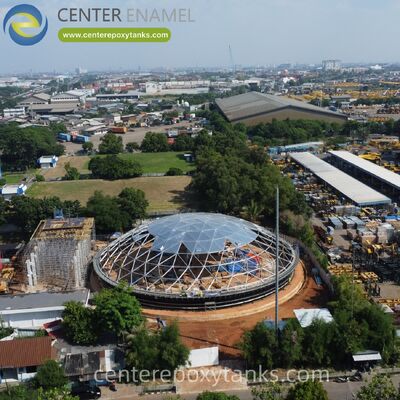
The Aluminum Dome Roof eliminates these risks through its self-supporting space-frame architecture. Because it requires no internal pillars, the interior of the welded stainless steel tank remains a completely unobstructed environment. This allows for the installation of an internal floating roof that can maintain a 100% effective seal against the smooth stainless steel wall. The dome itself acts as a robust secondary barrier, providing a weather-tight shield that effectively prevents moisture and air exposure. The precision-engineered batten-sealing system of the dome ensures that the tank headspace remains dry and isolated from the external environment, preserving the chemical balance and energy density of the biological fuel.
Material Compatibility and Thermal Regulation
Biofuels, particularly ethanol and fatty acid methyl esters, are chemically aggressive toward many common materials. They can degrade certain plastics, rubbers, and even carbon steel through localized corrosion or the stripping of protective coatings. Welded stainless steel is the premier choice for the primary shell because it is inherently resistant to the organic acids found in biofuels and does not require internal linings that could fail over time. The Aluminum Dome Roof complements this high-integrity environment by offering a cover that is similarly inert.
Thermal management is another critical factor in maintaining biofuel stability. High temperatures accelerate the rate of oxidation and fuel degradation. Aluminum is highly reflective, bouncing back a significant portion of solar radiation and keeping the tank headspace cool. This "cool roof" effect minimizes the thermal expansion of the internal vapor-air mixture, which reduces the "breathing" cycles that draw fresh, moist air into the tank. By maintaining a stable, cool internal environment, the combination of a stainless steel shell and an aluminum dome ensures that the biofuel remains within its required technical specifications for a much longer duration than conventional storage systems.
Operational Reliability and Structural Safety
The combination of welded stainless steel and an aluminum dome provides a storage solution with the lowest possible maintenance requirements. The Aluminum Dome Roof is naturally resistant to atmospheric corrosion and does not require periodic sandblasting or repainting. This is a significant advantage in biofuel facilities where maintaining a clean, contaminant-free environment is mandatory. The clear-span nature of the dome also facilitates safer and more effective inspections. Without a forest of internal columns to navigate, technicians or automated sensors can easily verify the integrity of the tank seals and the quality of the stored fuel.
The lightweight nature of the aluminum dome—roughly one-third the weight of a steel equivalent—also improves the overall seismic resilience of the welded stainless steel tank. By reducing the top-heavy load, the dome ensures the tank remains structurally stable during environmental stress, preventing the accidental release of valuable renewable fuels. This reliability ensures maximum operational uptime and provides the highest level of protection for the facility's investment in sustainable energy infrastructure.
Application Areas
The need for high-integrity environmental isolation and structural resilience makes these domes essential for:
Biodiesel Production Plants: Protecting refined feedstock from moisture and oxidation.
Ethanol Storage Hubs: Ensuring the purity of fuel-grade alcohols for blending.
Biomass-to-Liquid Facilities: Providing secure containment for next-generation renewable fuels.
Coastal Renewable Energy Terminals: Where the combination of a stainless steel shell and an Aluminum Dome Roof provides the best protection against salt-air corrosion.
Company Advantage and Comprehensive Service
Center Enamel is recognized globally for its expertise in providing high-performance industrial containment for the renewable energy sector. Our approach to Aluminum Dome Roofs for Welded Stainless Steel Biofuels Tanks is defined by a commitment to technical precision and product stability:
Stability-Focused Engineering: We design geodesic dome systems specifically to maximize environmental isolation and prevent the degradation of sensitive biological fuels.
Advanced Manufacturing Standards: Our facility utilizes high-grade aluminum alloys and precision-welded stainless steel to ensure the entire tank structure is a seamless, high-purity barrier.
Global Technical Support: We provide expert technical supervision for the assembly of clear-span domes and tank shells worldwide, ensuring absolute reliability for mission-critical biofuel storage.
Conclusion
In the rapidly evolving renewable energy market, the quality of storage infrastructure is a key driver of fuel reliability and facility efficiency. Aluminum Dome Roofs for Welded Stainless Steel Biofuels Tanks provide the most effective barrier against moisture, oxygen, and thermal degradation. By prioritizing a design that ensures product stability by preventing air and moisture exposure, operators protect their assets and the sustainability of their energy products. When these tanks are reinforced with the maintenance-free protection of an aluminum dome, they represent a world-class solution that balances safety, durability, and operational excellence.