-
Glass Fused To Steel Tanks (596)
-
Stainless Steel Tanks (434)
-
Fusion Bonded Epoxy Tanks (592)
-
Galvanized Steel Tanks (321)
-
Aluminum Dome Roofs (1316)
-
Wastewater Storage Tanks (231)
-
Welded Steel Tanks (457)
-
Pressure Vessels (295)
-
Anaerobic Digester (201)
-
Industrial Water Tanks (349)
-
Glass Lined Steel Tanks (180)
-
Bolted Steel Tanks (390)
-
Sludge Storage Tank (115)
-
Biogas Storage Tank (173)
-
Leachate Storage Tanks (133)
-
Agricultural Water Storage Tanks (179)
-
Fire Water Tank (166)
-
Grain Storage Silos (146)
-
Biogas Projects (425)
-
Wastewater Treatment Projects (788)
-
Double Membrane Roof (223)

|
External Floating Roof for Welded Steel Tanks for Petroleum Storage Tanks: Provides a Reliable Vapor Barrier to Reduce Product Loss
| Brand Name: | Shijiazhuang Zhengzhong Technology Co., Ltd (Center Enamel) |
|
Detail Information |
|||
Product Description
External Floating Roof for Welded Steel Tanks for Petroleum Storage Tanks: Provides a Reliable Vapor Barrier to Reduce Product Loss
In the global energy infrastructure, the secure and efficient storage of petroleum products is a critical component of the supply chain. External Floating Roofs for Welded Steel Tanks for Petroleum Storage Tanks represent a sophisticated engineering solution designed to address the inherent volatility of liquid hydrocarbons. Petroleum products, ranging from heavy fuel oils to lighter distillates, are susceptible to significant volume loss and chemical degradation when exposed to the atmosphere. This specialized storage configuration is vital because it provides a reliable vapor barrier to reduce product loss, creating a high-integrity interface that effectively seals the liquid surface from the air while ensuring the structural longevity of the storage vessel in demanding industrial environments.
The Logic of Vapor Suppression and Economic Retention
The primary economic challenge in petroleum storage is "standing loss," which occurs when the most volatile components of the oil evaporate into the tank's headspace. In a traditional fixed-roof tank, this gas-filled space expands and contracts with daily temperature shifts, venting valuable hydrocarbons into the atmosphere. External Floating Roofs for Welded Steel Tanks for Petroleum Storage Tanks solve this problem by utilizing a precision-engineered floating deck that rests directly on the liquid surface.
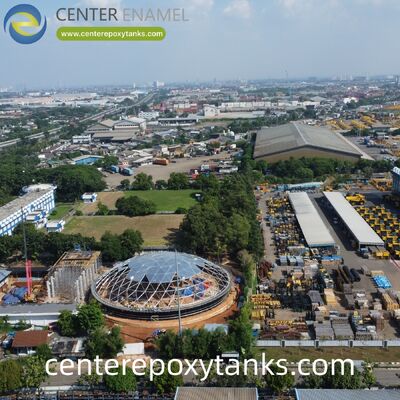
By removing the air-to-liquid interface, the floating roof acts as a continuous mechanical seal. This direct suppression is the most reliable method that provides a reliable vapor barrier to reduce product loss. To further strengthen this containment and protect the deck from environmental factors like rainwater accumulation, many modern terminals integrate Aluminum Dome Roofs into their tank architecture. While the floating roof manages the surface of the oil, the Aluminum Dome Roof acts as a superior, weather-tight external cover. The geodesic design of the Aluminum Dome Roof is a clear-span structure, meaning it requires no internal support columns. This is a decisive advantage; in traditional tanks, support columns penetrate the floating roof at multiple points, creating small gaps where vapors can "wick" through the seal and accumulate. By utilizing a column-free aluminum dome, the floating roof remains entirely continuous, providing a superior hermetic seal that ensures the highest level of vapor suppression.
Material Integrity and Advanced Thermal Regulation
Petroleum products can be chemically aggressive and are often sensitive to temperature fluctuations. The choice of welded stainless steel for the tank shell is a proactive measure against corrosion and product contamination. Stainless steel provides a naturally smooth, non-reactive, and corrosion-resistant surface that does not require internal epoxy coatings. The construction of External Floating Roofs for Welded Steel Tanks for Petroleum Storage Tanks utilizes automated precision welding to ensure a seamless primary container that can withstand the weight of a floating roof and the pressure of large-scale liquid storage.
The external Aluminum Dome Roof further reinforces this durability through advanced thermal regulation. Aluminum is highly reflective and naturally resistant to atmospheric corrosion without the need for periodic painting. The Aluminum Dome Roof acts as a permanent thermal regulator; by reflecting a significant portion of solar radiation, it helps maintain a lower and more stable internal temperature for the stored petroleum. This thermal stability is essential for safety; lower temperatures significantly reduce the internal vapor pressure of the product, which in turn reduces the physical stress on the floating roof's perimeter seals. By keeping the tank cool and stable, the combination of a welded stainless steel shell and a maintenance-free aluminum dome results in a storage system that offers the highest level of fire safety and product stability.
Enhancing Operational Efficiency and Maintenance Safety
The clear-span nature of the Aluminum Dome Roof also facilitates easier and more effective inspection and maintenance, which is critical for the safety audits required in heavy industrial zones. Petroleum tanks require frequent seal integrity checks to ensure the vapor suppression system is functioning at maximum efficiency. Without internal columns obstructing the view or the movement of the floating roof, technicians can more easily verify the condition of the deck and the effectiveness of the primary and secondary seals. This structural simplicity reduces the time the tank must spend offline during maintenance, maximizing the facility's operational throughput while minimizing the exposure of personnel to hazardous areas.
Furthermore, the absence of internal columns eliminates the risk of "hang-ups," where a floating roof might become stuck on a pillar during liquid level changes. In a large petroleum reservoir, a stuck roof can lead to a sudden exposure of the volatile liquid surface or mechanical damage to the tank structure. By providing a clear-span environment, the aluminum dome ensures that the floating roof operates smoothly and predictably, maintaining its role to provide a reliable vapor barrier to reduce product loss without interruption. This synergy between the stainless steel shell and the aluminum dome represents a world-class standard for industrial risk management and environmental protection.
Application Areas
The need for high-integrity vapor suppression and chemical resilience makes these tanks essential for:
Refinery Intermediate Storage: Managing volatile petroleum components during the refining process.
Bulk Distribution Terminals: Storing diverse grades of petroleum products for regional distribution.
Strategic Energy Reserves: Where long-term stability and minimal volume loss are required for national security.
Coastal and Marine Hubs: Where the combination of a stainless steel shell and an Aluminum Dome Roof provides the best protection against salt-air corrosion.
Company Advantage and Comprehensive Service
Center Enamel is recognized globally for its expertise in providing high-performance industrial containment for the petroleum sector. Our approach to External Floating Roofs for Welded Steel Tanks for Petroleum Storage Tanks is defined by a commitment to technical precision and environmental safety:
Retention-Focused Engineering: We design tank systems specifically to maximize vapor suppression and eliminate product loss, frequently incorporating Aluminum Dome Roofs to ensure a column-free, high-safety internal environment.
Advanced Manufacturing Standards: Our facility utilizes precision automated welding and high-grade stainless steel to ensure the tank shell is a seamless, corrosion-resistant barrier.
Global Technical Support: We provide expert technical supervision for the assembly of floating decks and geodesic domes worldwide, ensuring that the system will provide a reliable vapor barrier to reduce product loss with absolute reliability.
Conclusion
In the modern industrial era, the quality of storage infrastructure is the foundation of economic efficiency and environmental compliance. External Floating Roofs for Welded Steel Tanks for Petroleum Storage Tanks provide the most effective barrier against the primary causes of vapor loss and product degradation. By prioritizing a design that provides a reliable vapor barrier to reduce product loss, operators protect their expensive inventories and the environments in which they operate. When these tanks are reinforced with the maintenance-free protection of an Aluminum Dome Roof, they represent a world-class solution that balances safety, durability, and operational excellence.