-
Glass Fused To Steel Tanks (596)
-
Stainless Steel Tanks (434)
-
Fusion Bonded Epoxy Tanks (592)
-
Galvanized Steel Tanks (321)
-
Aluminum Dome Roofs (1316)
-
Wastewater Storage Tanks (231)
-
Welded Steel Tanks (457)
-
Pressure Vessels (295)
-
Anaerobic Digester (201)
-
Industrial Water Tanks (349)
-
Glass Lined Steel Tanks (180)
-
Bolted Steel Tanks (390)
-
Sludge Storage Tank (115)
-
Biogas Storage Tank (173)
-
Leachate Storage Tanks (133)
-
Agricultural Water Storage Tanks (179)
-
Fire Water Tank (166)
-
Grain Storage Silos (146)
-
Biogas Projects (425)
-
Wastewater Treatment Projects (788)
-
Double Membrane Roof (223)

|
Floating Roofs for Welded Stainless Steel Jet A-1 Aviation Fuel Storage Tank: Ensures Fuel Integrity and Reduces Fire Risk
| Brand Name: | Shijiazhuang Zhengzhong Technology Co., Ltd (Center Enamel) |
|
Detail Information |
|||
Product Description
Floating Roofs for Welded Stainless Steel Jet A-1 Aviation Fuel Storage Tank: Ensures Fuel Integrity and Reduces Fire Risk
In the high-stakes environment of aviation logistics, the transition of fuel from refinery to wing is a process that demands absolute precision. Floating Roofs for Welded Stainless Steel Jet A-1 Aviation Fuel Storage Tanks are the definitive engineering solution for maintaining the strict quality standards required for modern jet engines. Jet A-1 is a highly refined kerosene-type fuel that must remain free of surfactants, particulates, and, most importantly, water. This specialized storage configuration is vital because it ensures fuel integrity and reduces fire risk, providing a hermetically sealed environment that eliminates the dangerous vapor-air mixture in the tank headspace while simultaneously shielding the product from atmospheric contamination.
Securing Purity through Vapor Space Elimination
The most significant threat to the integrity of Jet A-1 is the presence of an air-liquid interface within the storage vessel. When fuel is exposed to air, it naturally absorbs moisture and oxygen. Moisture ingress is particularly hazardous; as ambient temperatures drop, dissolved water can condense into "free water," which settles at the bottom of the tank and facilitates the growth of microbial colonies—often referred to as "diesel bug"—which can clog sensitive aircraft fuel filters. Floating Roofs for Welded Stainless Steel Jet A-1 Aviation Fuel Storage Tanks solve this by resting a precision-engineered internal floating deck directly on the surface of the fuel.
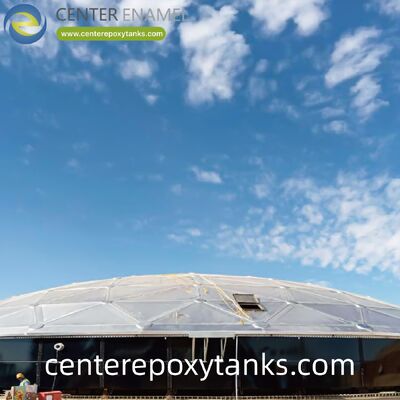
By removing the headspace, the internal floating roof (IFR) ensures there is no volume of air for the fuel to evaporate into. This is the fundamental mechanism that ensures fuel integrity and reduces fire risk. To reach a world-class standard of safety and purity, many modern airport fuel farms now integrate Aluminum Dome Roofs into their tank architecture. While the floating roof manages the surface of the Jet A-1, the Aluminum Dome Roof provides a superior, weather-tight external cover. The geodesic design of the Aluminum Dome Roof is a clear-span structure, meaning it requires no internal support columns. This is a critical advantage for aviation fuel; in traditional tanks, support columns penetrate the floating roof, creating small gaps where vapors can escape and where rain or dust can enter. By utilizing a column-free aluminum dome, the internal floating roof remains entirely continuous, providing a superior hermetic seal that guarantees the fuel remains "clear and bright."
Material Excellence and Thermal Regulation
The choice of welded stainless steel for the tank shell is a non-negotiable requirement for high-purity aviation applications. Stainless steel provides a naturally smooth, non-reactive, and corrosion-resistant surface that does not require internal epoxy coatings. In carbon steel tanks, these coatings can eventually flake or degrade, introducing microscopic debris into the fuel stream that can damage high-pressure fuel pumps. The construction of Floating Roofs for Welded Stainless Steel Jet A-1 Aviation Fuel Storage Tanks utilizes automated precision welding to create a seamless primary container that is immune to the "rust scale" issues common in older fuel terminals.
The external Aluminum Dome Roof further reinforces this defense through advanced thermal regulation. Aluminum is highly reflective and naturally resistant to atmospheric corrosion without the need for periodic painting. The Aluminum Dome Roof acts as a permanent thermal regulator; by reflecting a significant portion of solar radiation, it helps maintain a lower and more stable internal temperature for the Jet A-1. This thermal stability is essential for safety; lower temperatures significantly reduce the internal vapor pressure of the product, which in turn reduces the physical stress on the floating roof's perimeter seals. By keeping the tank cool and dry, the combination of a welded stainless steel shell and a maintenance-free aluminum dome results in a storage system that offers the highest level of fire safety and product stability.
Enhancing Operational Efficiency and Maintenance Safety
The clear-span nature of the Aluminum Dome Roof also facilitates easier and more effective inspection and maintenance, which is critical for meeting strict international aviation fuel standards (such as JIG 1 or EI 1530). Jet A-1 tanks require frequent sampling and seal integrity checks to ensure the fuel remains engine-ready. Without internal columns obstructing the view or the movement of the internal floating roof, technicians can more easily verify the condition of the deck and the effectiveness of the primary and secondary seals. This structural simplicity reduces the time the tank must spend offline during maintenance, maximizing the facility's operational throughput.
Furthermore, the absence of internal columns eliminates the risk of "hang-ups," where a floating roof might become stuck on a pillar during liquid level changes. In an aviation fuel reservoir, a stuck roof can lead to a sudden exposure of the volatile liquid surface or mechanical damage to the tank structure, creating an immediate fire hazard. By providing a clear-span environment, the aluminum dome ensures that the internal floating roof operates smoothly and predictably, maintaining its role to ensure fuel integrity and reduce fire risk without interruption. This synergy between the stainless steel shell and the aluminum dome represents a world-class standard for mission-critical fuel management.
Application Areas
The need for high-integrity purity control and absolute vapor suppression makes these tanks essential for:
Major International Hubs: Managing the high-volume storage of Jet A-1 for global commercial fleets.
Military Aviation Bases: Ensuring the reliability and purity of fuel for high-performance defense aircraft.
Strategic Fuel Reserves: Where long-term stability and fire hazard mitigation are required for national security.
Refinery and Pipeline Terminals: Holding finished jet fuel batches before final testing and regional distribution.
Company Advantage and Comprehensive Service
Center Enamel is recognized globally for its expertise in providing high-performance industrial containment for the aviation sector. Our approach to Floating Roofs for Welded Stainless Steel Jet A-1 Aviation Fuel Storage Tanks is defined by a commitment to technical precision and flight safety:
Safety-Focused Engineering: We design tank systems specifically to maximize vapor suppression and eliminate moisture contact, frequently incorporating Aluminum Dome Roofs to ensure a column-free, high-safety internal environment.
Advanced Manufacturing Standards: Our facility utilizes precision automated welding and high-grade stainless steel to ensure the tank shell is a seamless, non-reactive barrier against environmental stress.
Global Technical Support: We provide expert technical supervision for the assembly of internal floating decks and geodesic domes worldwide, ensuring that the system will ensure fuel integrity and reduce fire risk with absolute reliability.
Conclusion
In the demanding world of aviation fuel logistics, the quality of storage infrastructure is the first line of defense in flight safety. Floating Roofs for Welded Stainless Steel Jet A-1 Aviation Fuel Storage Tanks provide the most effective barrier against the primary causes of fuel contamination and loss. By prioritizing a design that ensures fuel integrity and reduces fire risk, operators protect their expensive inventories and the safety of the flying public. When these tanks are reinforced with the maintenance-free protection of an Aluminum Dome Roof, they represent a world-class solution that balances safety, durability, and operational excellence.