-
Glass Fused To Steel Tanks (596)
-
Stainless Steel Tanks (434)
-
Fusion Bonded Epoxy Tanks (592)
-
Galvanized Steel Tanks (321)
-
Aluminum Dome Roofs (1336)
-
Wastewater Storage Tanks (232)
-
Welded Steel Tanks (457)
-
Pressure Vessels (295)
-
Anaerobic Digester (201)
-
Industrial Water Tanks (349)
-
Glass Lined Steel Tanks (180)
-
Bolted Steel Tanks (389)
-
Sludge Storage Tank (115)
-
Biogas Storage Tank (173)
-
Leachate Storage Tanks (133)
-
Agricultural Water Storage Tanks (179)
-
Fire Water Tank (166)
-
Grain Storage Silos (146)
-
Biogas Projects (425)
-
Wastewater Treatment Projects (1028)
-
Double Membrane Roof (223)

|
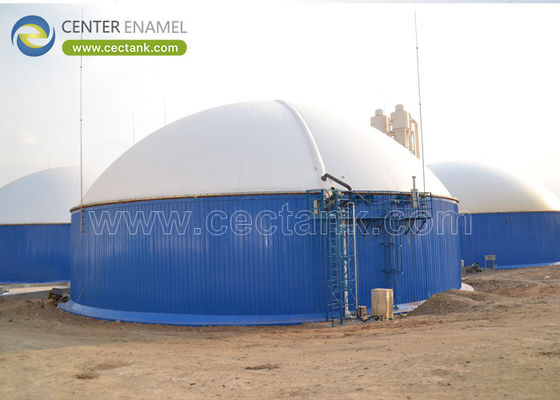
Glass-Lined-to-Steel Tanks as Anaerobic Digesters for Biogas and Wastewater Treatment
| Place of Origin: | China |
| Brand Name: | CEC TANKS |
| Certification: | ISO 9001:2008, AWWA D103 , OSHA , BSCI |
| Model Number: | W20170907002 |
| Minimum Order Quantity: | 1set |
| Price: | $5000~$20000 one set |
| Packaging Details: | PE poly-foam between each two steel plates ; wooden pallet and wooden box |
| Delivery Time: | 10-30 days after deposit received |
| Supply Ability: | 60 sets per month |
|
Detail Information |
|||
Product Description
- The Ideal Digester Vessel: Glass-Lined-to-Steel (GLS)—interchangeably known as Glass-Fused-to-Steel (GFS)—represents the ultimate material choice for anaerobic digesters used in biogas generation and wastewater treatment.
- Impermeable Chemical Barrier: By fusing vitreous glass to structural carbon steel at high temperatures (820C to 930C), the vessel gains a completely inert internal coating that is impervious to highly corrosive acids and aggressive biogases like hydrogen sulfide (H2S).
- Rapid, Modular Construction: The prefabricated, bolted design allows for rapid on-site assembly, eliminating long concrete curing times or high-risk field welding.
- Broad Standard Compliance: Engineered to meet strict international benchmarks including AWWA D103-09, ISO 28765, and NSF/ANSI 61 for chemical, wastewater, and bioenergy storage.
Anaerobic digestion (AD) is a highly efficient biological process that treats municipal wastewater sludge, industrial effluents, and organic waste while simultaneously generating renewable energy. However, the chemical and biological environment inside an anaerobic digester is exceptionally aggressive.
During the acidogenesis and acetogenesis phases, volatile organic acids are produced in high concentrations, driving the local pH down. Subsequently, the methanogenesis phase produces a gas mixture primarily composed of methane (CH4, 50–75%) and carbon dioxide (CO2, 25–50%), along with trace amounts of highly corrosive hydrogen sulfide (H2S) and ammonia (NH3).
These gases condense in the damp headspace of the reactor, forming sulfurous and carbonic acids that rapidly eat away at standard concrete and bare steel. To prevent structural failure, the reactor tank must be built with materials that offer absolute resistance to chemical degradation and physical wear.
Glass-Lined-to-Steel technology bridges the gap between the physical durability of structural steel and the chemical inertness of glass. The physical and chemical advantages make it highly superior to alternative tank materials:
The manufacturing process is not a simple spray-on paint coat or a plastic liner. Instead, a dry or wet enamel slurry is applied to high-tensile carbon steel plates and fired in a high-temperature furnace at temperatures between 820C and 930C. At these temperatures, the glass melts and fuses molecularly with the steel, creating an inseparable, highly durable composite layer.
Because the glass lining is completely inorganic and non-porous, it does not react with acids, bases, or dissolved gases. This makes the tank completely immune to microbial-induced corrosion (MIC) and the acidic condensation in the gas headspace that typically destroys concrete digesters within 10 to 15 years.
GLS coatings are engineered to perform reliably across an ultra-wide pH range of 1 to 14. This means the tank remains completely unaffected during unexpected process upsets—such as "digester souring," where a sudden spike in organic acids drops the internal pH—as well as during aggressive chemical cleaning routines.
| Feature / Metric | Glass-Lined-to-Steel (GLS / GFS) | Cast-In-Place Concrete | Field-Welded Carbon Steel |
|---|---|---|---|
| H₂S Headspace Corrosion | Impervious (Zero degradation) | Susceptible (requires expensive liners) | High corrosion risk (frequent painting) |
| Chemical Resistance | pH 1 to 14 | Narrow (susceptible to acid etching) | Moderate (dependent on epoxy coating) |
| Site Assembly Speed | Extremely Fast (1 to 3 weeks) | Slow (months of curing & formwork) | Moderate (weeks of welding and testing) |
| Thermal Insulation Integration | Easy (modular cladding panels) | Difficult (requires external insulation) | Moderate |
| Risk of Leaking | Zero (high-performance sealants) | Moderate (susceptible to seismic cracks) | Low |
- Integrated Gas Storage Cover: GLS tanks are easily fitted with Double Membrane Roofs, which act as dynamic, variable-volume gas holders directly on top of the digestion column.
- Agitator and Mixer Ports: Pre-engineered, factory-cut openings accommodate side-entry or top-entry mixers, ensuring optimal contact between anaerobic bacteria and feedstocks.
- Thermal Insulation Jackets: To maintain mesophilic (35C to 38C) or thermophilic (50C to 55C) digestion temperatures, GLS tanks are fitted with external insulation panels covered by protective aluminum cladding.
A: There is no practical difference. Both terms describe the exact same manufacturing technology where high-grade vitreous glass enamel is thermally fused to a steel substrate in a high-temperature furnace.
A: Yes. The fused glass layer has a high surface hardness rating of 6.0 on the Mohs scale (similar to steel or quartz). This provides outstanding resistance to physical abrasion from high-solids slurry, sand, grit, and intensive mechanical mixing inside the reactor.
A: Yes. Because GLS tanks are composed of modular panels bolted together, they can be disassembled, transported, and reassembled in a new location if facility logistics change. Additionally, the vertical modularity allows for tank height expansion by adding extra rings to the bottom of the structure.
A: Premium GLS tanks are designed and fabricated in strict accordance with the internationally recognized AWWA D103-09 standard for bolted steel tanks, ISO 28765 for vitreous and porcelain enamels, and NSF/ANSI 61 when the tank is also utilized for drinking water storage.