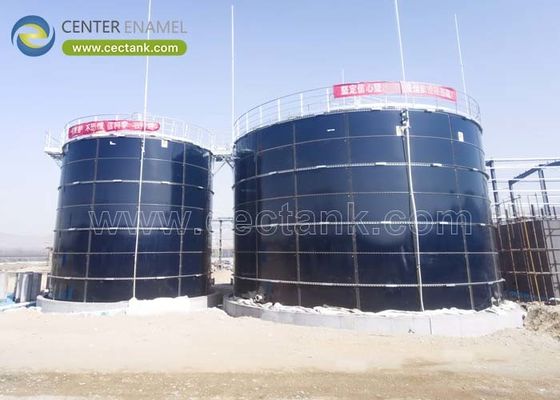
FBE Diesel Tank: The Engineering Standard for Bulk Fuel Storage
2026-04-23

FBE Diesel Tank: The Engineering Standard for Bulk Fuel Storage
In the energy sector, the secure containment of hydrocarbons like diesel requires more than a simple vessel; it demands a chemically inert, structurally sound system that prevents fuel degradation and environmental contamination. Shijiazhuang Zhengzhong Technology Co., Ltd (Center Enamel), a globally recognized China Epoxy Coated Tank manufacturer, delivers the Fusion Bonded Epoxy (FBE) Diesel Tank—the premier modular solution for refinery terminals, backup power sites, and industrial fuel farms.
1. Technical Excellence: The FBE Hydrocarbon Barrier
Fusion Bonded Epoxy (FBE) is a high-performance thermoset polymer. In our factory-controlled process, the epoxy powder is electrostatically applied and thermally fused to the steel substrate at 180°C to 250°C. This creates a monolithic, high-density bond that is non-reactive to the chemical additives and surfactants found in modern diesel fuel.
Core Performance Matrix
| Technical Parameter | Standard Reference | Performance Result |
| Coating Type | Thermoset Epoxy | Molecularly cross-linked fusion |
| Holiday Test | ≥1100V (All Panels) | Zero-discontinuity |
| Fuel Compatibility | ASTM D471 | Resistant to Diesel, Jet A1, & UCO |
| Adhesion Strength | ASTM D4541 | >12 MPa (Superior substrate bond) |
| Operational pH Range | Chemical Stability | pH 3 – pH 12 |
| Hardness | ASTM D3363 | 2H – 4H (Pencil Hardness) |
2. Why FBE Bolted Steel Over Traditional Welded Tanks?
Modern procurement for diesel storage favors Modular Assembly due to significant reductions in on-site labor and environmental risk.
- Zero-Discontinuity Integrity: Unlike field-painted welded tanks, Center Enamel’s FBE panels are 100% factory-tested using a high-voltage holiday detector. This ensures an impenetrable barrier, eliminating the risk of sub-film corrosion.
- Rapid Installation: Modular panels are assembled using high-grade bolts and hydrocarbon-resistant sealants. A typical bulk storage facility can be completed in weeks, whereas traditional welded tanks require months of on-site welding and climate-sensitive coating.
- Fuel Purity: The smooth, non-porous FBE surface prevents the buildup of "fuel sludge" and microbial growth, ensuring that the stored diesel remains within specification for precision engines.
- Scalability: As site demands grow, our bolted tanks can be expanded by adding additional rings, providing a flexibility that fixed welded structures cannot match.
3. Critical Safety & Environmental Features
Diesel storage is heavily regulated due to the risk of soil and groundwater contamination. Center Enamel integrates essential safety features into every Welded Steel Tank alternative:
- Internal Floating Roofs (IFR): For light refined products, we provide the precision fabrication necessary to accommodate IFR systems, which minimize vapor loss and VOC emissions.
- Secondary Containment Compatibility: Designed to integrate seamlessly with bunding systems and leak detection technology.
- Thermal Management: Our tanks structurally support heating coils and insulation jacketing, essential for maintaining diesel viscosity in extreme cold climates.
4. Engineering Standards & Compliance
For project bankability and insurance compliance, our tanks are designed to the most rigorous international codes:
- AWWA D103-19: The gold standard for factory-coated bolted steel tanks.
- API 650: Adherence to structural calculations for large-scale liquid containment.
- NFPA 30 / 31: Compliance with flammable and combustible liquid codes.
- ASCE 7-22: Structural engineering for high seismic and wind load resilience (up to 250 km/h).
5. Frequently Asked Questions (FAQ)
Q: Can FBE tanks handle biodiesel blends?
A: Yes. The FBE coating is chemically resistant to the increased acidity found in biodiesel (FAME) and renewable diesel blends, which can often degrade standard tank linings.
Q: What is the design life of an FBE diesel tank?
A: With professional factory application and standard maintenance, these tanks have a design life of 25–30 years.
Q: How do you handle corrosion at the bolted joints?
A: We use specialized, high-elasticity sealants specifically tested for hydrocarbon resistance and utilize bolt covers to ensure the structural integrity of every connection.
-
2026-08-31
-
2026-08-19
-
2026-07-10
-
2026-07-10